Dismissal and redundancy: the person or the job
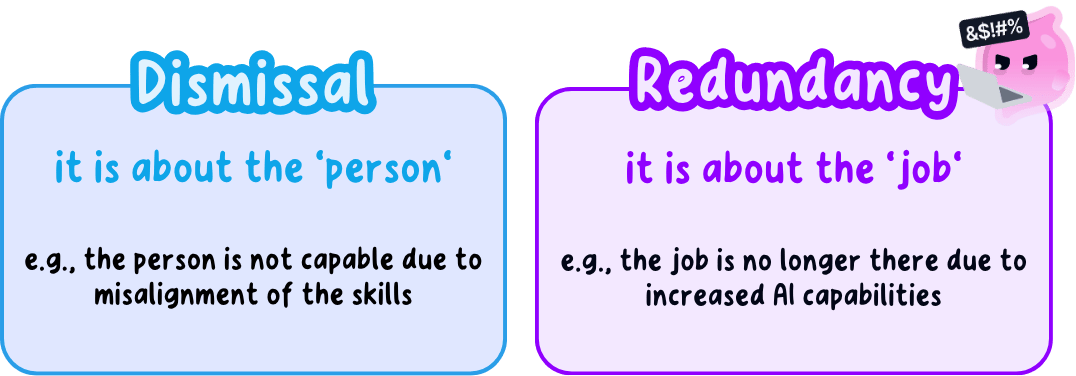
- Dismissal is about the person, because something the worker has done, or failed to do, has made the employer end their employment.
- Redundancy is about the job, because the work has disappeared and the employer no longer needs anyone to do it.
- The consequences differ, since a redundant employee is normally entitled to redundancy pay while a worker dismissed for gross misconduct is not.
- The procedure differs too, as dismissal follows a disciplinary process with warnings, while redundancy follows consultation and a selection process.
Common Mistake
- If the business advertises the same job again afterwards, it was a dismissal and not a redundancy, because a genuine redundancy means the post has gone.
- A redundant worker has done nothing wrong and did not choose to leave, so never write that they were sacked or that they resigned.
Dismissal: when the worker's conduct or capability ends the job
Definition
Dismissal: When an employer ends a worker's employment because of that worker's own conduct or inability to do the job to the required standard.
- Misconduct covers behaviour such as persistent lateness, refusing reasonable instructions, bullying colleagues or falsifying records.
- Gross misconduct is serious enough to end employment immediately without notice, for example theft, violence, or operating a forklift after drinking.
- Capability means the employee cannot reach the required standard even after training, support and a genuine chance to improve, which is different from misbehaving.
- A fair procedure runs from an investigation to a verbal warning, a written warning, a final written warning and then dismissal, with the employee allowed to state their case and to appeal.
- Skipping those steps is what turns a justified decision into an unfair dismissal, even where the employer had a genuine reason to act.
- Dismissal removes someone whose behaviour was slowing output or damaging colleagues' morale, but the vacancy then has to be advertised, filled and inducted all over again.
Redundancy: when the job itself disappears
Definition
Redundancy: When an employee loses their job because the job itself is no longer needed, not because of anything the worker has done wrong.
- The trigger is a fall in the amount of work of a particular kind, not a fall in the quality of a particular worker.
- Voluntary redundancy invites employees to put themselves forward in return for a larger payment, but the most employable staff volunteer first, so the firm can lose exactly the skills it needs to recover.
- Compulsory redundancy means the business chooses who goes, which keeps the skills it wants but causes resentment and can bring claims of unfair selection.
- Employees must normally be consulted before decisions are final, and those with enough service receive redundancy pay based on their age, length of service and weekly wage.
Example
Redundancy payments are a large one-off cost, so a firm cutting 20 jobs and saving £440,000 a year in wages may see very little of that saving until the second year.
Downsizing: when cutting the workforce becomes necessary
Definition
Downsizing: A planned reduction in the total size of a business's workforce, usually carried out through redundancies.
- Automation removes jobs when machines do the work more cheaply, and supermarkets such as Tesco have installed self-service checkouts that cut the number of staffed tills each store needs.
- Reduced demand removes jobs when customers stop buying, whether because of a recession, a change in taste or a competitor taking market share.
- Losing a major contract, a merger that leaves two finance teams doing one job, or moving production to a cheaper site can each remove whole departments at once.
- A loss-making business may have no choice, because wages are usually its largest single cost.
- Before making redundancies a firm can use natural wastage, which means not replacing people who leave, and it can also cut overtime, freeze recruitment or redeploy staff into departments that are still busy.
- The wage bill falls, but skills leave with the people, so a firm that cuts too deeply cannot take a large order when demand recovers and must recruit and train from scratch.
- The staff who remain feel insecure and carry heavier workloads, so motivation falls, absence rises and quality can slip just when the business needs it most.
Choosing who to make redundant
- The skills the business will need next come first, so a factory installing automated machines keeps the operators who can run and maintain them and releases those trained only on the closed line.
- Recorded performance and attendance can be used, provided the records are written and applied consistently rather than being a manager's opinion.
- Length of service, applied as last in first out, is easy to explain and often accepted by trade unions, but it removes the newest employees, who may hold the most recent training.
- Selecting someone because of pregnancy, trade union membership, race, sex, religion, disability, age or part-time status is unlawful whatever the state of the business.
Exam technique
- When a case describes automation or falling demand, the correct word is redundancy, however tempting the word sacked feels.
- If asked to choose who to make redundant, name the criterion you used and say what the business loses by releasing that person, rather than just listing names.
Self review
- Give the difference between dismissal and redundancy in one sentence.
- Give two reasons a business might dismiss an employee.
- Name three situations that could make downsizing necessary.
- What is natural wastage and why might a business prefer it to redundancy?
- Give two fair criteria and one unlawful criterion for selecting employees for redundancy.