A student investigated the effect of cell size on the rate of diffusion.
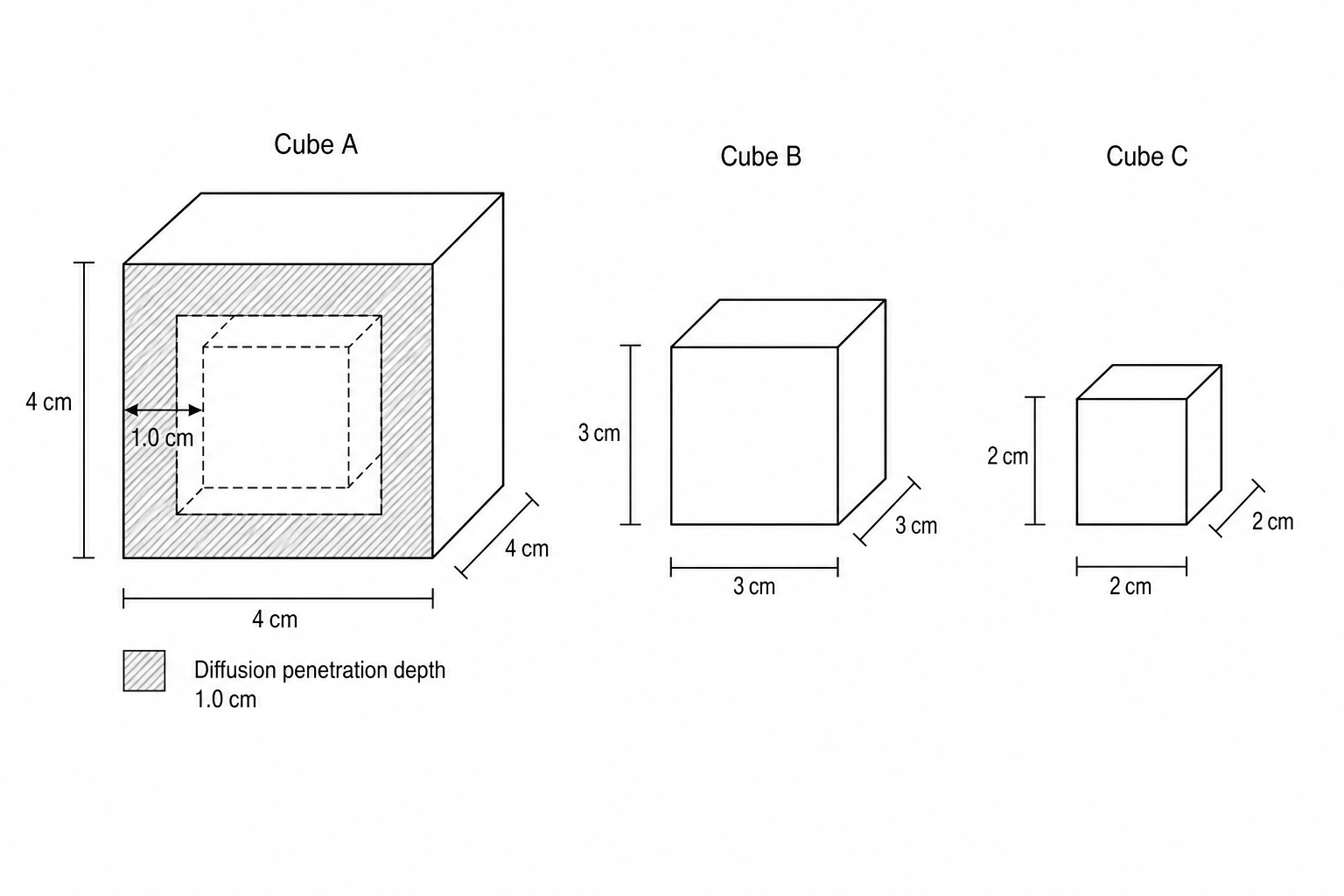
They cut three different-sized cubes from a block of dark blue starch-iodine agar jelly:
- Cube A was 4 cm×4 cm×4 cm4\text{ cm} \times 4\text{ cm} \times 4\text{ cm}4 cm×4 cm×4 cm
- Cube B was 3 cm×3 cm×3 cm3\text{ cm} \times 3\text{ cm} \times 3\text{ cm}3 cm×3 cm×3 cm
- Cube C was 2 cm×2 cm×2 cm2\text{ cm} \times 2\text{ cm} \times 2\text{ cm}2 cm×2 cm×2 cm
The student wore safety goggles and placed the cubes into a beaker containing a dilute solution of sodium thiosulfate for 15 minutes. The sodium thiosulfate diffuses into the cubes, reducing the iodine and turning the agar from dark blue to colorless.
Why did the student wear safety goggles?
Explain how the sodium thiosulfate particles entered the agar jelly.
Calculate the surface area of Cube A. State the unit.
Calculate the volume of Cube A. State the unit.
Calculate the surface area to volume (SA:V\text{SA}:\text{V}SA:V) ratio for both Cube A and Cube C. State which cube has the larger ratio.
After 15 minutes, the sodium thiosulfate has diffused a distance of 1.0 cm into each cube from all sides. Explain which cube has the greatest proportion of its volume turned colorless. Use this to explain why large multicellular organisms require specialized transport systems.