Movement of substances into and out of cells

EasyMediumHard
123456789101112131415161718192021222324252627282930313233343536373839
Question 31
Medium

A student prepared some plant cells from an Elodea leaf. She placed one group of cells in distilled water and another group in a concentrated sucrose solution. She then used a microscope to observe the cells.
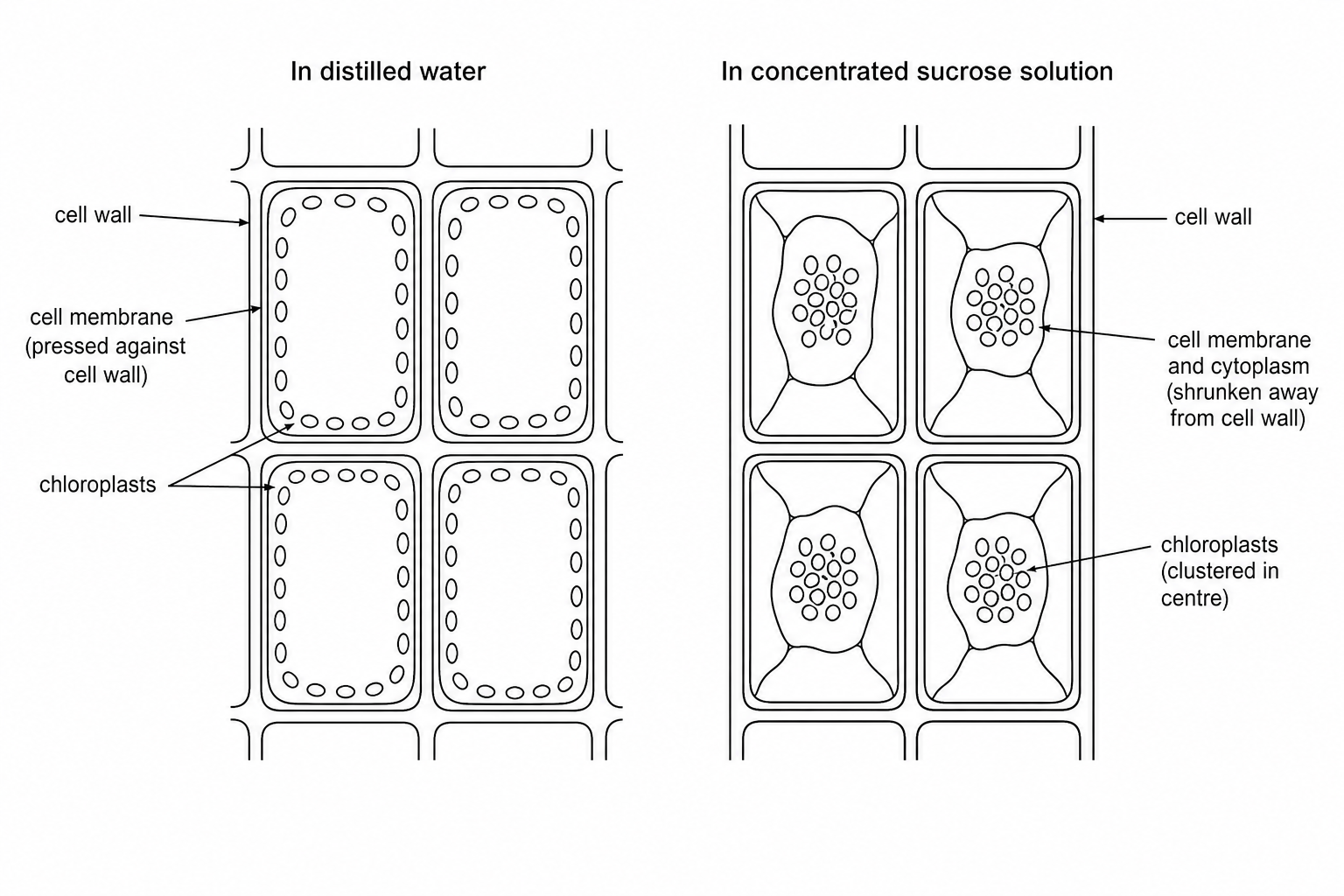
Two panels showing plant cells under a microscope. Panel 1: Cells in distilled water. The cells are rectangular and fully filled; the cell membrane is pressed firmly against the cell wall, and chloroplasts are distributed evenly around the cell periphery. Panel 2: Cells in a concentrated sucrose solution. The cell walls retain their rectangular shape, but the cell membrane and cytoplasm have shrunk away from the walls, clumping in the center of each cell with the chloroplasts clustered densely together.

a.

Describe the differences in the appearance of the cells in the concentrated sucrose solution compared with the cells in distilled water.

[2]
b.

State what is meant by the term osmosis.

[2]
c.

Explain what happens to the cells in the concentrated sucrose solution to change their appearance.

[3]
d.

Another student investigated the appearance of red blood cells in distilled water and in concentrated salt solution.

Use your knowledge of osmosis and the structure of red blood cells to describe and explain what the red blood cells would look like:

in distilled water

[2]
e.

in concentrated salt solution.

[2]

Movement of substances into and out of cells Questions

  1. IGCSE
  2. /Biology
  3. /Movement of substances into and out of cells