The Balanced Symbol Equation
Photosynthesis
The process by which plants make carbohydrates from carbon dioxide and water, using energy from light that is absorbed by chlorophyll.
- The reaction can be written as a balanced symbol equation using chemical formulae: 6CO2+6H2O→C6H12O6+6O26CO_2 + 6H_2O \rightarrow C_6H_{12}O_6 + 6O_26CO2+6H2O→C6H12O6+6O2.
- The reactants are carbon dioxide and water, and the products are glucose, C6H12O6C_6H_{12}O_6C6H12O6, and oxygen.
- The large numbers, the sixes, balance the equation, so there are equal numbers of each type of atom on both sides.
- Counting the atoms, there are 6 carbon, 12 hydrogen and 18 oxygen on each side.
The balanced symbol equation and limiting factors covered here are Extended-only (Supplement); Core students use the word equation instead.
Limiting Factors in Different Conditions
Limiting factor
The factor in shortest supply that holds back the rate of a process such as photosynthesis.
- At any moment the rate of photosynthesis is set by the one factor that is in shortest supply, the limiting factor.
- Increasing the limiting factor raises the rate, while increasing any other factor has no effect until it too runs short.
- On a bright but cold day, light is plentiful, so temperature is usually the limiting factor.
- In a dim room on a warm day, light intensity is usually the limiting factor.
- In a sealed greenhouse in bright sunshine, the plants use up the air's carbon dioxide, so carbon dioxide concentration becomes limiting.
A grower who adds more light to a warm greenhouse sees the rate rise, but once carbon dioxide runs short, adding still more light does nothing until the carbon dioxide is topped up.
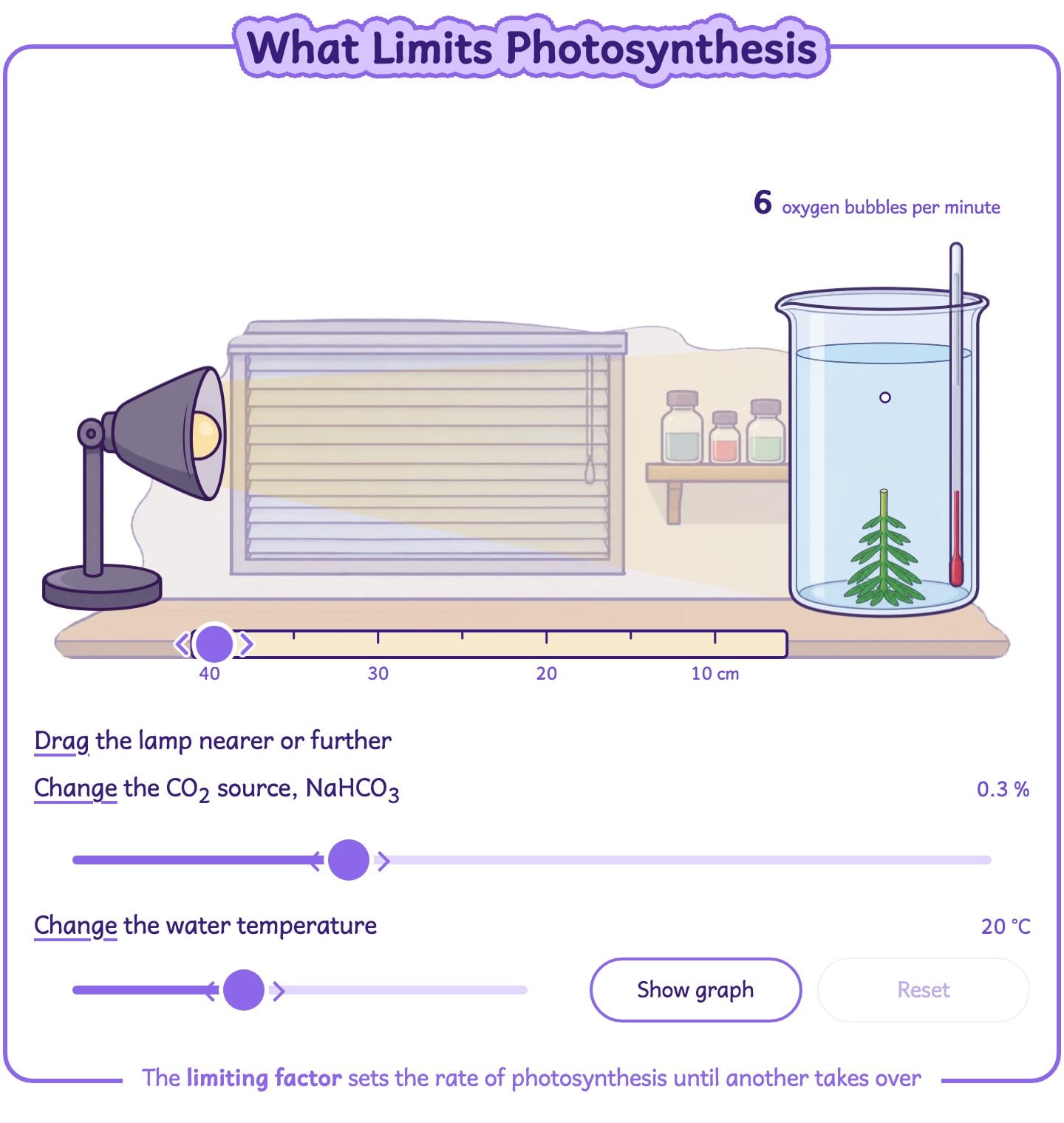
Change light, carbon dioxide and temperature and notice which one limits the rate of photosynthesis.
Explaining the Graphs
Denaturation
The permanent change in shape of an enzyme's active site, caused by high temperature or extreme pH, so that its substrate no longer fits.
- On a graph of rate against light intensity or carbon dioxide, the line rises steeply and then levels off into a plateau.
- At the plateau that factor is no longer limiting, so a different factor now holds the rate back.
- On a graph of rate against temperature, the rate rises to an optimum and then falls.
- The fall happens because the enzymes controlling photosynthesis are denatured, so their active sites change shape and the substrate no longer fits.
- To gain the mark when explaining a plateau, name the factor that has become limiting rather than only saying the rate stays the same.
- Write the balanced symbol equation for photosynthesis.
- How many oxygen atoms are there on each side of the equation?
- What is a limiting factor?
- Inside a sealed greenhouse in bright sunshine, which factor is most likely limiting, and why?
- Explain why the rate of photosynthesis falls at temperatures above the optimum.