How These Investigations Work
Definition
Starch
An insoluble carbohydrate made from many glucose molecules that plants use as an energy store.
- Each investigation uses the same test: a leaf is checked for starch, because a leaf that has photosynthesised stores its glucose as starch.
- Iodine solution is the test for starch, turning from orange-brown to blue-black where starch is present.
- Before an investigation the plant is destarched by leaving it in the dark for 24 to 48 hours, so any starch already in the leaves is used up and only new starch will show.
- A control is set up so that only the factor being tested is different, which lets you link the result to that one factor.
Practical
Testing a Leaf for Starch
- Dip the leaf in boiling water for about 30 seconds to kill the cells, stop any reactions and break down the cell membranes.
- Turn off the flame, then heat the leaf in a tube of ethanol standing in the hot water, so the ethanol boils and removes the green chlorophyll.
- Ethanol is highly flammable, so it is heated in a water bath with no naked flame nearby.
- Dip the pale, brittle leaf in hot water for a moment to soften it.
- Spread the leaf flat on a white tile and cover it with iodine solution.
- A blue-black colour shows starch is present; an orange-brown colour shows there is none.
Practical
Testing Whether Light Is Needed
- Destarch a potted plant by keeping it in the dark for 24 to 48 hours.
- Cover part of one leaf on both surfaces with aluminium foil or black card, so no light can reach that strip.
- Stand the plant in bright light for several hours.
- Remove the foil and test the whole leaf for starch.
- The exposed part turns blue-black while the covered part stays orange-brown, showing light is needed for photosynthesis.
Practical
Testing Whether Chlorophyll Is Needed
- Use a destarched plant with variegated leaves, which have green parts and white parts.
- Draw the leaf first, recording which parts are green (containing chlorophyll) and which are white (none).
- Leave the plant in bright light for several hours, then test the leaf for starch.
- Only the parts that were green turn blue-black, showing chlorophyll is needed for photosynthesis.
Practical
Testing Whether Carbon Dioxide Is Needed
- Destarch two potted plants.
- Enclose a leaf of each plant in a clear, sealed plastic bag.
- In one bag place soda lime, which absorbs carbon dioxide; in the other place sodium hydrogencarbonate, which keeps carbon dioxide present as the control.
- Leave both plants in bright light, then test the enclosed leaves for starch.
- The leaf without carbon dioxide stays orange-brown, while the control turns blue-black, showing carbon dioxide is needed.
Practical
Measuring the Rate with Pondweed
- Place a piece of pondweed such as Elodea, cut-end upwards, in water containing sodium hydrogencarbonate to supply carbon dioxide.
- Stand the tube in a large beaker of water, which acts as a water bath and absorbs the lamp's heat so temperature stays steady.
- Count the oxygen bubbles released per minute, or collect the gas in a capillary tube and gas syringe and measure its volume, to find the rate.
- To vary light intensity, move a lamp to measured distances with a ruler; to vary carbon dioxide, change the hydrogencarbonate concentration; to vary temperature, use water baths set to different temperatures.
- Change only one factor at a time, keep the others constant, and take repeat readings to calculate a mean.
Practical
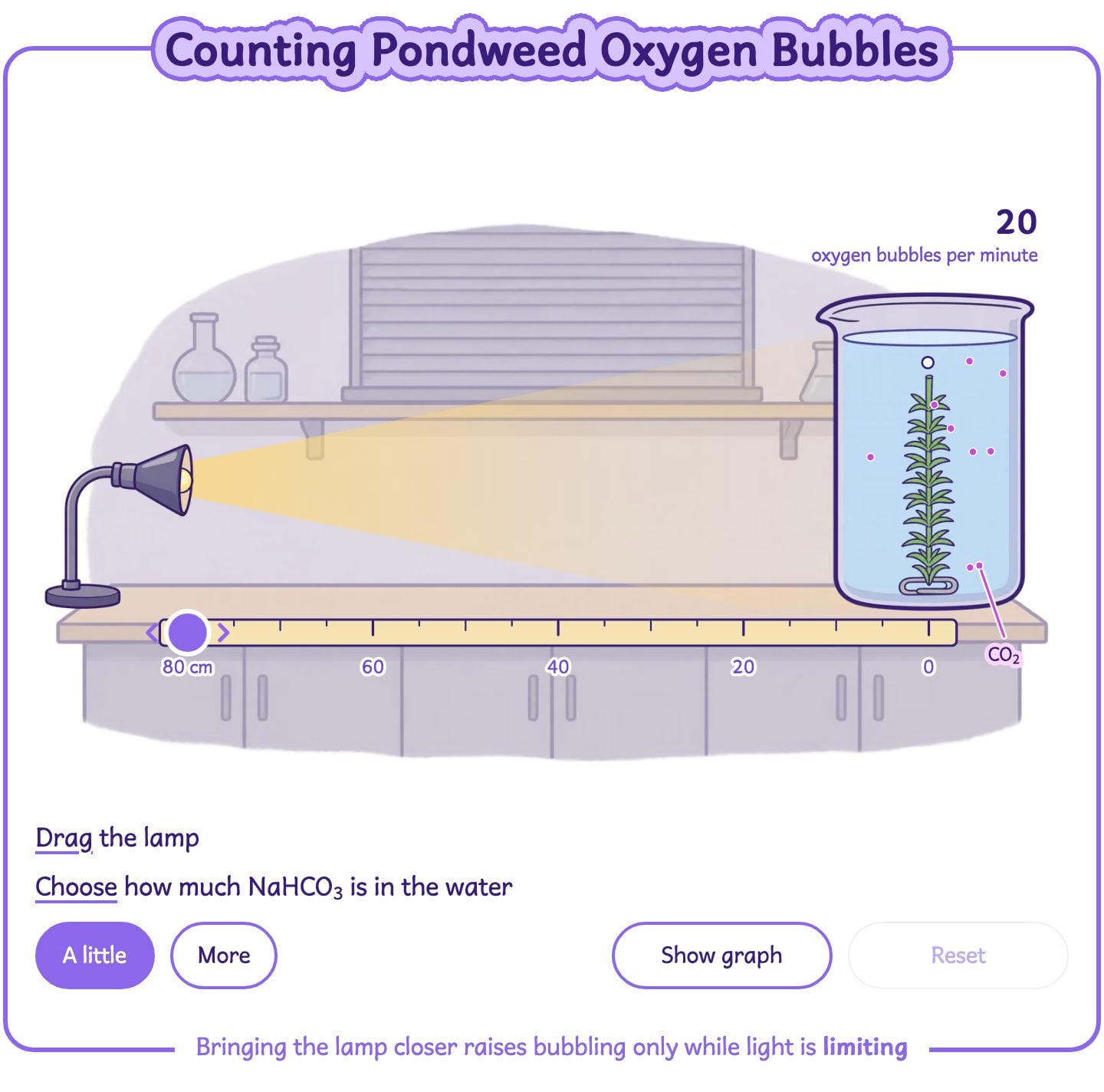
Move the lamp closer and watch the bubble count rise while light is limiting the rate.
Gas Exchange with Hydrogencarbonate Indicator
- Hydrogencarbonate indicator solution is orange-red at normal carbon dioxide levels, turns purple when carbon dioxide falls, and yellow when carbon dioxide rises.
- Put equal volumes of indicator into sealed tubes, each holding a piece of aquatic plant, and set them in the light, in the dark, and one wrapped in foil, with a plant-free tube as a control.
- Leave the tubes for a few hours, keeping the temperature constant.
- In the light, the plant photosynthesises faster than it respires, so it removes carbon dioxide and the indicator turns purple.
- In the dark, the plant only respires, so it adds carbon dioxide and the indicator turns yellow.
What the Rate Results Show
Definition
Limiting factor
The factor in shortest supply that holds back the rate of a process such as photosynthesis.
- As light intensity increases, the rate of photosynthesis rises, because more energy is available for the reaction.
- The rate then levels off at a plateau, where light is no longer limiting and another factor, such as carbon dioxide, holds the rate back.
- As carbon dioxide concentration increases, the rate rises in the same way and then plateaus.
- As temperature rises, the rate increases at first because the molecules and enzymes have more energy.
- Above the optimum, around 40 to 45 °C, the rate falls sharply because the enzymes controlling photosynthesis are denatured and their active sites change shape.
Self review
- What colour change with iodine solution shows that starch is present in a leaf?
- Why is a plant destarched before an investigation?
- How would you show that carbon dioxide is needed for photosynthesis?
- What does hydrogencarbonate indicator show about an aquatic plant kept in the dark?
- Why does the rate of photosynthesis fall at very high temperatures?