Conserving forests
Sustainability
Meeting the needs of people today without damaging the ability of future generations to meet their own needs, for example by not using up resources faster than they can be replaced.
- Forests can be conserved and used sustainably using several methods.
- Education teaches local people and industry why forests matter and how to use them without destroying them.
- Protected areas, such as national parks, set aside forest where felling is banned or strictly limited.
- Quotas limit how many trees may be cut down in a given time, so removal does not outpace regrowth.
- Replanting means planting new trees to replace those felled, keeping the forest going for the future.
This is Supplement (Extended) content for Papers 2 and 4; Core students only need that forests and fish stocks can be managed sustainably, from article 20.4.1.
Conserving fish stocks
Fishing quota
A limit on the mass of a particular type of fish that boats are allowed to catch in a given period, used to protect fish stocks.
- Fish stocks are conserved so that fish are not caught faster than they can reproduce.
- Education encourages fishers and consumers to support sustainable fishing.
- Closed seasons ban fishing while fish are breeding, so they can reproduce undisturbed.
- Protected areas ban fishing altogether in some places, giving stocks a refuge in which to recover.
- Controlled net types and mesh size use nets with larger holes, so young fish escape and grow to breeding age.
- Quotas limit the mass of each type of fish that boats may land, and monitoring checks stock sizes so the limits can be adjusted.
A larger mesh lets small, young fish slip through the net and survive to reproduce, replacing the fish that are caught.
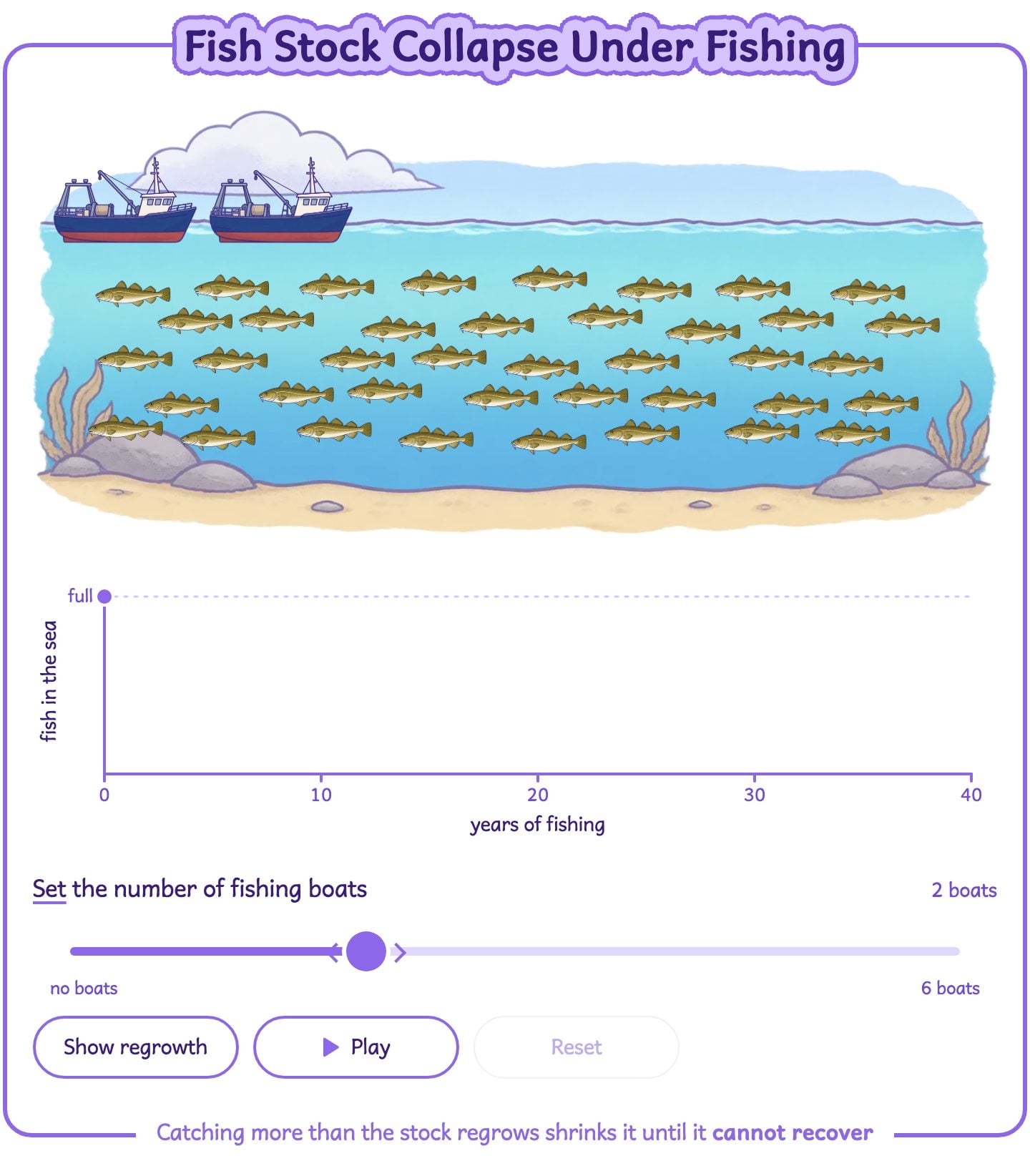
Raise the catch and watch the fish stock shrink once more is caught than regrows.
Why we run conservation programmes
Biodiversity
The number of different species that live in an area.
- Maintaining or increasing biodiversity keeps a wide range of species, which makes ecosystems more stable.
- Reducing extinction protects species that would otherwise be lost for ever.
- Protecting vulnerable ecosystems safeguards habitats that are easily damaged, such as coral reefs and rainforests.
- Maintaining ecosystem functions keeps natural processes working, including nutrient cycling.
- It also protects the resources that ecosystems provide, including food, drugs, fuel and useful genes.
Wild species are a store of useful genes and of chemicals used to make medicines, so losing them removes resources we may need in the future.
Evaluating conservation decisions
- Conservation methods can be costly or unpopular, for example when quotas reduce a fishing community's income.
- A good evaluation weighs the benefits for biodiversity against the economic and social costs before reaching a supported conclusion.
- Describe two methods used to conserve forests.
- Explain how a larger net mesh size helps conserve a fish stock.
- Give two reasons why fishing quotas and closed seasons protect fish stocks.
- State four reasons for running conservation programmes.