Energy loss along a food chain
Definition
Energy transfer efficiency
The percentage of energy or biomass at one trophic level that is passed on to the next, found by dividing the amount transferred by the amount available and multiplying by 100.
- Only about 10% of the energy is passed on at each step, so the energy available falls sharply at each higher trophic level.
- After only a few steps, very little of the original energy is left.
- Starting from 100 000 kJ100\,000\ \text{kJ}100000 kJ in the producers, roughly 10 000 kJ10\,000\ \text{kJ}10000 kJ reaches level 2, 1 000 kJ1\,000\ \text{kJ}1000 kJ level 3 and only 100 kJ100\ \text{kJ}100 kJ level 4.
Note
This is Supplement content, studied by Extended candidates for Papers 2 and 4.
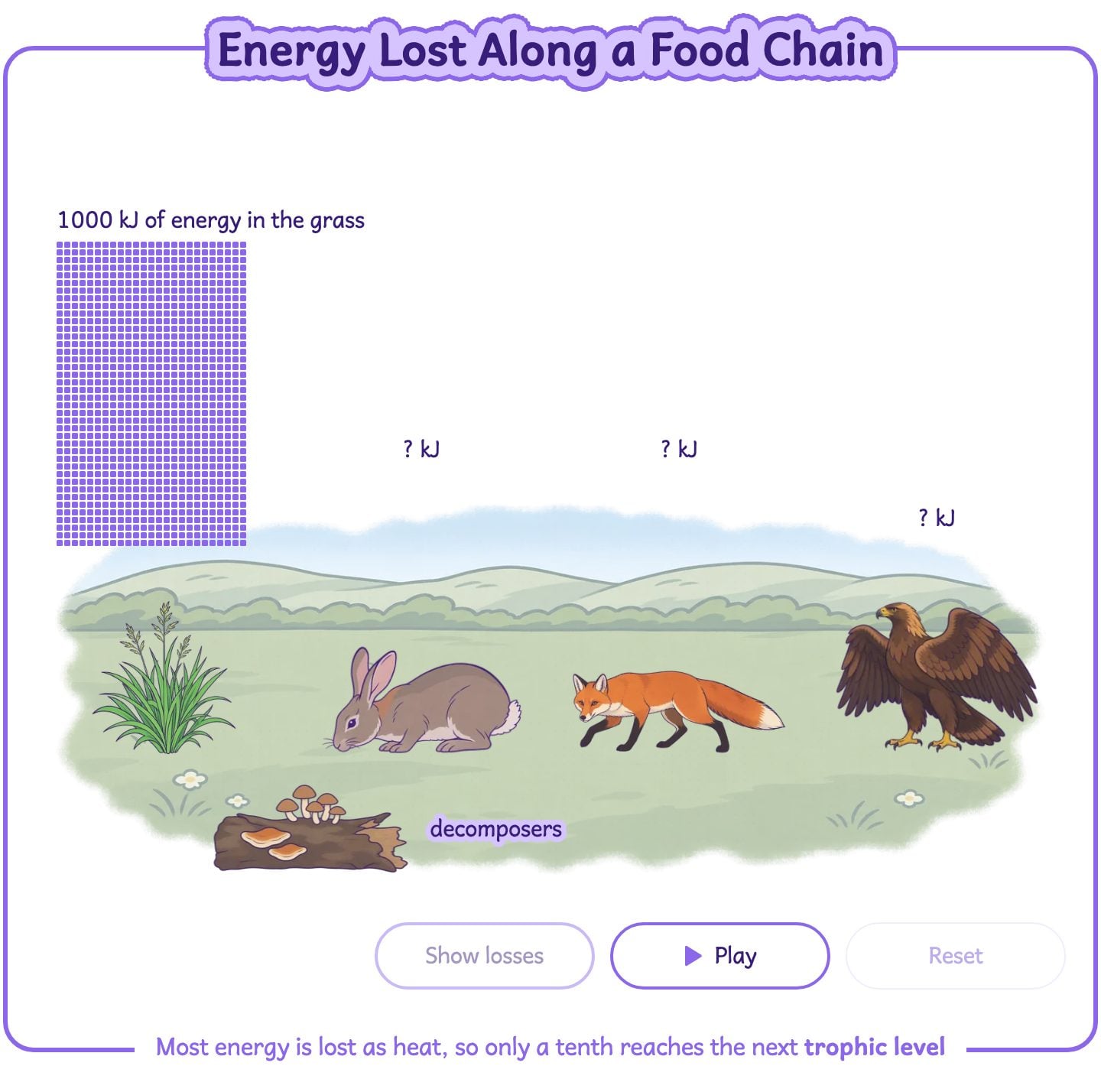
Add trophic levels and watch how much energy is lost, leaving little for the next level.
Why food chains are short
- A trophic level can only support organisms if enough energy reaches it.
- By about the fifth level, so much energy has been lost that there is too little left to support a further population.
- This is why most food chains have fewer than five trophic levels, and why top predators are usually few in number.
Example
In grass to zebra to lion, the lion is only the third level, because most of the grass's energy is lost before it reaches the top.
Eating crops rather than livestock
- Energy is lost at every transfer, so a shorter food chain wastes less energy.
- When people eat crop plants directly, they are primary consumers, only one step from the producer.
- When people eat livestock fed on crops, they are secondary consumers, one step further along, so more energy has been lost on the way.
Example
The chain wheat to human keeps far more energy than the chain wheat to cattle to human.
Feeding more people from the same land
- Because less energy is wasted, a given area of land can feed more people on crops than on meat.
- Growing crops for people to eat can improve food supply where land, water or other resources are limited.
- There can still be good reasons to keep livestock, such as using land that is unsuitable for growing crops.
Self review
- About what percentage of the energy passes on to the next trophic level?
- Explain, in terms of energy loss, why food chains rarely have more than five trophic levels.
- What trophic level is a person at when they eat crops directly?
- Why can a field feed more people by growing crops than by raising cattle?