Pyramids of energy
Definition
Pyramid of energy
A diagram in which the width of each bar shows the amount of energy available at each trophic level over a period of time, usually in kilojoules per square metre per year.
- A pyramid of energy shows the amount of energy available at each trophic level.
- The energy is measured over a period of time, usually in kilojoules per square metre per year (kJ m−2 yr−1\text{kJ}\,\text{m}^{-2}\,\text{yr}^{-1}kJm−2yr−1).
- The producer forms the base, and each level above it holds less energy than the one below.
Note
This is Supplement content, studied by Extended candidates for Papers 2 and 4.
Why an energy pyramid is always upright
- Because energy is lost at every transfer, each level always has less energy than the level below it.
- So a pyramid of energy is always a true pyramid and can never be inverted.
- A pyramid might show 80 000 kJ m−2 yr−180\,000\ \text{kJ}\,\text{m}^{-2}\,\text{yr}^{-1}80000 kJm−2yr−1 at the producers but only about 8 0008\,0008000 at the primary consumers.
Advantages of a pyramid of energy
- A pyramid of numbers can be distorted by a single large producer or by many small parasites.
- A pyramid of biomass is only a snapshot and can be affected by the water content of organisms when they are sampled.
- A pyramid of energy accounts for the rate of energy flow over time, so it gives the most accurate and reliable picture.
Why energy transfer is inefficient
Definition
Energy transfer efficiency
The percentage of energy or biomass at one trophic level that is passed on to the next, found by dividing the amount transferred by the amount available and multiplying by 100.
- Only about 10% of the energy at one trophic level is passed on to the next, so about 90% is lost.
- Much energy is transferred to the surroundings as heat from respiration, and is used for movement and other life processes.
- Not all of an organism is eaten, and energy is also lost in waste, as undigested food in faeces (egestion) and urea in urine (excretion).
- The efficiency of a transfer is efficiency=energy transferred to next levelenergy available at this level×100\text{efficiency} = \dfrac{\text{energy transferred to next level}}{\text{energy available at this level}} \times 100efficiency=energy available at this levelenergy transferred to next level×100.
- For example, if 10 000 kJ10\,000\ \text{kJ}10000 kJ is available and 1 000 kJ1\,000\ \text{kJ}1000 kJ passes on, the efficiency is 1 00010 000×100=10%\dfrac{1\,000}{10\,000} \times 100 = 10\%100001000×100=10%.
- The lost energy is not destroyed; it is transferred to the surroundings, mostly as heat, and can no longer reach the next level.
Self review
- What does a pyramid of energy show, and in what units?
- Why is a pyramid of energy always a true pyramid?
- Give two reasons why energy transfer between trophic levels is inefficient.
- Calculate the efficiency if 2 000 kJ2\,000\ \text{kJ}2000 kJ is passed on from 20 000 kJ20\,000\ \text{kJ}20000 kJ.
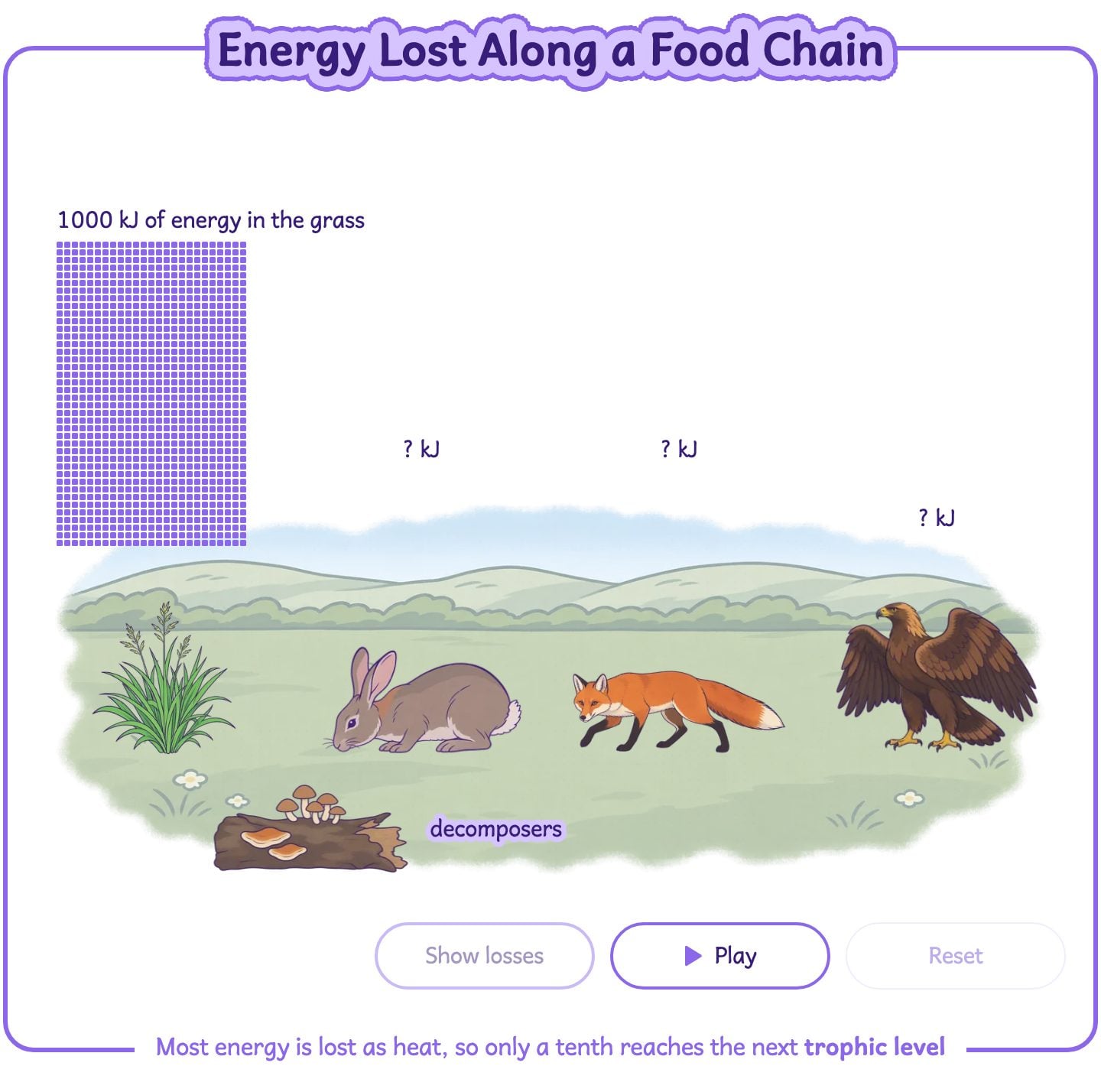
Add trophic levels and watch most energy lost as heat, leaving little for the next level.