Sex hormones at puberty
Definition
Secondary sexual characteristics
Secondary sexual characteristics are the features that develop at puberty which distinguish adult males and females but are not the reproductive organs themselves.
- At puberty, sex hormones cause secondary sexual characteristics to develop.
- Testosterone, made in the testes, controls male features such as a deeper voice, facial and body hair and more muscle.
- Oestrogen, made in the ovaries, controls female features such as breast development, wider hips and body hair.
- These features are not the reproductive organs themselves.
Note
Testosterone and oestrogen also make the reproductive systems active, so that gametes are produced.
The menstrual cycle
Definition
Menstrual cycle
The menstrual cycle is the monthly sequence of changes in the ovaries and the lining of the uterus that prepares the body for a possible pregnancy.
- The menstrual cycle takes about 28 days.
- On about days 1 to 5 the uterus lining breaks down and is lost through the vagina, which is menstruation.
- The lining then thickens again, building a good blood supply ready for a possible pregnancy.
- If no fertilised egg implants, the lining breaks down again and the cycle repeats.
Note
Day 1 of the cycle is counted from the first day of menstruation.
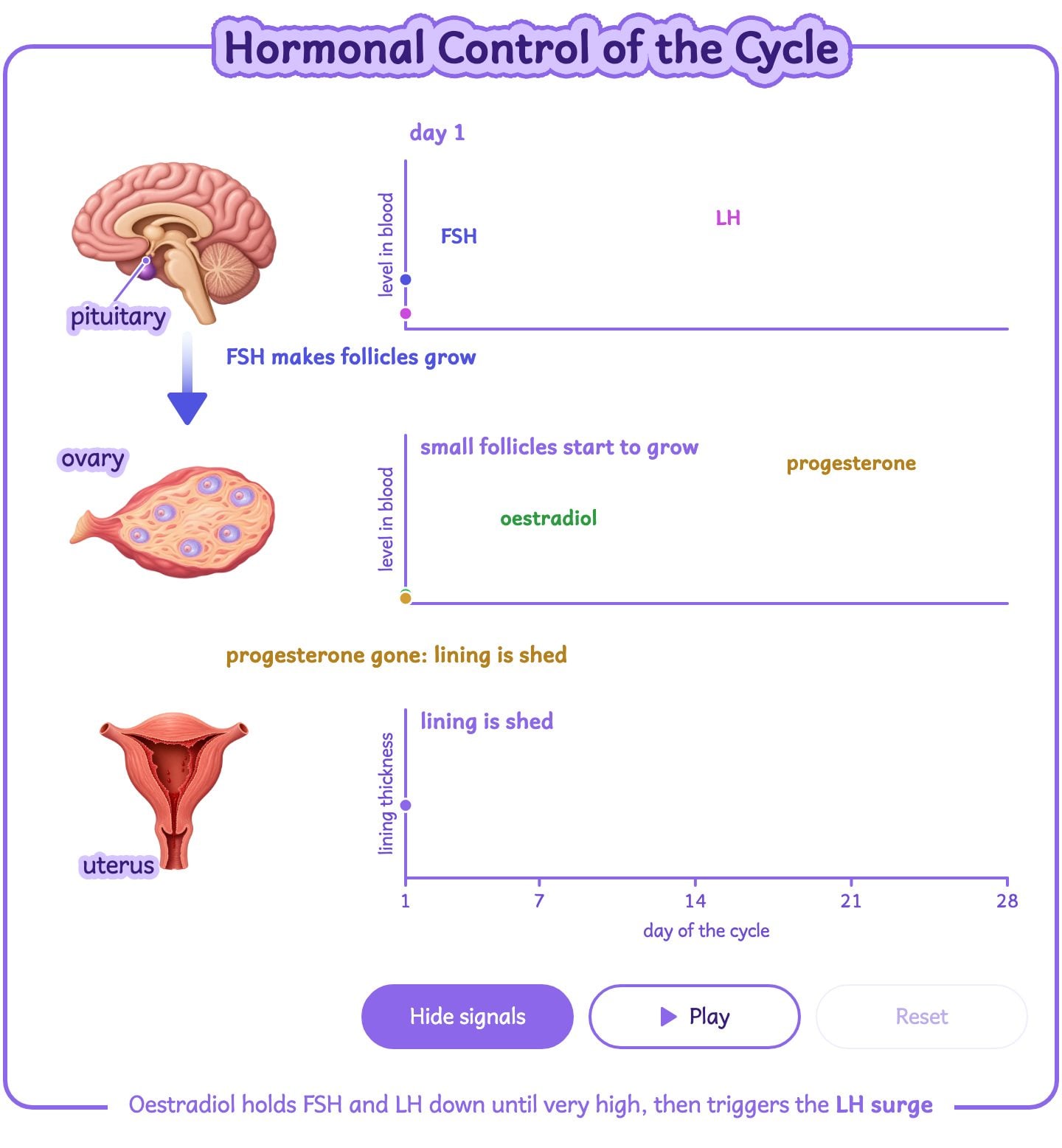
Follow the hormone levels through the cycle and notice what triggers ovulation.
Ovulation and the ovary
Definition
Ovulation
Ovulation is the release of a mature egg cell from an ovary, about halfway through the menstrual cycle.
- During the cycle an egg matures inside the ovary.
- At about day 14, ovulation releases the egg from the ovary.
- The egg travels down the oviduct, where it may be fertilised.
- Ovulation happens when the uterus lining is thick and ready to receive a fertilised egg.
Self review
- What is the role of testosterone at puberty?
- Give two secondary sexual characteristics controlled by oestrogen.
- What happens to the uterus lining during menstruation?
- What is ovulation, and on about which day does it happen?
- Why does the uterus lining thicken during the cycle?