Exchange at the placenta
Definition
Placenta
The placenta is the organ that develops in the uterus during pregnancy and exchanges dissolved substances between the blood of the mother and the blood of the fetus.
- In the placenta the fetus's blood and the mother's blood flow very close together but do not mix.
- Dissolved nutrients, such as glucose and amino acids, and oxygen pass from the mother to the fetus.
- Carbon dioxide and other excretory products, such as urea, pass from the fetus to the mother.
- These substances move across by diffusion down their concentration gradients.
Note
This topic is Supplement content, studied only by Extended candidates.
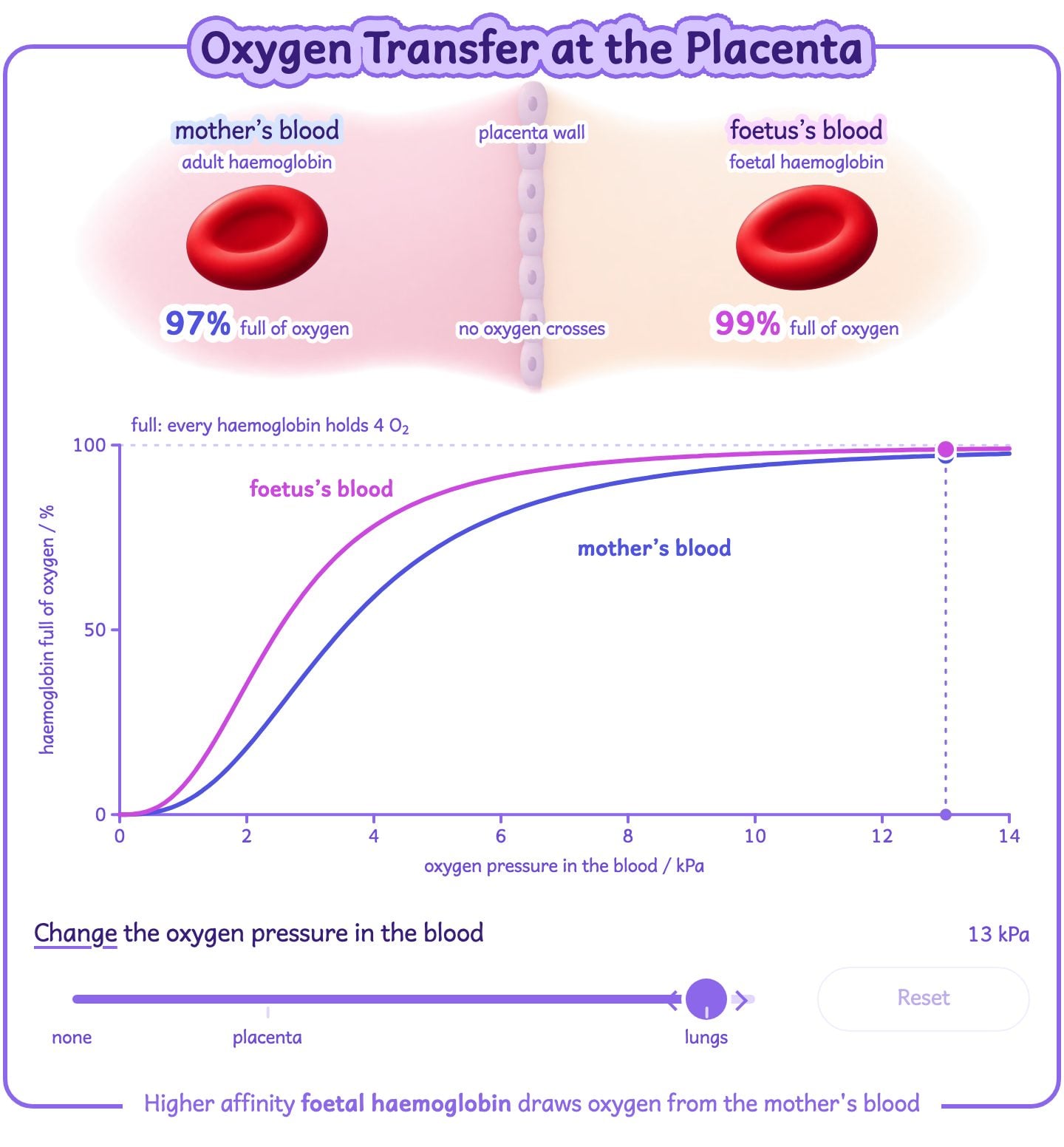
Follow the oxygen from the mother's blood to the fetus and notice why it moves that way.
The umbilical cord carries the blood
Definition
Umbilical cord
The umbilical cord is the structure that connects the fetus to the placenta, carrying blood between them.
- The umbilical cord connects the fetus to the placenta.
- It carries the fetus's blood to the placenta to unload waste and collect oxygen and nutrients.
- It then carries blood back to the fetus.
Key Idea
Keeping the two blood supplies separate protects the fetus from the mother's higher blood pressure and from any difference in blood group.
Harmful substances can cross the placenta
- The placenta is a barrier, but it does not stop everything.
- Some pathogens, such as the rubella virus, can cross and harm the fetus.
- Some toxins, such as those in alcohol and tobacco smoke, can also cross the placenta.
- These can damage the development of the fetus.
Self review
- Name two substances that pass from mother to fetus and two that pass from fetus to mother.
- By what process do substances cross the placenta?
- Why is it important that the two blood supplies do not mix?
- What is the role of the umbilical cord?
- Give one pathogen and one toxin that can cross the placenta and harm the fetus.