Why Temperature Is Controlled
Thermoregulation
The control of body temperature, keeping it close to about 37 degrees Celsius so that enzymes work efficiently.
- Mammals keep their body temperature close to 37 ∘C37\,^{\circ}\text{C}37∘C.
- This is the temperature at which their enzymes work best.
- Keeping the temperature constant is called thermoregulation, and it is controlled by the brain.
This is Supplement (Extended) content in Cambridge IGCSE Biology (0610), Topic 14: Coordination and response.
The Structure of the Skin
- The skin contains hairs and tiny hair erector muscles that raise or lower them.
- Sweat glands make sweat, which passes to the surface through small ducts.
- Receptors and sensory neurones detect temperature and touch.
- Blood vessels run through the skin, and a layer of fatty tissue lies underneath as insulation.
Cooling Down When Too Hot
Sweating
The release of sweat onto the skin surface when the body is too hot; as the sweat evaporates it transfers energy away from the skin, cooling the body.
Vasodilation
The widening of the blood vessels supplying the skin capillaries when the body is too hot, so more blood flows near the surface and more heat is lost.
- Sweating releases sweat onto the skin, and as it evaporates it transfers heat away from the body.
- Vasodilation widens the arterioles supplying the skin surface capillaries.
- More warm blood then flows near the surface, so more heat is lost to the surroundings.
- The hairs lie flat, so little air is trapped and less heat is kept in.
Warming Up When Too Cold
Vasoconstriction
The narrowing of the blood vessels supplying the skin capillaries when the body is too cold, so less blood flows near the surface and less heat is lost.
Shivering
Rapid, repeated contraction of the skeletal muscles when the body is too cold; it increases respiration in muscle cells, which releases heat that warms the body.
- Vasoconstriction narrows the arterioles supplying the skin surface capillaries.
- Less warm blood then flows near the surface, so less heat is lost.
- Shivering makes the muscles contract rapidly, and this respiration releases heat.
- The hair erector muscles raise the hairs, trapping a layer of air that acts as insulation.
Vasodilation and vasoconstriction change the arterioles near the surface; the capillaries themselves do not widen or narrow.
- Why does the body keep its temperature near 37 degrees Celsius?
- Name three structures in the skin involved in controlling temperature.
- How does sweating cool the body down?
- Explain how vasodilation increases heat loss.
- How does shivering help warm the body?
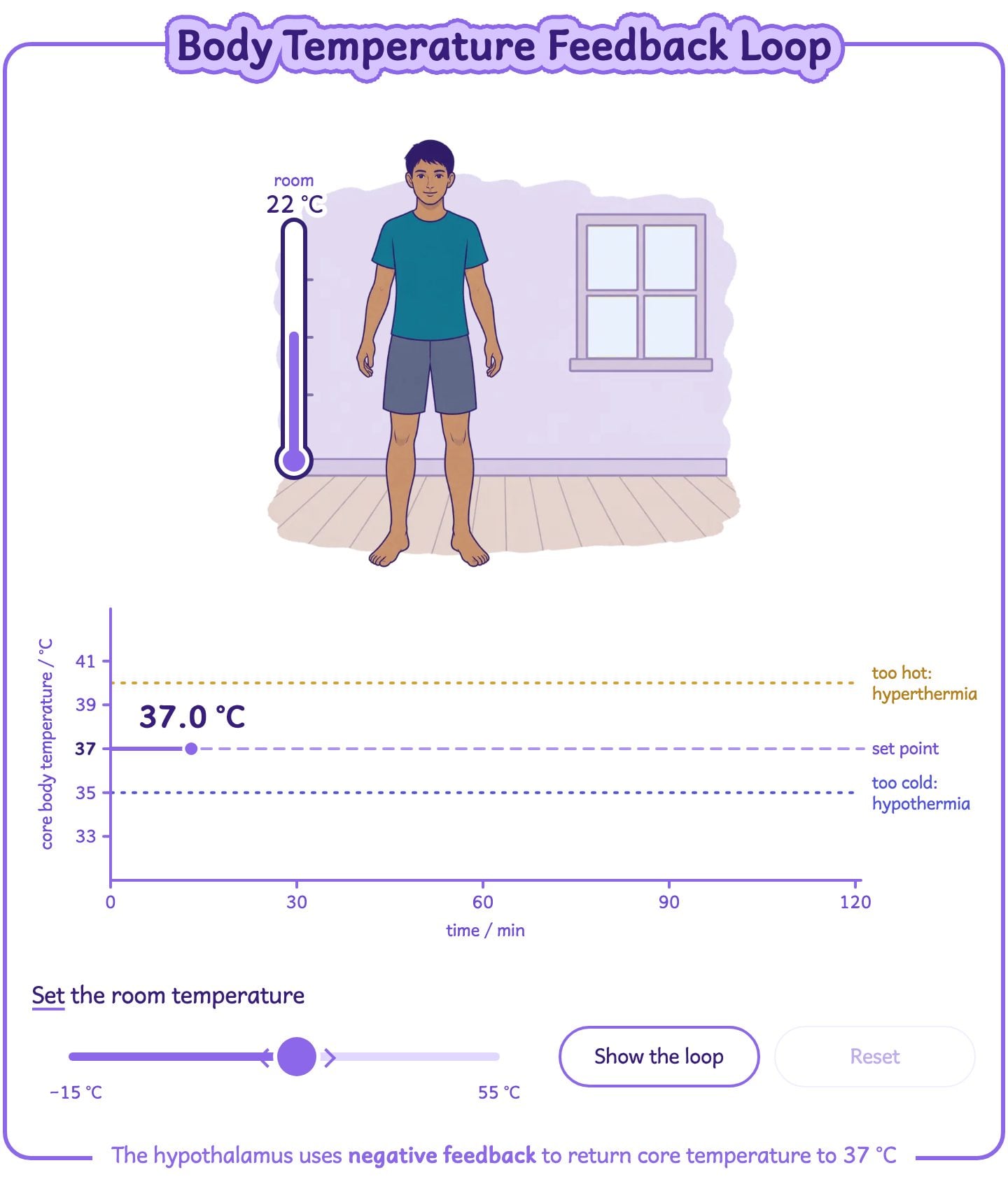
Change the surrounding temperature and watch the body's responses bring core temperature back to 37 degrees Celsius.