

What you'll learn
- How to compare renewable and non-renewable energy resources.
- Why the UK’s energy use has changed over time.
- How the National Grid transfers electrical power efficiently.
- The key facts about UK mains electricity, a.c./d.c., and plug safety.
Energy, power, and energy resources
When people say “making electricity”, they usually mean transferring energy into an electrical pathway so it can be used by homes, schools, factories, and transport systems.
Energy and power
- Energy is transferred when something changes. It is measured in joules (J).
- Power is the rate of energy transfer. It is measured in watts (W), where 1 W means 1 J transferred each second.
Energy is not power
Phrases like “solar power” are everyday shortcuts. In physics, the Sun is an energy resource; power is how quickly energy is transferred.
An energy resource is a store or natural process we can use to transfer energy usefully. Many electricity generators use a turbine: moving steam, air, or water spins a generator, which transfers kinetic energy into electrical energy.
Renewable and non-renewable resources
- A renewable resource is replaced naturally on a human timescale, so it is not used up if managed properly.
- A non-renewable resource is finite, or is replaced so slowly that we treat it as being used up.
Main energy sources on Earth
Non-renewable sources
Fossil fuels include coal, oil, and natural gas. They are burned to heat water, producing steam that spins turbines. They are reliable and can produce large amounts of power, but they release carbon dioxide and other pollutants, and they will eventually run out.
Nuclear fuel, such as uranium, releases energy in nuclear reactions. This energy heats water to make steam for turbines. Nuclear power stations release very little carbon dioxide during operation, but nuclear fuel is non-renewable and radioactive waste must be stored safely.
Renewable sources
Biofuel is fuel made from living or recently living material, such as plant matter. It can be renewable if crops are replanted, but burning it still releases carbon dioxide and growing fuel crops uses land.
Wind turns turbine blades directly. Wind has no fuel cost and low emissions during operation, but output changes with the weather.
Hydroelectricity uses water stored high up behind a dam. Falling water drives turbines. It can respond quickly to demand, but it needs suitable geography and can flood habitats.
Tides can drive turbines using moving seawater. Tides are predictable, but only some coastal locations are suitable.
The Sun can be used by solar cells, which transfer light energy directly to electrical energy. Solar cells have no fuel cost, but their output depends on daylight, weather, and season.
Choosing energy resources
No energy source is perfect. Good comparisons include whether it is renewable, how reliable it is, where it can be used, its cost, and its environmental impact.
Choosing an energy resource for a location
A coastal town has a large tidal range and wants a low-carbon electricity source. Should it consider tidal power?
- Match the resource to the location: a large tidal range means there is a useful movement of seawater, so tidal power is geographically suitable.
- Compare reliability: tides are predictable, so the town can forecast when electricity will be generated more easily than with wind.
- Balance the disadvantage: tidal systems can affect coastal habitats and are expensive to build, so the final decision depends on whether the environmental and cost impacts are acceptable.
Patterns and trends in energy use
A pattern is what the data show at one time. A trend is how the data change over time.
Over the last 150 years, electricity use has generally increased because of lighting, heating, appliances, industry, communication, and transport. The mix of resources has also changed. In many countries, coal use has fallen, while gas, nuclear, wind, and solar have become more important.
Reasons for changing energy use include:
- changes in fuel cost and availability
- new technology, such as better wind turbines or solar cells
- environmental concerns, especially carbon dioxide emissions
- government rules, taxes, and targets
- the need for reliable supply when demand changes
Trend answers
For graph questions, do two things: describe the change using data, then explain it using science, cost, technology, or environmental reasons.
Explaining a change in an energy mix
A graph shows coal falling from 35% of electricity generation to 2%, while wind and solar rise from 3% to 28%.
- Describe the trend with data: coal has greatly decreased, while wind and solar have increased by a large amount.
- Quantify the change where useful: coal has fallen by 33 percentage points, while wind and solar have risen by 25 percentage points.
- Explain the likely reasons: coal produces large carbon dioxide emissions, so many coal power stations have closed; wind and solar have become cheaper and are supported because they are renewable and low-carbon during operation.
The National Grid
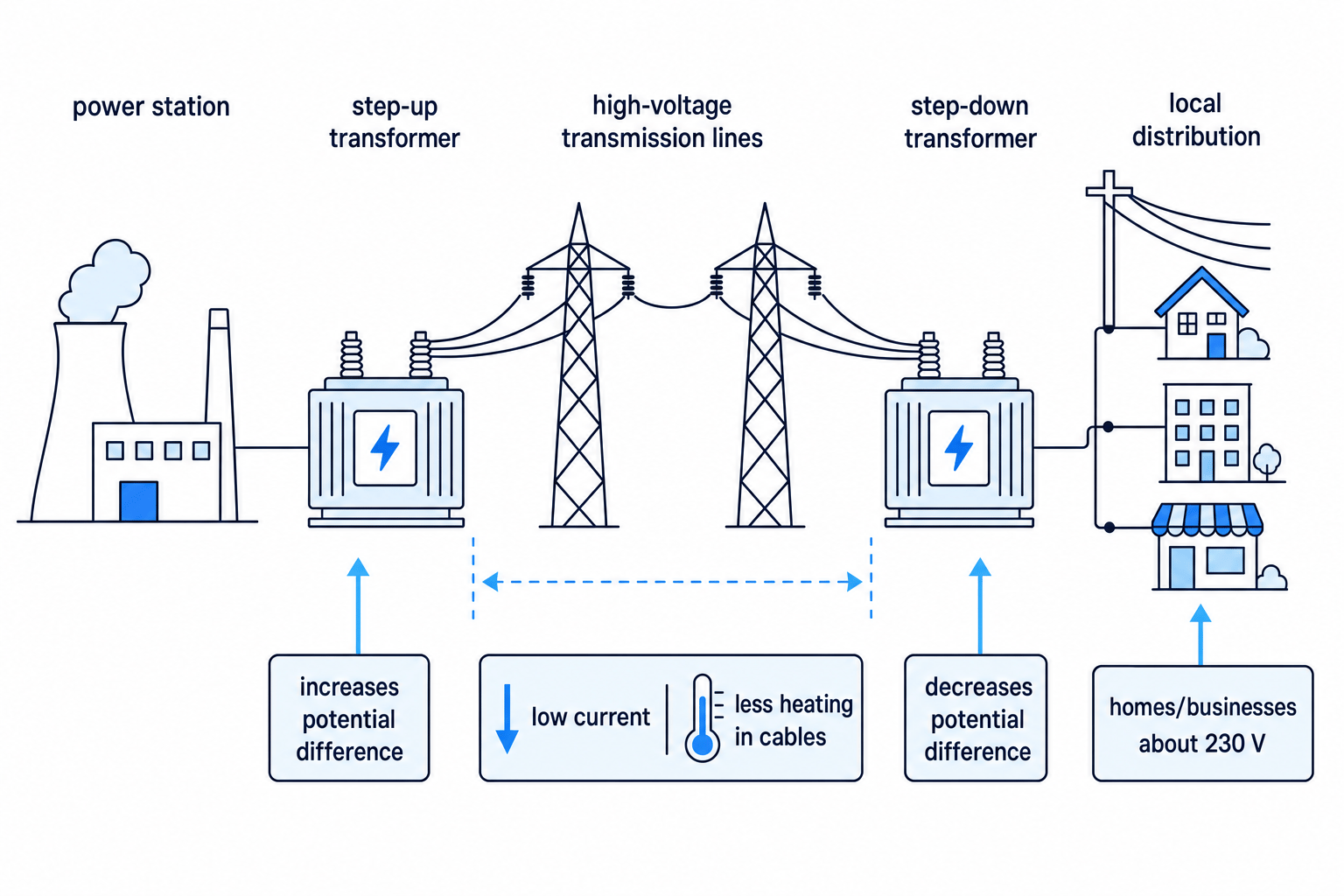
The National Grid is the network of cables and transformers that transfers electrical power from power stations to homes and businesses. Power stations are often far from where electricity is used, so energy must be transferred over long distances.
Potential difference and current
- Potential difference is the energy transferred per unit charge. It is measured in volts (V) and is often called voltage.
- Current is the flow of electric charge. It is measured in amperes (A).
A transformer changes the potential difference of an alternating supply. A step-up transformer increases the potential difference near the power station. A step-down transformer decreases the potential difference near local users.
The National Grid transfers power at a high potential difference and a low current. This is efficient because current in cables causes heating. A lower current means less energy is wasted by heating the cables.
Voltage is across, not along
A high potential difference is between conductors in the power line. Do not write that voltage “travels along” a cable; energy is transferred along the cable by moving charges.
For an ideal transformer, the input power equals the output power:
VpIp=VsIsV_p I_p = V_s I_sVpIp=VsIsHere, the primary coil is the input side and the secondary coil is the output side. For J250, you must be able to apply this relationship and rearrange it in calculations.
Ideal transformer assumption
The relationship VpIp=VsIsV_p I_p = V_s I_sVpIp=VsIs assumes the transformer is 100% efficient. Real transformers waste a small amount of energy as heating and sound.
Finding the current after a step-up transformer
A step-up transformer has a primary potential difference of 25,000 V and a primary current of 800 A. The secondary potential difference is 400,000 V. Find the secondary current.
- Choose the transformer relationship and identify the known values: Vp=25,000 VV_p = 25{,}000 \text{ V}Vp=25,000 V, Ip=800 AI_p = 800 \text{ A}Ip=800 A, and Vs=400,000 VV_s = 400{,}000 \text{ V}Vs=400,000 V.
- Substitute into VpIp=VsIsV_p I_p = V_s I_sVpIp=VsIs: 25,000 V×800 A=400,000 V×Is25{,}000 \text{ V} \times 800 \text{ A} = 400{,}000 \text{ V} \times I_s25,000 V×800 A=400,000 V×Is.
- Rearrange and calculate: Is=25,000 V×800 A400,000 V=50 AI_s = \frac{25{,}000 \text{ V} \times 800 \text{ A}}{400{,}000 \text{ V}} = 50 \text{ A}Is=400,000 V25,000 V×800 A=50 A.
- Interpret the result: the current is much lower after the step-up transformer, so less energy is wasted heating the transmission cables.
Direct and alternating voltage
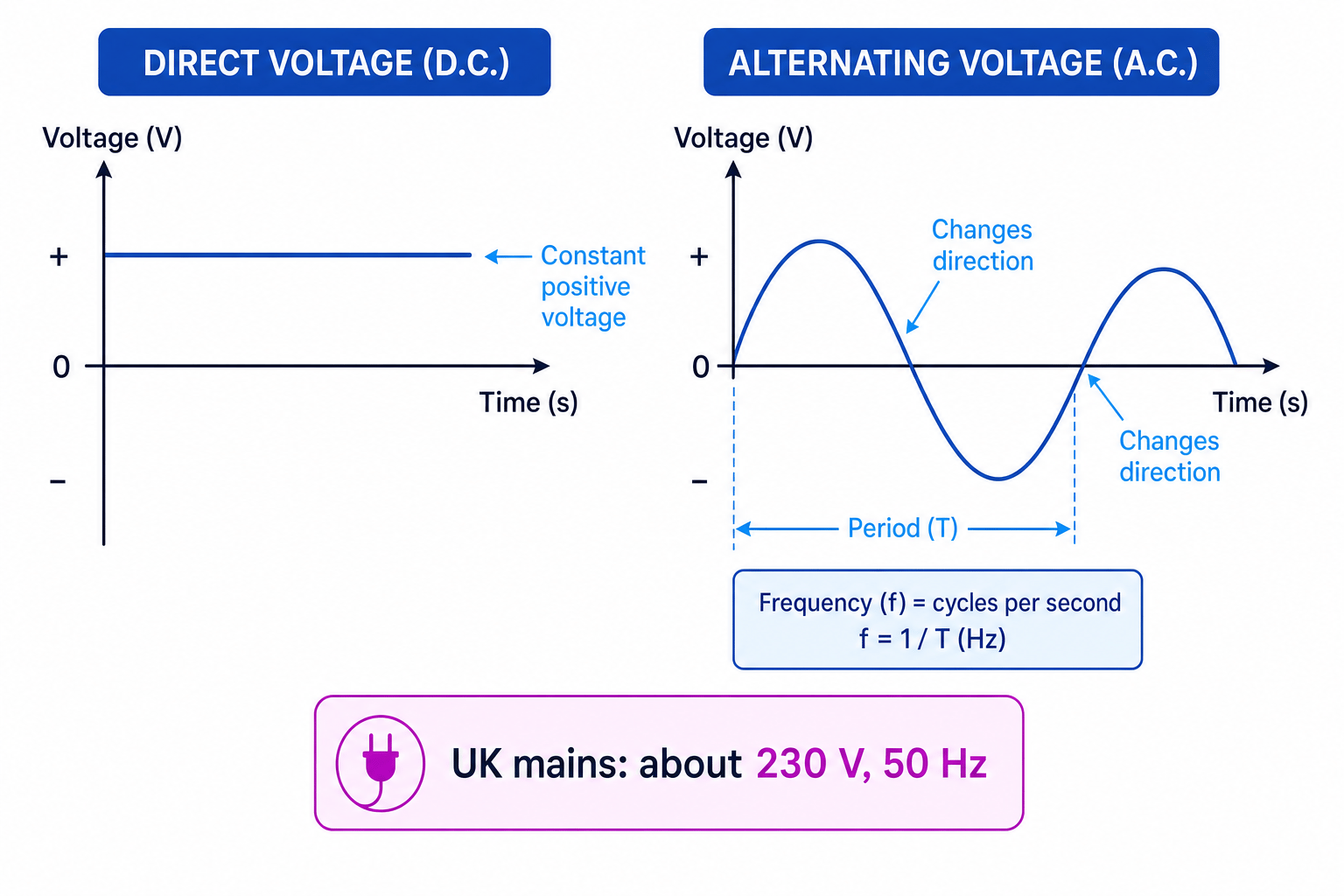
A direct voltage has one fixed polarity, so in a complete circuit it drives current in one direction. This is what a cell or battery provides.
An alternating voltage repeatedly changes polarity, so in a complete circuit the current repeatedly changes direction. The UK domestic mains supply is a.c., with a frequency of 50 Hz and a potential difference of about 230 V.
Frequency
Frequency is the number of complete cycles each second. It is measured in hertz (Hz), so 50 Hz means 50 complete cycles per second.
Mains wires and electrical safety
Many UK appliances use three wires in a mains cable. The plug and appliance diagram below shows how the wires connect and how the earth wire helps during a fault.
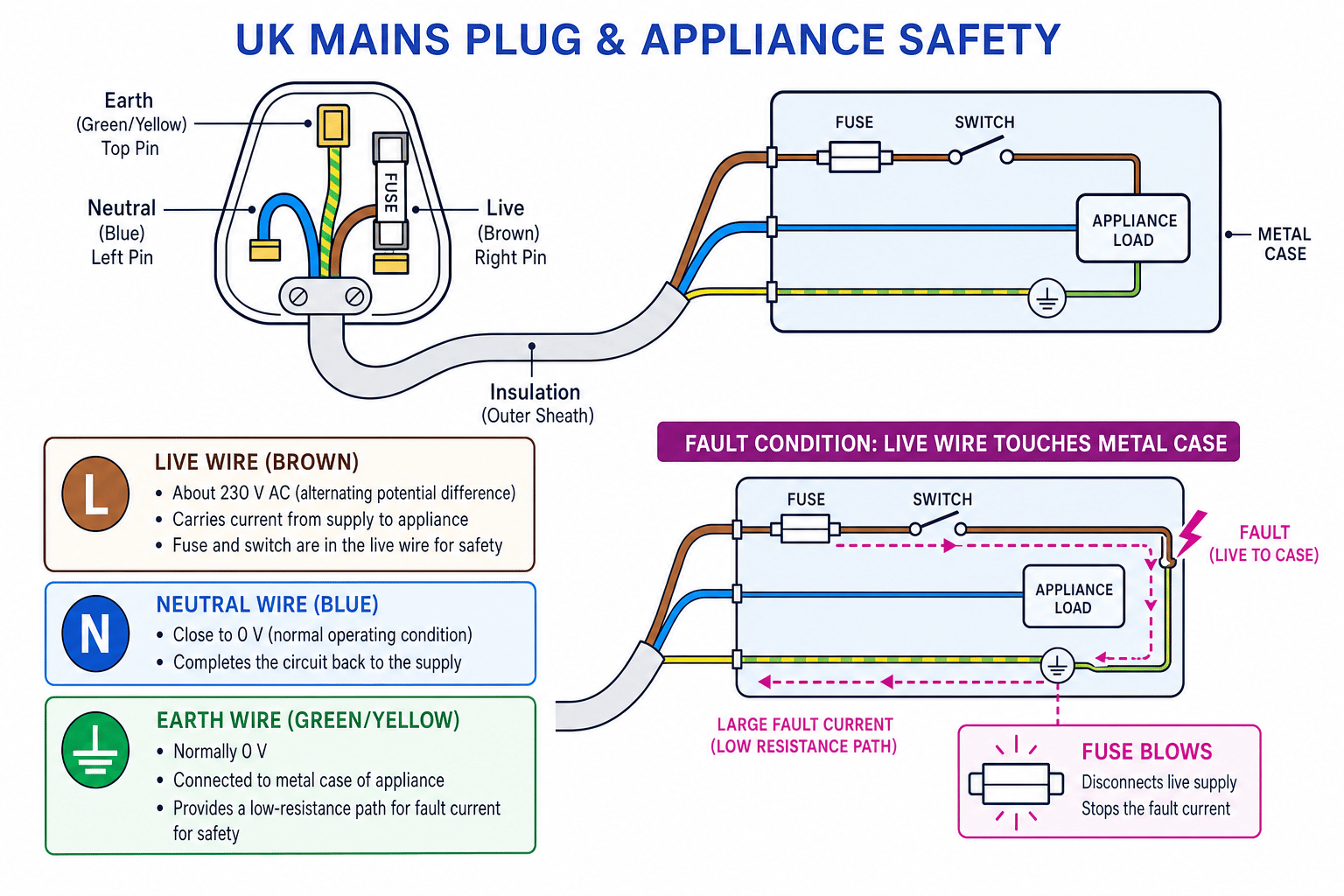
The live wire is brown. It is at about 230 V compared with the neutral wire and carries energy from the supply to the appliance. Switches and fuses are placed in the live wire so the live connection can be disconnected.
The neutral wire is blue. It is close to 0 V in normal operation and completes the circuit back to the supply.
The earth wire is green and yellow. It is normally at 0 V and usually carries no current. It is connected to the metal case of an appliance so that, if the live wire touches the case, current has a low-resistance path to earth.
The key potential differences are:
- live to neutral: about 230 V
- live to earth: about 230 V
- neutral to earth: about 0 V
Insulation is non-conducting material around wires or around an appliance. It helps stop you touching live parts and becoming a path for current to flow to earth.
An open switch is not automatically safe
Even when a switch is open, the live wire on the supply side can still be at about 230 V compared with earth. Touching it while also connected to earth can complete a dangerous circuit through your body.
Also remember: sockets and batteries do not contain “current waiting to escape”. They provide a potential difference. Current flows only when there is a complete conducting circuit.
Tracing a live-to-case fault
A metal-cased appliance develops a fault: the live wire touches the metal case.
- Identify the danger: the case could become live, so there is about 230 V between the case and earth.
- Apply the role of the earth wire: if the case is earthed, a large fault current flows through the low-resistance earth path instead of through a person.
- Link to protection: the large current melts the fuse or trips a safety device, disconnecting the live supply and reducing the risk of electric shock.
In the exam
- For energy resources, always link your advantage or disadvantage to the resource named: do not write vague answers like “it is better for the environment” without saying why.
- For the National Grid, use the chain: high potential difference means low current for the same power, which means less heating in cables, so less energy is wasted.
- For mains safety, explain using potential differences and complete circuits: live-to-earth is dangerous because it can drive current through a person or fault path.
Check yourself
- Why does the National Grid use a step-up transformer before long-distance transmission cables?
- Give one renewable resource that is predictable and one that depends strongly on the weather.
- What happens when the live wire touches the metal case of an earthed appliance?
