What you'll learn
- How gas molecules move in the particle model.
- Why temperature is linked to the average kinetic energy of gas molecules.
- How gas pressure is produced by collisions with container walls.
- Why heating a gas at constant volume increases its pressure.
The particle model: gases first
The particle model describes matter as being made of tiny particles. In a gas, the particles are far apart and can move freely in all directions.
A molecule is a particle made from atoms joined together. In this topic, the spec talks about gas molecules, but the same particle-model ideas also work for gases made of single atoms, such as helium.
Gas molecules
Gas molecules are tiny particles in a gas that are far apart, arranged randomly, and moving freely in all directions.
Gas molecules are in constant random motion. This means they are always moving, and their directions keep changing because they collide with other molecules and with the walls of the container.
Random motion
Random motion means there is no fixed pattern or single direction to the movement of the molecules.
Kinetic energy and temperature
Kinetic energy is the energy an object has because it is moving. Gas molecules have kinetic energy because they are moving.
Kinetic energy
Kinetic energy is the energy of movement. Faster-moving molecules have more kinetic energy.
A gas contains a huge number of molecules. They do not all move at exactly the same speed, so we talk about their average kinetic energy. “Average” means the mean value for all the molecules in the gas.
Temperature is linked to the average kinetic energy of the molecules. A higher temperature means the molecules have a higher average kinetic energy, so on average they move faster.
Temperature and particle speed
For a gas, higher temperature means higher average kinetic energy of the molecules. The molecules move faster on average, but they do not all have exactly the same speed.
Temperature is not the same as heat
Temperature tells you about the average kinetic energy of particles. Heating is an energy transfer to the gas. Do not write “the particles gain temperature”; write that they gain energy, so their average kinetic energy increases.
How gas pressure is produced
Pressure means force per unit area. It is measured in pascals, Pa. In equation form:
p=FAp = \frac{F}{A}p=AFwhere ppp is pressure in Pa, FFF is force in newtons, N, and AAA is area in square metres, m².
In a gas, pressure happens because molecules collide with the walls of their container. Each collision gives the wall a tiny push. There are enormous numbers of collisions every second, so the pushes add up to a steady pressure.
Gas pressure
Gas pressure is the pressure exerted by gas molecules when they collide with the walls of their container.
The molecules move in all directions, so gas pressure acts in all directions too — upwards, downwards, sideways, and onto every surface touching the gas.
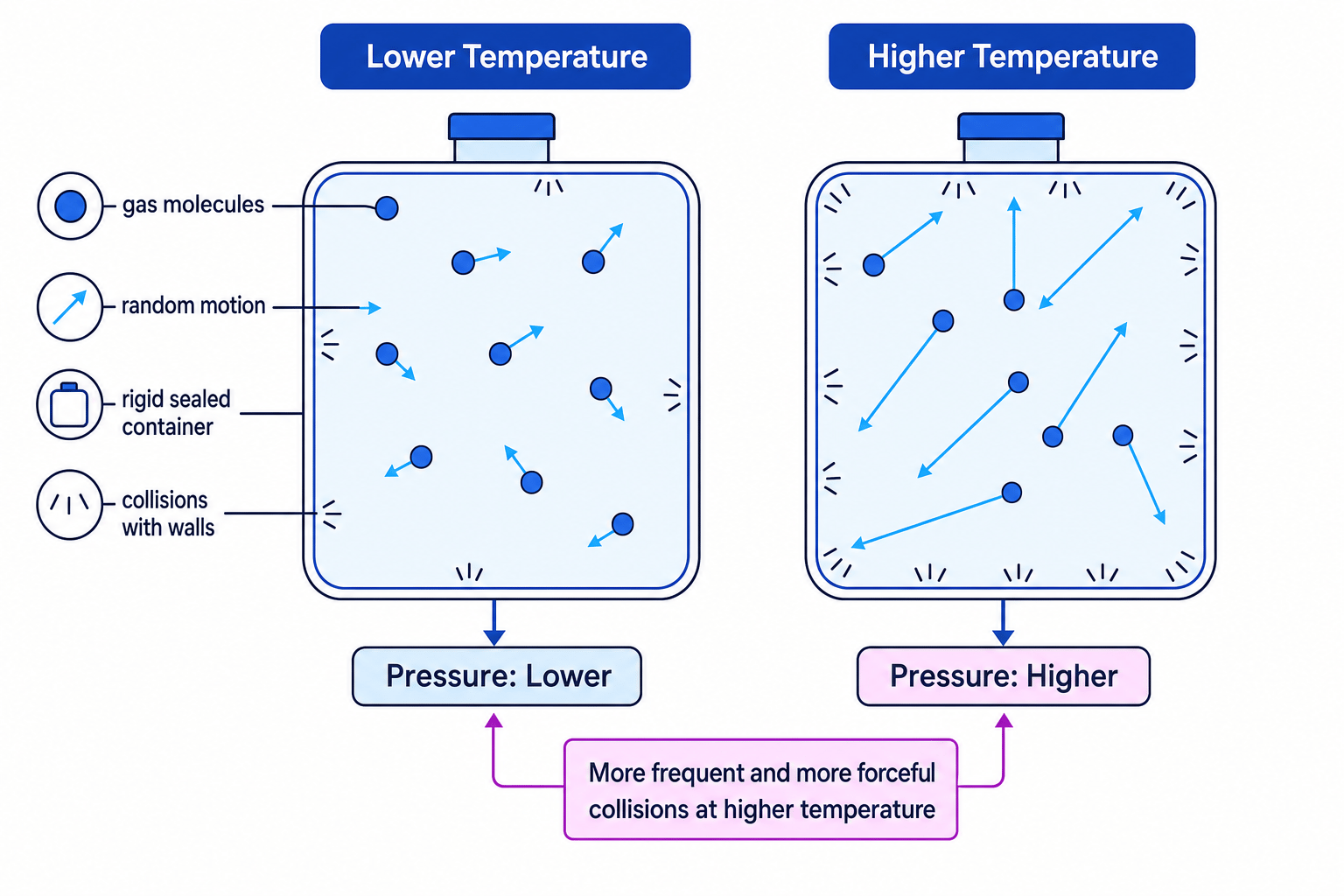
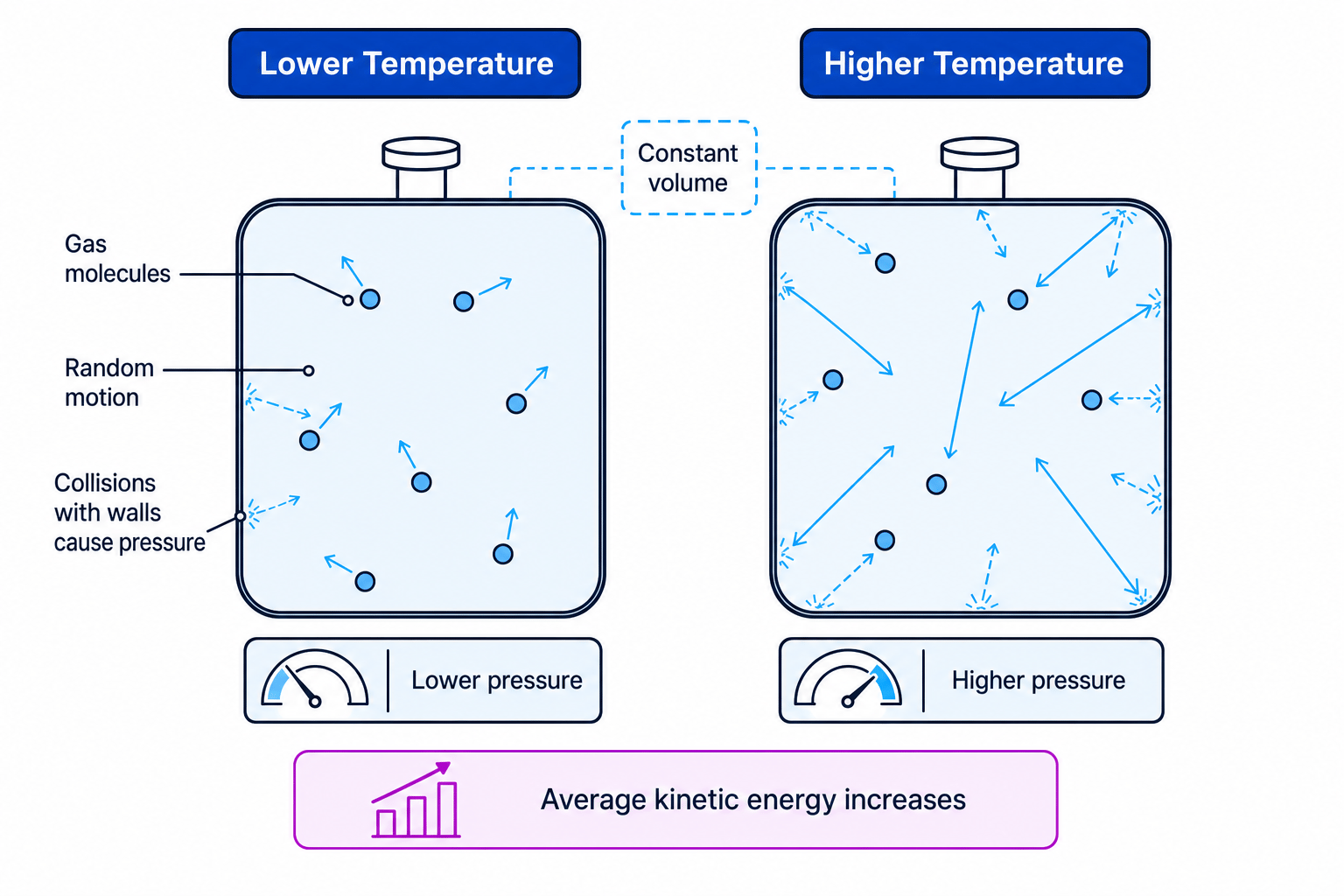
The diagram shows the key idea: at higher temperature, molecules move faster on average, so collisions with the walls are more frequent and more forceful.
Explaining pressure in a sealed gas
A sealed container is filled with gas. Explain why the gas exerts pressure on the inside walls.
-
The gas molecules are in constant random motion, so they travel in many different directions inside the container.
-
When molecules reach the wall, they collide with it and give the wall a tiny push.
-
Huge numbers of molecules collide with the wall every second, so the total force on each area of wall produces a measurable pressure.
Gas pressure is not mainly about weight
In these GCSE explanations, focus on molecular collisions with the container walls, not the weight of the gas. Random molecular motion is the key cause of gas pressure.
Constant volume: what it means
Volume is the amount of space something occupies. A gas fills the volume of its container.
A gas is at constant volume if the space it occupies does not change. For example, gas in a sealed, rigid metal can has constant volume because the container cannot expand.
Constant volume
Constant volume means the gas is kept in the same amount of space. In this topic, assume the container is sealed and rigid, so the amount of gas and the volume stay the same.
This matters because the pressure-temperature relationship in the spec is for a gas held at constant volume.
Constant volume matters
If the gas can expand or escape, heating it will not necessarily increase the pressure in the same way. The GCSE statement is for a fixed amount of gas in a rigid container.
Heating a gas at constant volume
Now put the ideas together.
When a gas is heated, energy is transferred to its molecules. Their average kinetic energy increases, so they move faster on average.
If the volume is fixed, the molecules still have the same amount of space. Because they are moving faster, they collide with the container walls more often. Each collision also gives the wall a larger push. So the pressure increases.
Temperature and pressure at constant volume
For a fixed amount of gas at constant volume: increasing the temperature increases the pressure, and decreasing the temperature decreases the pressure.
Heating a gas at constant volume
A sealed, rigid can contains gas. The can is heated. Explain what happens to the pressure inside.
-
The can is sealed and rigid, so the amount of gas and the volume stay constant.
-
Heating transfers energy to the gas molecules, increasing their average kinetic energy.
-
The molecules move faster on average, so they collide with the walls more frequently.
-
The faster molecules also give the walls a larger push during each collision.
-
The total force on each area of the wall increases, so the gas pressure increases.
Cooling a gas at constant volume
Cooling is the opposite process. Energy is transferred away from the gas, so the molecules have lower average kinetic energy.
They move more slowly on average, so they collide with the walls less often and with less force. Therefore, the pressure decreases.
Cooling a gas at constant volume
A sealed, rigid gas cylinder is cooled in a freezer. Explain the effect on pressure.
-
The cylinder is rigid, so the gas volume stays the same.
-
Cooling transfers energy away from the gas molecules, reducing their average kinetic energy.
-
The molecules move more slowly on average, so collisions with the walls become less frequent and less forceful.
-
The force per unit area on the walls decreases, so the pressure decreases.
Temperature scale: Celsius and kelvin
In everyday life, temperature is often measured in degrees Celsius, °C. In physics, the kelvin, K, is often used because it starts from absolute zero, the lowest possible temperature.
You may see the conversion:
T(K)=θ(∘C)+273T(\text{K}) = \theta(^{\circ}\text{C}) + 273T(K)=θ(∘C)+273where TTT is temperature in kelvin and θ\thetaθ is temperature in degrees Celsius.
For this section, you mainly need the qualitative explanation: higher temperature means higher average kinetic energy and therefore higher pressure at constant volume.
Best wording for explanations
Use the chain: temperature increases, so average kinetic energy increases, so molecules move faster, so wall collisions are more frequent and more forceful, so pressure increases.
Do not just say particles expand
Gas molecules themselves do not get bigger when heated. The important change is that they move faster on average because their average kinetic energy increases.
In the exam
-
State the condition clearly: the gas must be in a sealed, rigid container so the amount of gas and volume are constant.
-
Link temperature to average kinetic energy, not just “energy” vaguely.
-
Explain pressure using collisions with the walls, including both more frequent collisions and more forceful collisions when temperature increases.
Check yourself
- Why does a gas exert pressure on the walls of its container?
- What happens to the average kinetic energy of gas molecules when temperature increases?
- Why is “constant volume” important when explaining the effect of temperature on gas pressure?