

What you'll learn
- How to tell the difference between scalar and vector quantities.
- How forces can be contact or non-contact forces.
- How to calculate weight using mass and gravitational field strength.
- How to find a resultant force and draw simple force diagrams.
Scalars and vectors
Before you can describe forces properly, you need to know whether a quantity has a direction.
A quantity is something you can measure, such as mass, speed, force or temperature. Its magnitude means its size or amount.
Scalar and vector quantities
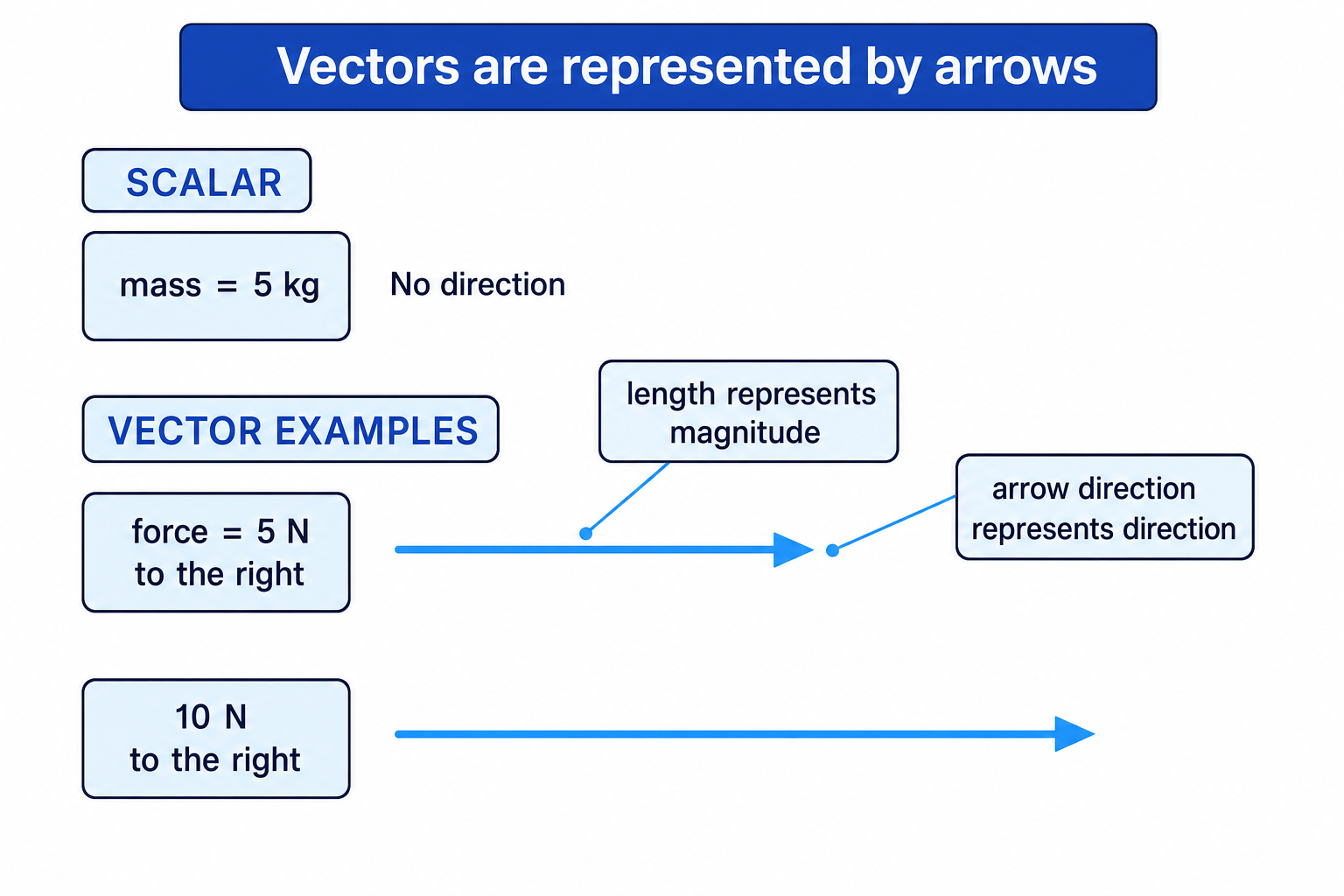
A scalar quantity has magnitude only. A vector quantity has magnitude and an associated direction.
For example, mass is scalar: 5 kg is enough information. Force is vector: “5 N” is not complete unless you also say the direction, such as “5 N to the right”.
A vector can be represented by an arrow. The length of the arrow represents the magnitude, and the direction of the arrow shows the direction of the vector.
Deciding whether a quantity is scalar or vector
A car is described as travelling at 12 m/s north. Decide whether this is scalar or vector.
- The value 12 m/s gives the magnitude of the motion.
- The word north gives a direction.
- Because the description includes both magnitude and direction, it is a vector quantity. In physics, this would be a velocity, not just a speed.
Vectors need direction
If an answer is about a vector quantity, include both the size and the direction, for example “30 N downwards”.
What is a force?
A force is a push or pull acting on an object due to its interaction with another object. Force is measured in newtons, symbol N.
Force is a vector quantity, so every force has:
- a magnitude, in newtons
- a direction
Forces do not just “appear” on their own. They come from interactions between objects. If one object exerts a force on another, the interaction also produces a force on the first object.
Contact and non-contact forces
All forces are either contact forces or non-contact forces.
Contact and non-contact forces
A contact force acts when objects are physically touching. A non-contact force acts when objects are physically separated.
Common contact forces
- Friction: a force that opposes motion between touching surfaces.
- Air resistance: a force that opposes motion through air.
- Tension: a pulling force in a stretched rope, string or cable.
- Normal contact force: the support force from a surface, acting at right angles to the surface.
Common non-contact forces
- Gravitational force: attraction between masses.
- Electrostatic force: force between electric charges.
- Magnetic force: force involving magnets, magnetic materials or currents.
Describing an interaction force
A magnet attracts a paperclip without touching it. Describe the forces as vectors.
- The magnet and paperclip are separated, so the force is a non-contact force.
- The interaction is magnetic, so draw a force arrow on the paperclip pointing towards the magnet.
- The paperclip also interacts with the magnet, so draw a force arrow on the magnet pointing towards the paperclip. The two arrows act on different objects.
Forgetting the object the force acts on
A force arrow should show the force on one chosen object. Do not mix up “the force of A on B” with “the force of B on A”.
Gravity, mass and weight
Close to Earth, objects experience gravity because Earth has a gravitational field around it.
Gravitational field strength
Gravitational field strength, symbol ggg, is the force of gravity on each kilogram of mass at a particular point. It is measured in newtons per kilogram, N/kg.
Mass is not the same as weight
Mass is the amount of matter in an object. It is measured in kilograms, kg, and is a scalar quantity.
Weight is the force acting on an object due to gravity. It is measured in newtons, N, and is a vector quantity because it acts downwards towards the centre of the Earth.
Weight equation
Weight is calculated using:
W=mgW = mgW=mgwhere WWW is weight in newtons (N), mmm is mass in kilograms (kg), and ggg is gravitational field strength in newtons per kilogram (N/kg).
In GCSE calculations, the value of ggg will be given. Near Earth it is often about 9.8 N/kg, but use the value in the question.
Calculating weight
An object has a mass of 3.0 kg. The gravitational field strength is 9.8 N/kg. Calculate its weight.
- Choose the weight equation because the question gives mass and gravitational field strength: W=mgW = mgW=mg.
- Substitute the values with units: W=3.0 kg×9.8 N/kgW = 3.0\,\text{kg} \times 9.8\,\text{N/kg}W=3.0kg×9.8N/kg.
- Calculate the weight: W=29.4 NW = 29.4\,\text{N}W=29.4N. The force acts downwards.
Mass and weight units
Mass is measured in kg. Weight is a force, so it is measured in N. Do not write “weight = 3 kg”.
Weight is directly proportional to mass
If gravitational field strength stays the same, weight and mass are directly proportional.
That means if the mass doubles, the weight doubles. If the mass triples, the weight triples.
In symbols:
W∝mW \propto mW∝mA graph of weight against mass would be a straight line through the origin, as long as ggg is constant.
Centre of mass and measuring weight
The centre of mass is the point where an object’s weight may be considered to act. For a uniform, symmetrical object, this is usually at its geometric centre.
Weight is measured using a calibrated spring-balance, also called a newtonmeter. It stretches when a force is applied, and the scale reads the force in newtons.
Resultant forces
Often, more than one force acts on an object at the same time. Instead of listing every force separately, we can replace them with one overall force.
Resultant force
The resultant force is a single force that has the same effect as all the original forces acting together.
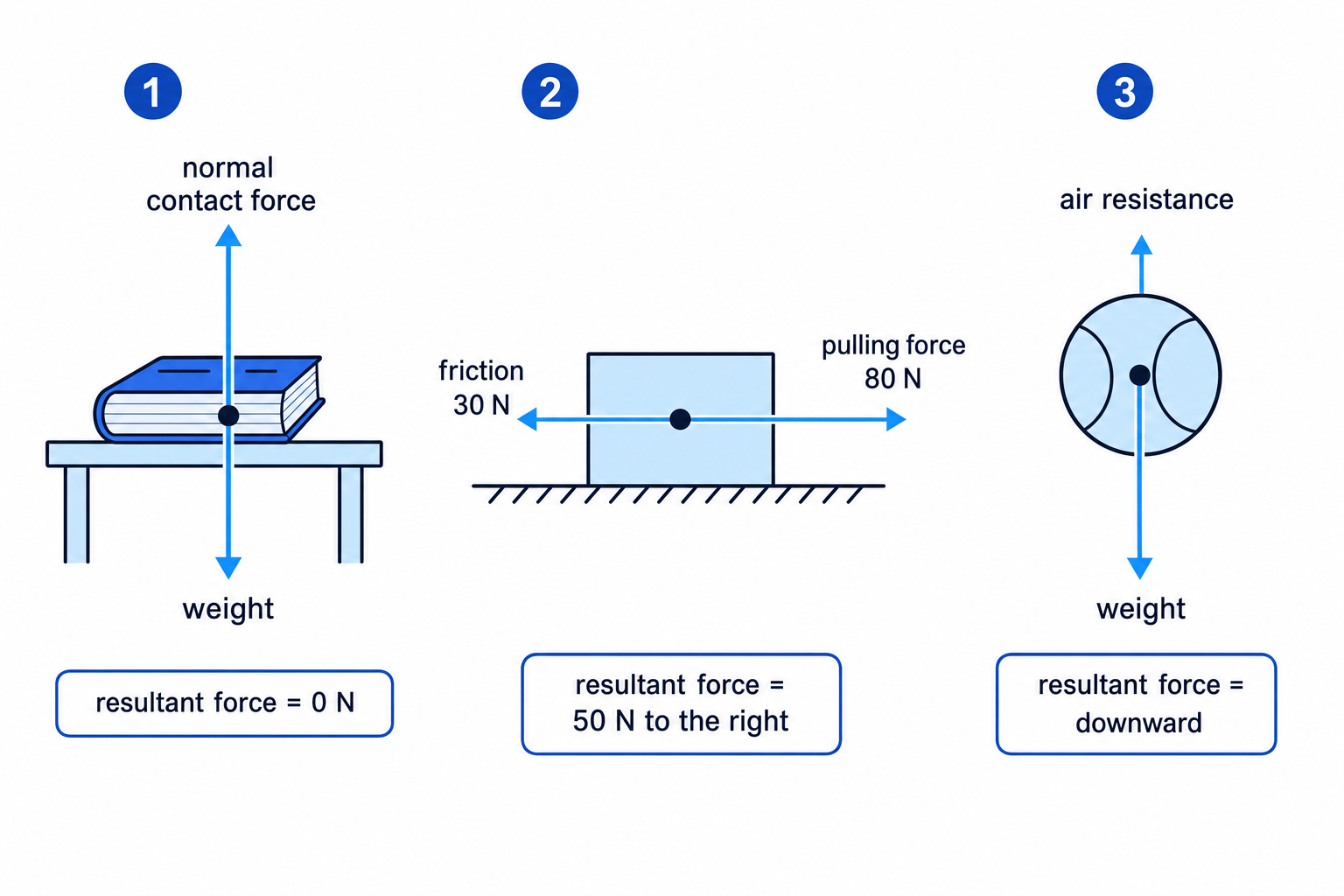
If the resultant force is zero, the forces are balanced. Balanced forces do not mean “no forces”; they mean the forces cancel out.
Calculating resultants in a straight line
For two forces acting along the same straight line:
- forces in the same direction are added
- forces in opposite directions are subtracted
- the resultant acts in the direction of the larger force
Calculating a resultant force
A box is pulled to the right with a force of 80 N. Friction acts to the left with a force of 30 N. Find the resultant force.
- Choose a positive direction. Let right be positive, so the pulling force is +80 N+80\,\text{N}+80N and friction is −30 N-30\,\text{N}−30N.
- Add the forces along the line: Fresultant=80 N−30 NF_\text{resultant} = 80\,\text{N} - 30\,\text{N}Fresultant=80N−30N.
- Calculate and interpret the sign: Fresultant=50 NF_\text{resultant} = 50\,\text{N}Fresultant=50N, so the resultant force is 50 N to the right.
Free-body diagrams
A free-body diagram shows the forces acting on one object. The object is often drawn as a dot or simple box, with arrows showing the forces.
To draw one:
- choose the object you are focusing on
- draw only the forces acting on that object
- make larger forces longer arrows
- label each force clearly
Free-body diagram check
Ask yourself: “Is this force acting on my chosen object?” If not, it should not be on that object’s free-body diagram.
If you are taking Higher Tier, you may also be asked about an isolated object or system. A system is the object or group of objects you choose to focus on. Forces between parts inside the system are internal; free-body diagrams usually focus on external forces acting on the system.
Forces at angles
Sometimes forces do not act neatly left, right, up or down. This is where vector diagrams help.
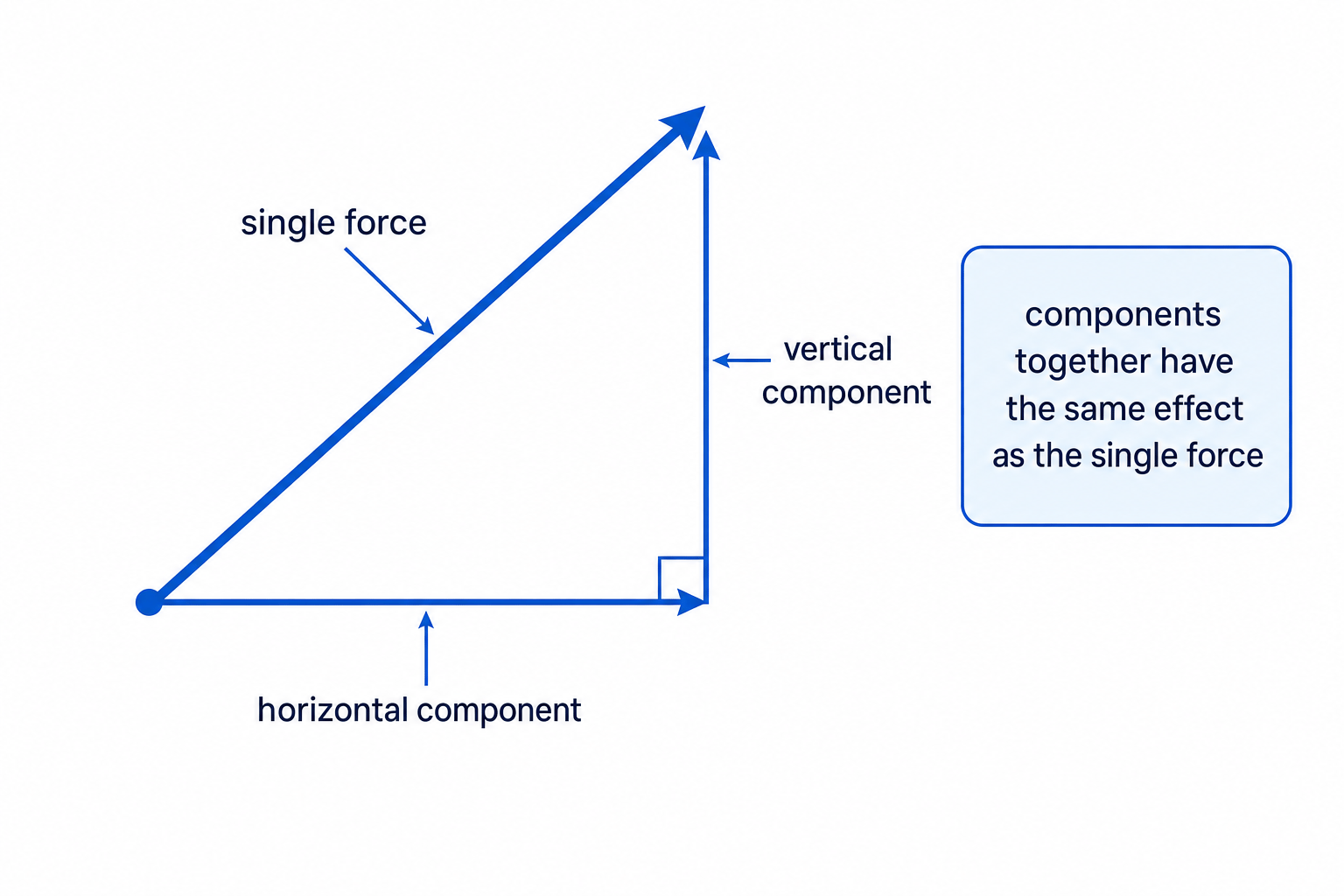
For Higher Tier, you need to know that a single force can be resolved into two components at right angles to each other. These two component forces together have the same effect as the original force.
Resolving a force
To resolve a force means to replace one force by two perpendicular component forces that have the same overall effect.
Components are not extra forces
Resolving a force is a mathematical model. It does not mean a new pair of physical forces has suddenly appeared on the object.
Scale vector diagrams
For Higher Tier, you can use scale drawings to find the resultant of two forces, including both magnitude and direction.
Finding a resultant by scale drawing
Two forces act on an object: 30 N east and 40 N north. Find the resultant using a scale drawing.
- Choose a scale, such as 1 cm representing 10 N. Draw a 3 cm arrow east for the 30 N force.
- From the tip of that arrow, draw a 4 cm arrow north for the 40 N force. This is the tip-to-tail method.
- Draw the resultant from the start of the first arrow to the end of the second arrow. Measuring this line gives 5 cm, so the resultant is 50 N in a north-easterly direction.
If the vectors form a closed shape when placed tip-to-tail, the resultant is zero. This is an equilibrium situation: the forces are balanced.
In the exam
- For vector quantities, always give a magnitude and a direction, with the correct unit.
- For weight questions, use W=mgW = mgW=mg, check mass is in kg, and give weight in N.
- For resultants, draw arrows first if needed, then add forces in the same direction and subtract forces in opposite directions.
Check yourself
- Is “20 N to the left” a scalar or vector quantity? Why?
- A 4.0 kg object is in a gravitational field strength of 9.8 N/kg. What is its weight?
- Two forces act on a box: 18 N to the right and 25 N to the left. What is the resultant force?
