

What you'll learn
- Why some atomic nuclei are unstable and what radioactive decay means.
- The differences between alpha, beta and gamma radiation.
- How to balance simple nuclear equations for alpha and beta decay.
- How half-life, contamination and irradiation are used in radiation safety.
1. Starting point: atoms and nuclei
An atom has a tiny central nucleus, which contains protons and neutrons. Protons are positively charged. Neutrons have no charge. Electrons are negatively charged and are found around the nucleus.
Most of the mass of an atom is in the nucleus, so changes to the nucleus can make a big difference to the atom.
Mass number and atomic number
For a nuclear symbol ZAX^{A}_{Z}\text{X}ZAX:
- AAA is the mass number: the total number of protons and neutrons.
- ZZZ is the atomic number: the number of protons.
- X is the chemical symbol of the element.
An isotope is a form of an element with the same number of protons but a different number of neutrons. Some isotopes have unstable nuclei.
2. Radioactive decay
Some atomic nuclei are unstable. They change to become more stable by giving out nuclear radiation. This process is called radioactive decay.
Radioactive decay
Radioactive decay is the random process where an unstable nucleus gives out radiation as it changes to become more stable.
The word random is important: you cannot predict exactly when one particular unstable nucleus will decay. However, with a large sample containing many nuclei, you can describe the overall pattern.
Activity and count-rate
Activity is the rate at which a radioactive source decays. It is measured in becquerels (Bq). One becquerel means one decay per second.
Count-rate is the number of decays recorded each second by a detector, such as a Geiger-Muller tube. The detector may not record every single decay, so count-rate is what the equipment measures.
count-rate=number of counts recordedtime taken\text{count-rate} = \frac{\text{number of counts recorded}}{\text{time taken}}count-rate=time takennumber of counts recordedCalculating count-rate
A detector records 450 counts in 90 s. Calculate the count-rate.
- Use the definition of count-rate, so divide the number of counts by the time taken.
- Substitute the values: count-rate=45090\text{count-rate} = \frac{450}{90}count-rate=90450.
- Calculate the result: count-rate=5 counts/s\text{count-rate} = 5\ \text{counts/s}count-rate=5 counts/s.
3. Types of nuclear radiation
The nuclear radiation emitted during decay may be:
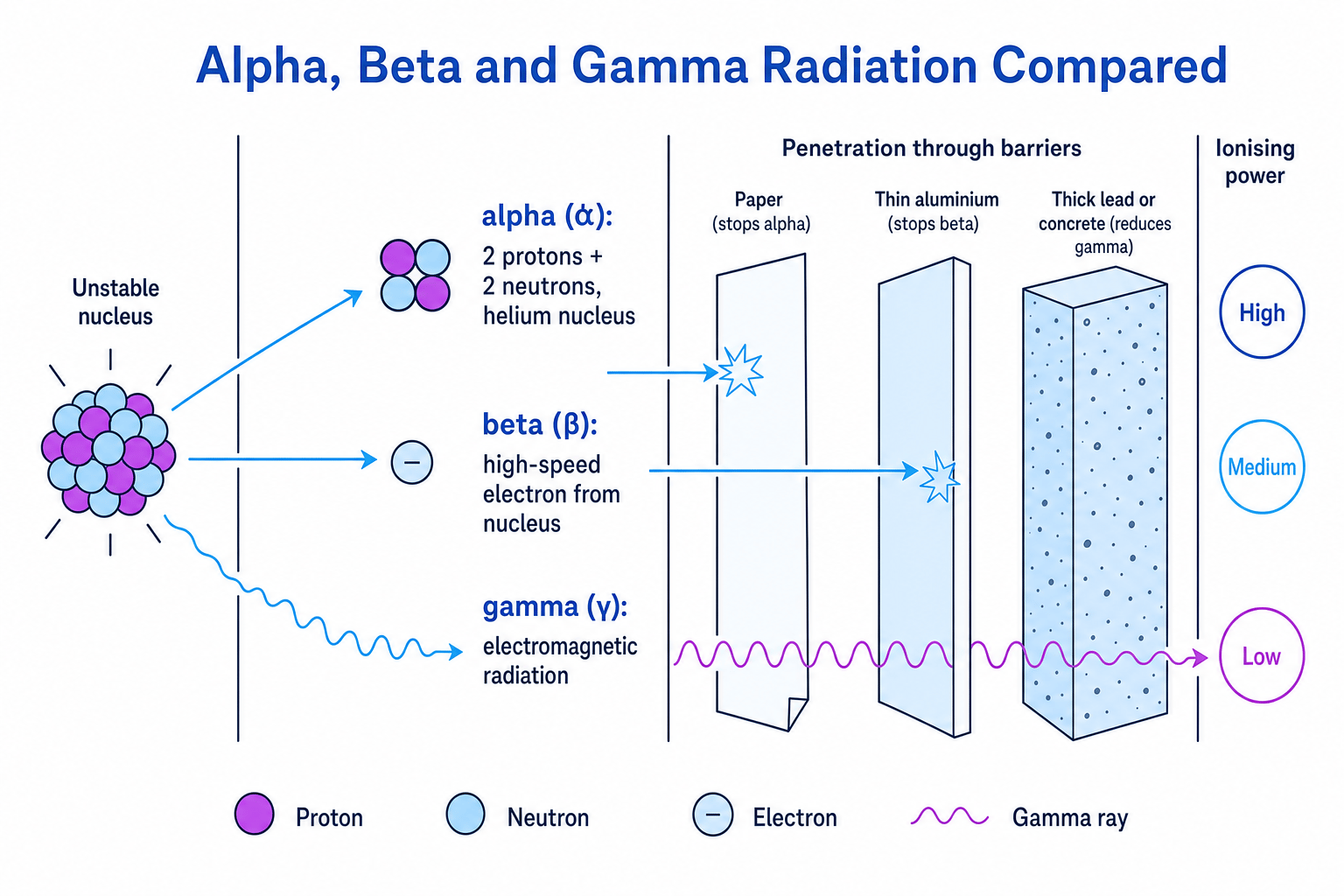
- Alpha radiation (α): an alpha particle contains two protons and two neutrons. It is the same as a helium nucleus.
- Beta radiation (β): a beta particle is a high-speed electron ejected from the nucleus when a neutron turns into a proton.
- Gamma radiation (γ): a gamma ray is electromagnetic radiation emitted from the nucleus.
- Neutron radiation (n): a neutron can also be emitted in some nuclear processes.
The key GCSE properties for alpha, beta and gamma are their penetration, range in air and ionising power. Ionisation means knocking electrons off atoms, forming charged particles called ions.
Comparing alpha, beta and gamma
- Alpha: strongly ionising, but weakly penetrating. It is stopped by paper or skin and travels only a few centimetres in air.
- Beta: moderately ionising and moderately penetrating. It is stopped by thin aluminium and travels around a metre in air.
- Gamma: weakly ionising, but very penetrating. It is reduced by thick lead or concrete and has a long range in air.
Penetration versus ionisation
Radiation that is more strongly ionising usually has a shorter range and lower penetration. Alpha is the most ionising but least penetrating; gamma is the most penetrating but least ionising.
Choosing radiation for thickness monitoring
A factory wants to monitor the thickness of aluminium foil using a radioactive source on one side and a detector on the other. Choose the best type of radiation.
- Alpha is rejected because it would be stopped by the air, paper-like materials or the foil, so almost none would reach the detector.
- Gamma is not ideal because it is so penetrating that changes in foil thickness would cause only a small change in count-rate.
- Beta is best because some beta radiation passes through the foil, but thicker foil absorbs more of it, so the detector count-rate changes noticeably.
High penetration is not always best
Do not automatically choose gamma just because it penetrates furthest. The best radiation depends on the job: for thickness monitoring you need the count-rate to change when the thickness changes.
4. Nuclear equations
A nuclear equation represents radioactive decay. It shows how the nucleus changes when radiation is emitted.
In GCSE nuclear equations, you balance:
- the total mass numbers, the top numbers
- the total atomic numbers, the bottom numbers
Alpha and beta particles are written as:
- alpha particle: 24He^{4}_{2}\text{He}24He
- beta particle: −10e^{0}_{-1}\text{e}−10e
Gamma radiation does not change the mass number or atomic number of the nucleus.
What alpha and beta decay do
In alpha decay, the nucleus loses two protons and two neutrons. So:
- mass number decreases by 4
- atomic number decreases by 2
In beta decay, a neutron in the nucleus turns into a proton and a high-speed electron is emitted. So:
- mass number stays the same
- atomic number increases by 1
Balancing alpha and beta decay
Complete the missing nuclei in these nuclear equations.
92238U→ZAX+24He614C→ZAY+−10e\begin{aligned} {}^{238}_{92}\text{U} &\to {}^{A}_{Z}\text{X} + {}^{4}_{2}\text{He} \\ {}^{14}_{6}\text{C} &\to {}^{A}_{Z}\text{Y} + {}^{0}_{-1}\text{e} \end{aligned}92238U614C→ZAX+24He→ZAY+−10e- For the alpha decay, balance the mass numbers: 238=A+4238 = A + 4238=A+4, so A=234A = 234A=234.
- Balance the atomic numbers: 92=Z+292 = Z + 292=Z+2, so Z=90Z = 90Z=90.
- The alpha equation becomes: 92238U→90234X+24He{}^{238}_{92}\text{U} \to {}^{234}_{90}\text{X} + {}^{4}_{2}\text{He}92238U→90234X+24He.
- For the beta decay, balance the mass numbers: 14=A+014 = A + 014=A+0, so A=14A = 14A=14.
- Balance the atomic numbers carefully: 6=Z+(−1)6 = Z + (-1)6=Z+(−1), so Z=7Z = 7Z=7.
- The beta equation becomes: 614C→714Y+−10e{}^{14}_{6}\text{C} \to {}^{14}_{7}\text{Y} + {}^{0}_{-1}\text{e}614C→714Y+−10e.
Balancing beta decay
The bottom number on a beta particle is negative. That is why the daughter nucleus has an atomic number one higher than the original nucleus.
5. Half-life
Because radioactive decay is random, you cannot say exactly when one nucleus will decay. But with many nuclei, the overall count-rate decreases in a predictable pattern.
Half-life
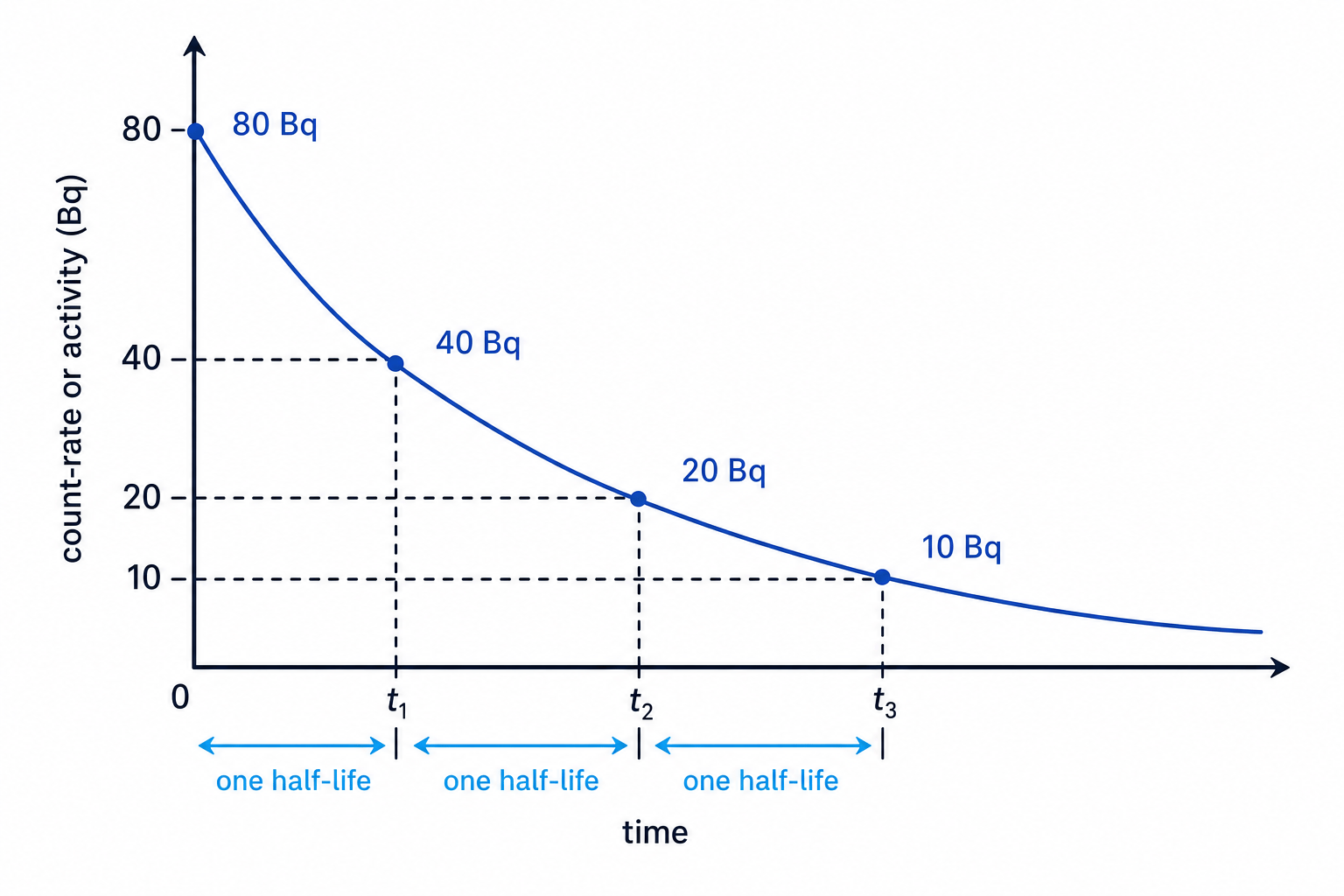
The half-life of a radioactive isotope is the time taken for the number of unstable nuclei in a sample to halve. It is also the time taken for the activity or count-rate to fall to half its initial value.
A graph of radioactive decay shows repeated halving: 80 Bq to 40 Bq to 20 Bq to 10 Bq, with each equal time interval being one half-life.
Determining half-life from count-rate
A sample’s count-rate falls from 640 Bq to 80 Bq in 240 s. Find the half-life.
- Work out how many halvings have happened: 640 Bq to 320 Bq to 160 Bq to 80 Bq is three half-lives.
- The total time of 240 s covers three half-lives.
- Divide the total time by the number of half-lives: 240 s3=80 s\frac{240\ \text{s}}{3} = 80\ \text{s}3240 s=80 s.
This bit is Higher Tier only: after each half-life, the remaining emission is multiplied by one half.
Calculating the remaining ratio after half-lives
A source is left for four half-lives. Find the ratio of final activity to initial activity.
- Each half-life halves the activity, so after four half-lives the fraction remaining is (12)4\left(\frac{1}{2}\right)^4(21)4.
- Calculate the fraction: (12)4=116\left(\frac{1}{2}\right)^4 = \frac{1}{16}(21)4=161.
- Therefore the final activity is 1:16 of the initial activity, meaning it has decreased by a factor of 16.
Half-life does not mean the source is finished
After one half-life, half the unstable nuclei remain. After two half-lives, a quarter remain. The activity keeps decreasing, but it does not suddenly become zero.
6. Contamination and irradiation
Radioactive contamination is the unwanted presence of materials containing radioactive atoms on other materials. The contaminating atoms decay, so the contaminated object can keep giving out radiation.
Irradiation is the process of exposing an object to nuclear radiation. The object has been hit by radiation, but it has not had radioactive atoms transferred to it.
Contamination versus irradiation
Contamination means radioactive material is present where it should not be. Irradiation means radiation has reached the object, but the object does not become radioactive.
The hazard from contamination depends on the type of radiation emitted. Alpha contamination is especially dangerous if swallowed or breathed in, because alpha radiation is strongly ionising inside the body. Gamma radiation is more of an external hazard because it can penetrate through the body.
Comparing contamination and irradiation
A medical syringe is sterilised using gamma radiation, while a lab coat gets radioactive dust on it. Compare the hazards.
- The syringe has been irradiated because radiation has passed through it, but no radioactive atoms have been transferred to it.
- The lab coat is contaminated because radioactive dust is present on it, so it can keep emitting radiation until the dust is removed or decays.
- The syringe is safe once removed from the radiation source, but the contaminated coat must be handled carefully and cleaned or stored safely.
Protecting against radiation
Use the ideas of time, distance and shielding: spend less time near the source, keep further away, and use suitable shielding such as paper, aluminium, lead or concrete depending on the radiation type.
Studies into the effects of radiation on humans should be published and shared with other scientists. This allows peer review, where other scientists check the methods, evidence and conclusions.
In the exam
- For nuclear equations, balance the top numbers and bottom numbers separately; remember beta has a bottom number of -1.
- For half-life questions, keep halving the activity or count-rate until you reach the given value, then link the number of halvings to the time.
- For radiation uses and hazards, compare ionising power, penetration, range in air, and whether the situation involves contamination or irradiation.
Check yourself
- Why does beta decay increase the atomic number but leave the mass number unchanged?
- Which radiation would be most suitable for monitoring the thickness of aluminium foil, and why?
- A sample’s count-rate falls from 400 Bq to 50 Bq in 180 s. What is its half-life?
