The hypothalamus
Definition
Hypothalamus
A small region deep in the brain that keeps the body's internal conditions steady and houses the body clock that times the sleep-wake cycle.
- The hypothalamus is a small region deep in the brain, sitting below the thalamus and just above the brainstem.
- Its job is to keep the body's internal conditions steady, controlling temperature, hunger, thirst and the release of several hormones.
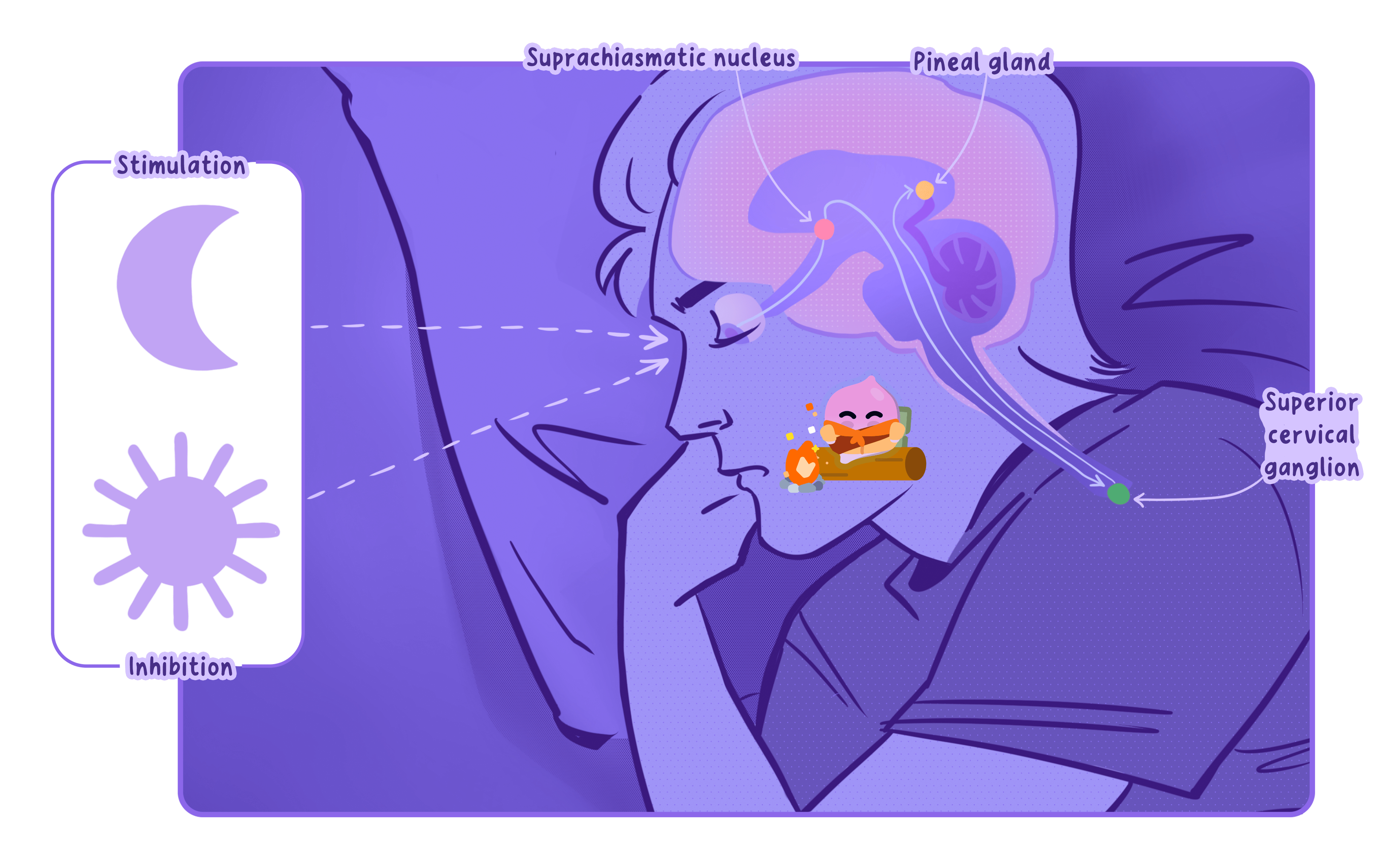
- Timing is one of those jobs, because the hypothalamus houses the body's master clock, the suprachiasmatic nucleus.
- That clock sets when you feel sleepy and when you feel alert, so sleep depends on it running properly.
Key Idea
- The hypothalamus holds the suprachiasmatic nucleus, the clock that times sleep using the light that reaches the eyes.
- Damage to that region destroys clock cells or cuts the pathway carrying light information to them, so sleep is no longer tied to darkness.
- Melatonin then arrives at the wrong times, and sleep comes in short stretches spread across the 24 hours instead of one block at night.
The three main divisions of the brain
Definition
Cerebrum
The largest of the brain's three main divisions, split into two hemispheres, which deals with thinking, language, personality and voluntary movement.
- The cerebrum is the largest of the three divisions, split into two hemispheres, dealing with thinking, language, personality and voluntary movement.
- The hypothalamus lies deep inside this part of the brain, well below the folded outer surface.
- The cerebellum is tucked underneath at the back, handling balance, posture and the coordination of movement.
- The brainstem is the stalk joining the brain to the spinal cord, controlling breathing, heart rate and levels of arousal.
- The pons sits in the brainstem, and it fires the random signals behind dreaming.
Note
- The divisions matter here because they place the timing of sleep deep inside the cerebrum, a long way from the brainstem structures active during a dream.
- An injury does not respect those boundaries, so damage near the hypothalamus usually reaches neighbouring tissue as well.
How the body clock times sleep
Definition
Suprachiasmatic nucleus (SCN)
A tiny region in the brain's hypothalamus that acts as the body's master clock, using light information from the eyes to control the sleep-wake cycle.
- Light entering the eyes travels along a nerve pathway from the retina to the suprachiasmatic nucleus.
- The clock uses that light information to work out what time of day it is outside.
- As light fades in the evening, the clock signals the pineal gland to release melatonin.
- Rising melatonin lowers alertness, so sleep starts at roughly the same time each night.
- Morning light switches that signal off, so alertness climbs again and you wake.
- The cycle runs to roughly 24 hours, and the light information is what keeps it locked to the outside day.
Note
- With no light information reaching it the clock runs slightly longer than 24 hours, so it needs that daily cue to stay in step with the outside day.
- A cut light pathway therefore shows up as sleep drifting later day by day rather than as sleep stopping.
- The clock sets when sleep happens, and the stages inside a night are a separate matter.
Neurological damage to the hypothalamus
- Neurological damage means physical damage to brain tissue, caused by a head injury, a stroke, a tumour or an infection.
- Damage to the hypothalamus can destroy cells of the suprachiasmatic nucleus, or cut the pathway carrying light information to it.
- The clock then loses its link with the outside day, so it can no longer time sleep to darkness.
- Melatonin is released at the wrong times, or its daily rhythm flattens out, so the signal to sleep is weak or badly timed.
- Sleep and waking then drift, so the person may sleep through the afternoon and lie awake for most of the night.
- Sleep is also broken into short stretches spread across the 24 hours instead of one long block at night, so it restores far less.
- Because the hypothalamus also controls temperature and appetite, damage there usually disturbs those too.
- Most of what is known here comes from case studies of individual patients with damage in that region, whose sleep and waking no longer follow the day.
Common Mistake
- The clock sits in the hypothalamus, and the pineal gland is the part that releases melatonin when that clock tells it to.
- This is not ordinary insomnia, because no change to the bedroom or the bedtime routine can repair a damaged clock.
Turning this into marks
- When two effects on sleep are asked for, make them genuinely separate, so badly timed sleep and sleep broken into short stretches count as two.
- Name the suprachiasmatic nucleus inside the hypothalamus, because writing that the brain's clock is damaged does not secure the knowledge mark.
- The mark most often lost is saying that sleep is disrupted without tracing the chain from the damaged clock to badly timed melatonin.
Self review
- What does the hypothalamus do, apart from timing sleep?
- Which body clock sits inside the hypothalamus, and what information does it use?
- Name the brain's three main divisions.
- Explain the chain from damaged hypothalamus to badly timed sleep.
- Give two ways such damage changes a person's sleep pattern.
