What a hypothesis is
Definition
Hypothesis
A clear, testable prediction of what a study expects to find, written before the data is collected.
- A hypothesis is a precise, testable prediction of what a study will find.
- It is written before any data is collected, working from the aim of the study.
- The aim is the general purpose, such as finding out whether background music affects recall.
- The hypothesis turns that aim into a prediction specific enough to be shown wrong.
- Both variables are operationalised, which means saying exactly how each one is set up or measured.
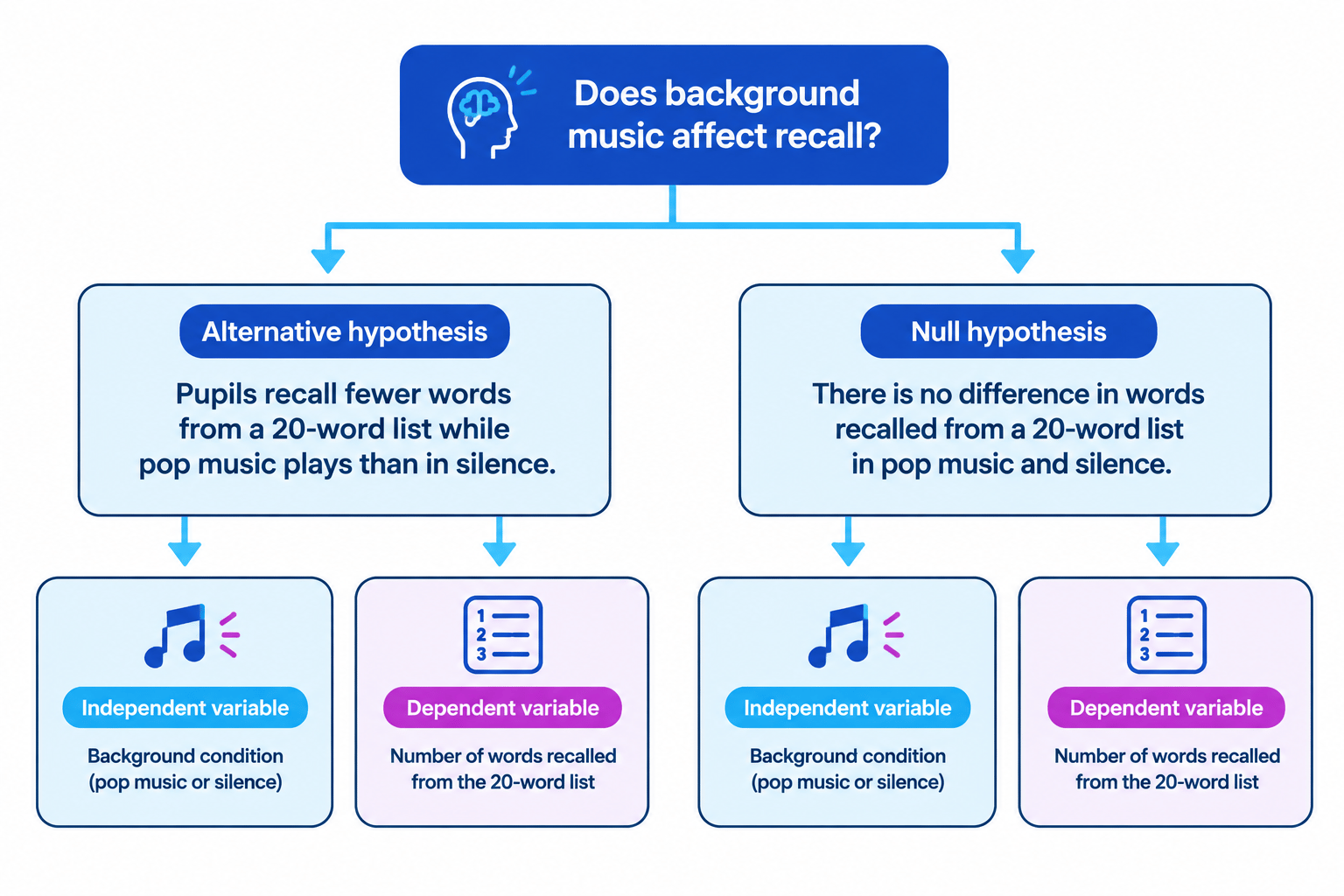
- An operationalised prediction reads "people recall fewer words from a 20-word list while pop music plays than in silence".
- Every study carries two hypotheses: the alternative and the null.
Key Idea
- A hypothesis has to be specific enough to be shown wrong, so "music affects memory" is not one while "pupils recall fewer words from a 20-word list with pop music playing than in silence" is.
- Every study is written with a pair of hypotheses, and the data decides which of the two is accepted.
- Operationalising both variables is what makes the prediction testable, because it fixes the exact task set and the exact score recorded.
The alternative hypothesis
Definition
Alternative hypothesis
A precise, testable prediction that there will be a difference between conditions or a relationship between variables. It is sometimes called the research or experimental hypothesis.
- The alternative hypothesis predicts that a real pattern will show up in the data.
- It claims the difference or the relationship is produced by the variables being studied.
- It is also called the research hypothesis or the experimental hypothesis.
- When the results show the predicted pattern, the alternative hypothesis is accepted and the null hypothesis is rejected.
The null hypothesis
Definition
Null hypothesis
A prediction that there will be no difference between the conditions, or no relationship between the variables, and that any pattern in the results is down to chance.
- The null hypothesis states that there will be no difference between the conditions, or no relationship between the co-variables.
- Any small gap left in the numbers is put down to chance rather than to the independent variable.
- When the results show no clear pattern, the null hypothesis is accepted and the alternative hypothesis is rejected.
Example
- Alternative: "Pupils recall more words from a 20-word list in silence than with pop music playing."
- Null: "There is no difference in the number of words pupils recall from a 20-word list in silence and with pop music playing."
- The pair name the same two variables and the same measure, so only the predicted outcome changes.
Predicting differences, correlations and no patterns
- Predicting a difference is used when two conditions or two groups are compared.
- The prediction names both conditions and says which one scores higher on the measured outcome.
- One example is "pupils who revise with a quiz score higher on a 20-word spelling test than pupils who reread their notes".
- Difference hypotheses belong with experiments, where an independent variable is manipulated and a dependent variable is measured.
- Predicting a correlation is used when two co-variables are measured in the same people.
- The prediction names both co-variables and which way the link runs.
- A positive prediction reads "the more hours of sleep a pupil has, the higher their score on a 20-mark maths test".
- A negative prediction reads "the more hours a pupil spends on a phone after midnight, the lower their score on a 20-mark maths test".
- A correlation hypothesis predicts a link between the two co-variables, and does not claim that one produces the other.
- Predicting no pattern is the null hypothesis written for the same study.
- For a difference study it reads "there is no difference in spelling scores between pupils who revise with a quiz and pupils who reread their notes".
- For a correlation study it reads "there is no relationship between hours of sleep and score on a 20-mark maths test".
Directional and non-directional predictions
Definition
Directional hypothesis
An alternative hypothesis that states which way the results will go, for example which condition will score higher or whether a correlation is positive or negative.
- A directional prediction states which way the result will go, such as which condition scores higher or whether a correlation is positive or negative.
- A non-directional prediction states that the two conditions will differ on the measured outcome.
- Both are forms of the alternative hypothesis, so each one is paired with the same null hypothesis.
Note
- Which form to use is decided by what earlier findings suggest, so a prediction only states a direction where there is a reason to expect one.
- Where nobody has tested the two conditions before, the prediction says the conditions will differ without naming which one scores higher.
- A directional prediction that comes out the other way round is not supported, even though the data does show a difference.
Strengths and weaknesses of a precise hypothesis
- A hypothesis that operationalises both variables tells another researcher exactly what to repeat, which makes a check on reliability possible.
- A fixed measure, such as words recalled from a set 20-word list, means two researchers marking the same participant reach the same score.
- Naming the measure forces the question of whether it captures the behaviour being studied, which is a question about validity.
- "Measures memory" could mean recognition, free recall or how long something is held, so a result based on it can be read three ways.
- Because the prediction is written down before the data comes in, a result in the opposite direction counts against it.
- One weakness is that the prediction narrows what is looked at, so an unexpected pattern in the data is easy to walk past.
- A weakness of a correlation hypothesis is that a strong link can still be produced by a third variable that was never measured.
- A weakness of a difference hypothesis is that it predicts the outcome without saying why the two conditions differ.
Common Mistake
- A hypothesis is a prediction, so an aim or a question written in its place cannot be tested.
- "Affects memory" leaves the variable vague, because it never says what was counted.
- The null predicts no difference and no relationship, not that the opposite will happen.
Writing a hypothesis for a given study
- Name the two things the investigation compares or links.
- Decide whether the study looks for a difference between conditions or a relationship between co-variables.
- Write the alternative hypothesis as one full sentence, naming both variables and how each one is measured.
- Turn that same sentence into the null by replacing the predicted pattern with "no difference" or "no relationship".
- Match the rest of the plan to it, so the people tested, the task set and the score recorded all fit the prediction.
- When the study is already described, work its hypothesis out from the aim given in that description.
Note
- Not every piece of research is built around a prediction, and an interview or an observation that sets out to explore a topic can work from an aim alone.
- A hypothesis is needed once the study sets up conditions to compare or co-variables to measure, because only then is there a specific outcome to predict.
Turning this into marks
- When both hypotheses are asked for, write the alternative and the null as two separate full sentences rather than one sentence with "not" added.
- Name the measure, such as words recalled from a 20-word list, because "affects memory" does not secure the knowledge mark.
- State which condition scores higher when the prediction is directional, because a sentence that only says the groups differ answers a different question.
- The mark most often lost is writing the null as the opposite prediction instead of as no difference or no relationship.
Self review
- What does a null hypothesis predict?
- What does it mean to operationalise a variable in a hypothesis?
- Write an alternative hypothesis predicting a correlation between hours of sleep and maths test score.
- Write the null hypothesis for a study comparing recall in silence and with music.
- Why does a vague hypothesis weaken the validity of a study?