Definition
Psychotherapy
Treatment for a mental health condition that works through structured conversation with a trained therapist rather than through medication.
- Psychotherapy treats mental health conditions through structured conversation with a trained therapist rather than through medication.
- Cognitive behaviour therapy, or CBT, works on the here and now, changing unhelpful thoughts and the behaviours tied to them.
- Longer-term psychotherapy takes a wider view, exploring feelings and past experiences to work out where the difficulties began.
- In the UK most people are offered CBT first through NHS Talking Therapies, usually somewhere between six and twenty weekly sessions.
- Therapy is used for both clinical depression and schizophrenia.
Key Idea
- A talking therapy reduces symptoms by changing what a person thinks and does, without acting on the synapse at all.
- In CBT the person identifies an unhelpful thought, tests it against the evidence, and then takes on a task that supplies new evidence.
- For depression that works directly on the irrational beliefs of the ABC model, and for schizophrenia it sits alongside medication.
How CBT works
Definition
CBT
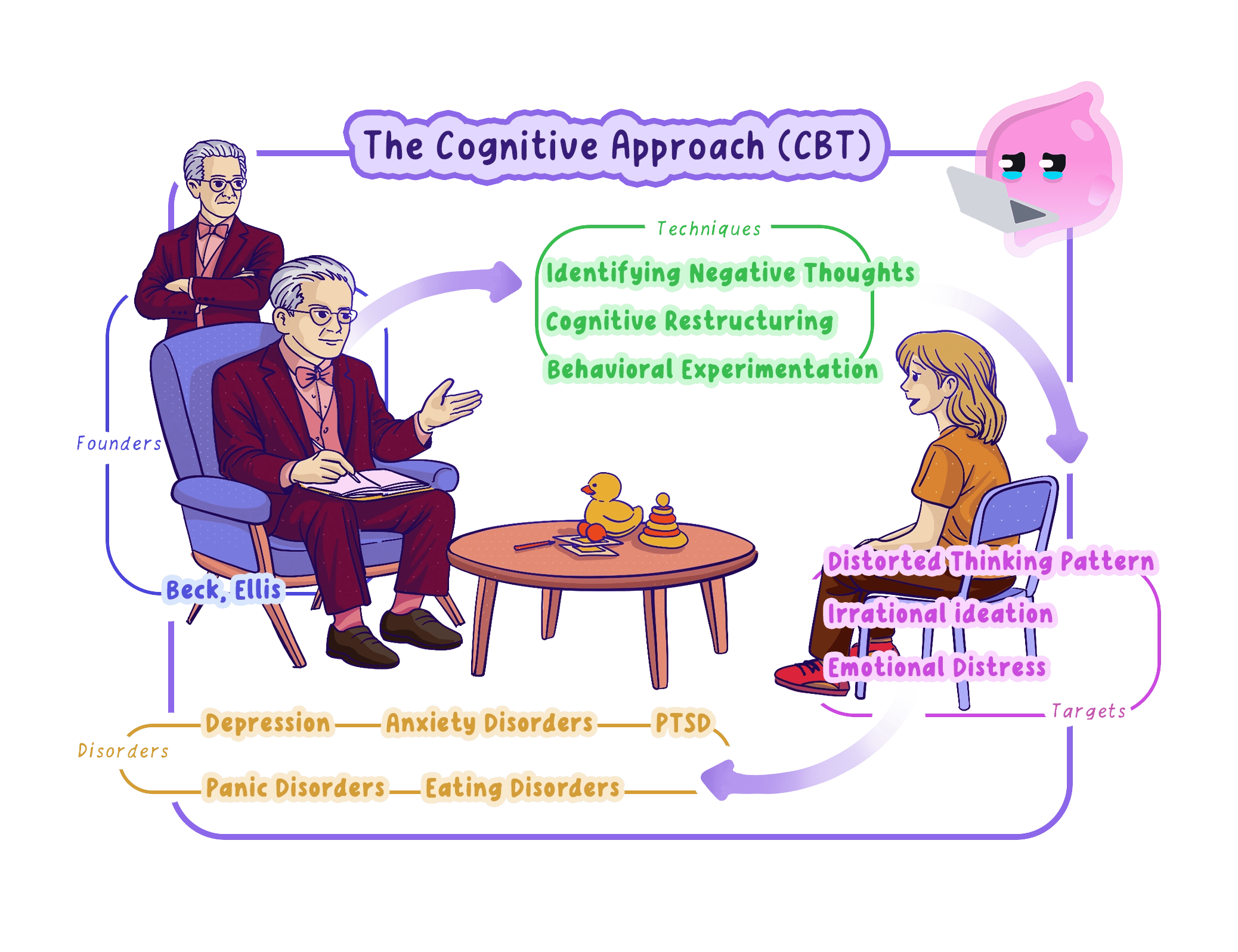
Cognitive behaviour therapy, a talking therapy that helps a person identify and change the unhelpful thoughts that drive their distress, so that their behaviour and feelings can change too.
- The therapist first helps the person identify the negative automatic thoughts that fuel low mood or distress, often by recording them in a thought diary between sessions.
- Therapist and client then challenge each thought, weighing the evidence for and against it.
- A belief that the evidence does not support is replaced with a more realistic one.
- The client is then set behavioural tasks, such as gradually facing an avoided situation or restarting an activity they had dropped.
- Carrying out the task supplies new evidence, which weakens the original thought further.
- As the unhelpful thoughts are replaced, mood lifts and the symptoms ease.
Example
- Someone with depression might hold the irrational belief that they always fail.
- In CBT they list the evidence, notice the passes and successes they had discounted, and adjust the belief.
- They then agree one task for the week, such as going back to football training, and the result tests the belief in real life.
Longer-term psychotherapy
- Psychotherapy gives a person space to talk through emotions and experiences, often from earlier in their life.
- The therapist helps them find links between those past experiences and how they feel and behave now.
- Gaining that insight is thought to relieve distress and to change how the person relates to other people.
- It works on causes, so it usually runs for months or years.
- For some conditions it works best combined with medication.
- Group therapy and family therapy count as psychotherapy too, and family work is common in schizophrenia.
Note
- Most people in the UK are offered CBT first, because a course of it is short and the evidence for it is the strongest.
- Family therapy belongs here as well, and its target is the level of stress and criticism at home rather than one person's thoughts.
Psychotherapy for clinical depression
- Therapy challenges the irrational beliefs of the ABC model and builds more realistic ways of thinking, which lifts mood.
- Since the ABC model is the psychological explanation of depression, therapy is treating what the model says causes it.
- Behavioural activation helps a person re-engage with the activities, work and relationships they had withdrawn from.
- Re-engaging brings back small rewards, which lifts mood again and makes the next step easier.
- The person also keeps the skill of spotting and challenging a belief once the sessions end, which lowers the risk of relapse.
Psychotherapy for schizophrenia
- For schizophrenia, therapy is used alongside medication.
- CBT for psychosis helps a person question a distressing belief, such as being followed, by weighing the evidence for and against it.
- It teaches coping strategies for hearing voices, such as distraction, or answering them, or having a plan for when they are loud.
- The person learns to recognise their own early warning signs of relapse, so support can start sooner.
- Family therapy lowers stress and criticism at home, and it is linked to fewer relapses.
- Across both conditions the aim is improved mental health, meaning less distress, better daily functioning and more support from other people.
Example
- A person with schizophrenia might work with a therapist to test the belief that strangers are watching them, by checking how often it turns out to be true.
- They would also agree a plan for the days when the voices are loud, such as ringing a named person or putting on a playlist.
- Recovery here means living the life they want alongside the condition, and many people do.
Strengths of psychotherapy
- Strength, no physical side effects: talking therapies avoid the side effects that medication can bring.
- Strength, treats causes: they work on thoughts, feelings and circumstances, so they can address why the condition started.
- Strength, lasting skills: what the person learns stays with them after treatment ends, which lowers the relapse rate.
Common Mistake
- CBT works on the thoughts a person is having now, and longer-term psychotherapy works on the underlying causes.
- For schizophrenia, therapy is used alongside medication rather than in place of it.
Weaknesses of psychotherapy
- Weakness, time and effort: they need weeks or months of active work, so they suit someone in acute crisis far less well than medication does.
- Weakness, the relationship: success depends heavily on trust between the person and their therapist, and that does not always build.
- Weakness, access: UK waiting lists can be long, and for schizophrenia medication is usually needed as well.
Note
- Neither approach rules the other out, and many people get the best outcome from a talking therapy and medication together.
- A long wait for therapy is a limit on how services are funded rather than a limit on the therapy itself.
Turning this into marks
- When a strength and a weakness are both asked for, make them genuinely separate rather than one point rephrased.
- Name CBT and the step involved, such as challenging a negative automatic thought, because a general reference to talking about problems does not secure the knowledge mark.
- The mark most often lost is describing therapy in general terms without saying which condition it is being used for.
Self review
- What does CBT target, and what are the main steps of a session?
- How does longer-term psychotherapy differ from CBT?
- How does psychotherapy improve mental health for a person with clinical depression?
- Name three things therapy does for a person with schizophrenia.
- Give one strength and one weakness of talking therapies compared with drugs.
