Neuropsychology
Definition
Neuropsychology
The study of how the brain and its workings are linked to behaviour and mental processes such as memory.
- Neuropsychology studies how the structure and activity of the brain link to behaviour and mental processes.
- It gives psychologists a way to investigate schizophrenia and clinical depression from a biological angle.
- The two methods are neuropsychological tests and brain imaging techniques.
Key Idea
- There are two tools here: a standardised test that measures one thinking skill, and a scan that shows the brain's structure or its activity.
- Using them together links a low score on a task to the area that would normally do that work, as Daniel and colleagues did with card sorting and prefrontal blood flow.
- Both tools describe patterns across groups, so neither of them diagnoses a condition on its own.
The development of neuropsychology
- The earliest evidence came from people with brain injuries, whose lost abilities showed what the damaged area had been doing.
- Post-mortem examination came next, so a brain could be compared with the behaviour recorded during that person's life.
- Both approaches needed damage or death, so nothing could be learned about a healthy living brain at work.
- Standardised tests then made it possible to measure one thinking skill in a living person and compare their score with typical scores.
- Brain imaging from the 1970s onwards, beginning with CT, added pictures of the living brain, and functional scanning later showed which parts were working during a task.
- Schizophrenia and clinical depression can therefore now be studied in living people, during ordinary thinking, without waiting for injury or death.
Note
- Injury and post-mortem evidence came from a small number of unusual cases, which is why findings from that era are hard to generalise.
- Imaging did not replace the earlier methods, because a scan is still read against what damaged brains had already shown.
Neuropsychological tests
Definition
Neuropsychological test
A standardised task that measures one mental ability, such as memory, attention or planning, so that a person's score can be compared with typical scores and linked to how their brain is working.
- A neuropsychological test is a standardised task that measures a specific mental ability such as memory, attention or problem-solving.
- Standardising it means every person does the same task in the same way, so their scores can be compared fairly.
- Comparing a person's score with the typical score for their age shows up difficulties linked to a condition.
- The Wisconsin Card Sort Test measures the planning and strategy-switching that the frontal lobes handle.
- People with schizophrenia often score poorly on it, which points to frontal lobe dysfunction.
- In clinical depression, tests often show slowed thinking, poorer concentration and weaker memory, which matches the ICD characteristics.
- Because the tasks are standardised, the results are objective and quantitative.
Example
- A researcher might read out a list of fifteen words and ask the person to recall as many as they can.
- That score is then set against the average for the same age group.
- Consistently lower recall would point to a cognitive difficulty that goes with the condition.
Brain imaging techniques
- Structural scans such as CT and MRI produce detailed images of the brain, showing its size, its shape and any damage.
- Functional scans such as fMRI, PET and SPECT show which areas are active, by tracking blood flow while a person carries out a task.
- Blood flow works as the measure because a working area of brain needs more oxygen, so more blood is sent to it.
- In schizophrenia, scans may show enlarged ventricles, a smaller hippocampus or reduced activity in the frontal lobes.
- Over-activity in the temporal lobes has also been reported, and it is associated with hallucinations and disordered thinking.
- In clinical depression, imaging may show differences in activity in the areas involved in mood, and reduced hippocampal volume where depression has lasted for years.
- Daniel et al. (1991) paired a SPECT scan with the Wisconsin Card Sort Test, so a scan and a test were used together in one study.
- A scan is a snapshot, so its findings describe patterns across a group.
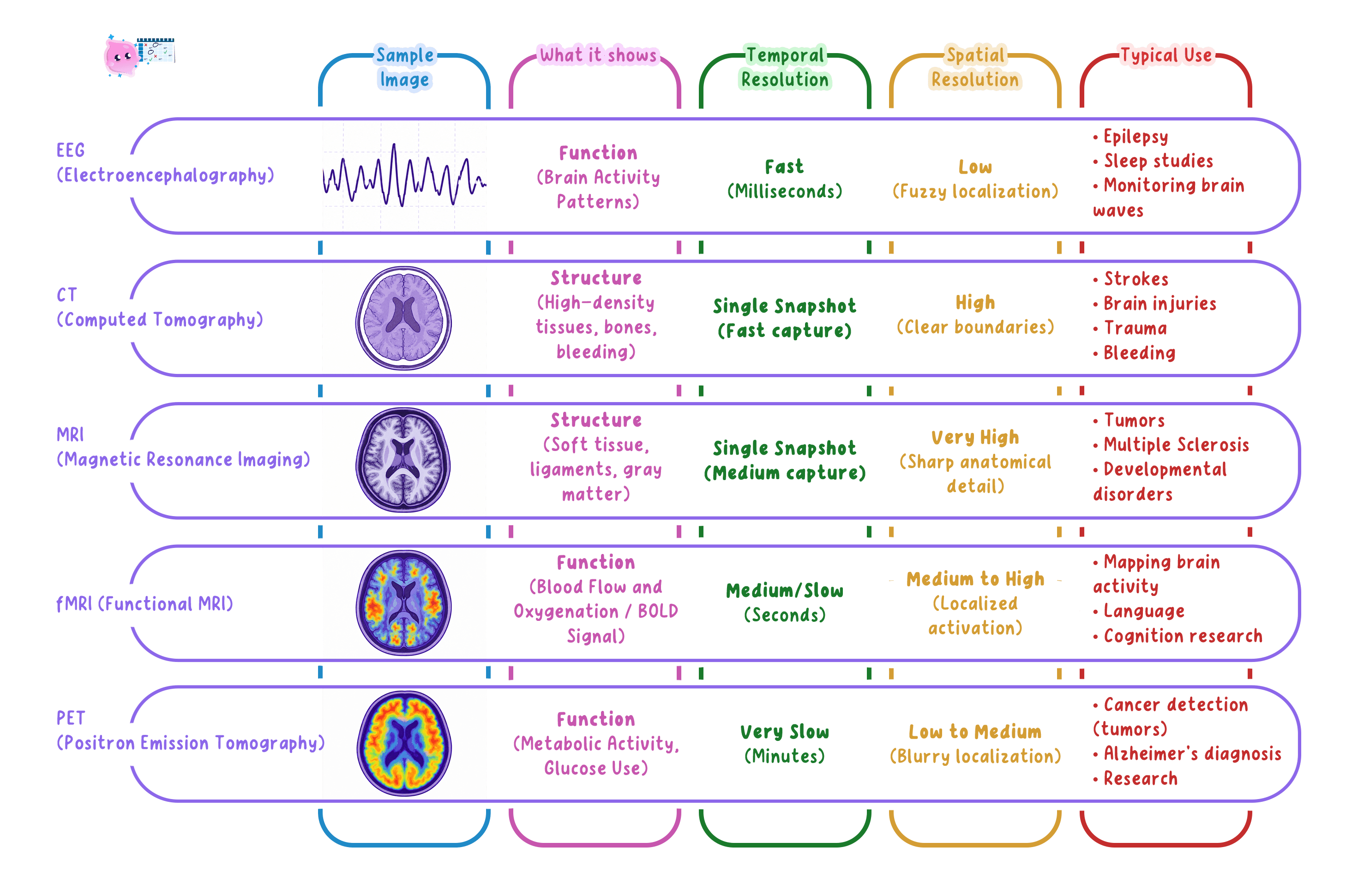
Note
- A functional scan measures blood flow rather than thought, so it shows where the work is happening rather than what a person is thinking.
- Findings such as reduced hippocampal volume tend to appear where depression has lasted for years, so they may be a consequence of the condition.
Strengths of these techniques
- Strength, objectivity: tests and scans give measurable, quantitative data.
- Strength, safety: imaging is non-invasive, so a living brain can be studied without surgery.
- Strength, practical use: a scan can rule out a physical cause such as a tumour, and repeated tests can track whether a treatment is helping.
Common Mistake
- A scan usually shows an association between a brain difference and a condition, not the cause of it.
- Depression and schizophrenia are diagnosed in the UK using the ICD, not by a brain scan.
Weaknesses of these techniques
- Weakness, correlation: a difference in the brain may be a result of the condition, or of long-term medication, rather than its cause.
- Weakness, overlap: many of these findings turn up in people without the condition too, so a scan cannot diagnose depression or schizophrenia by itself.
- Weakness, a narrow focus: looking only at biology misses social and psychological factors, so these techniques work best alongside other evidence.
Turning this into marks
- When two techniques are asked for, make them genuinely separate: a neuropsychological test measures thinking, and a scan shows the brain.
- Name the technique, such as the Wisconsin Card Sort Test or an fMRI scan, because a general reference to brain research does not secure the knowledge mark.
- The mark most often lost is treating a scan as a way of diagnosing schizophrenia or depression.
Self review
- What is neuropsychology, and name the main stages of its development.
- What does the Wisconsin Card Sort Test measure, and what do low scores suggest?
- What is the difference between a structural and a functional scan?
- Give one imaging finding in schizophrenia and one in clinical depression.
- Why can imaging not establish the cause of a condition?
