Defining mental health
Definition
Mental health problem
A mental health problem is a condition that affects a person's thoughts, feelings or behaviour strongly enough to make everyday life harder. Depression and anxiety disorders are common examples.
- Mental health is a person's emotional and psychological wellbeing, and it shapes how they think, feel and cope with daily life.
- The positive definition treats good mental health as the ability to handle the ordinary ups and downs of life.
- A second definition works from absence, so a mental health problem is a difficulty serious enough to disrupt everyday functioning.
- Wellbeing names the healthy end of that picture, where a person feels able to cope and take part in life.
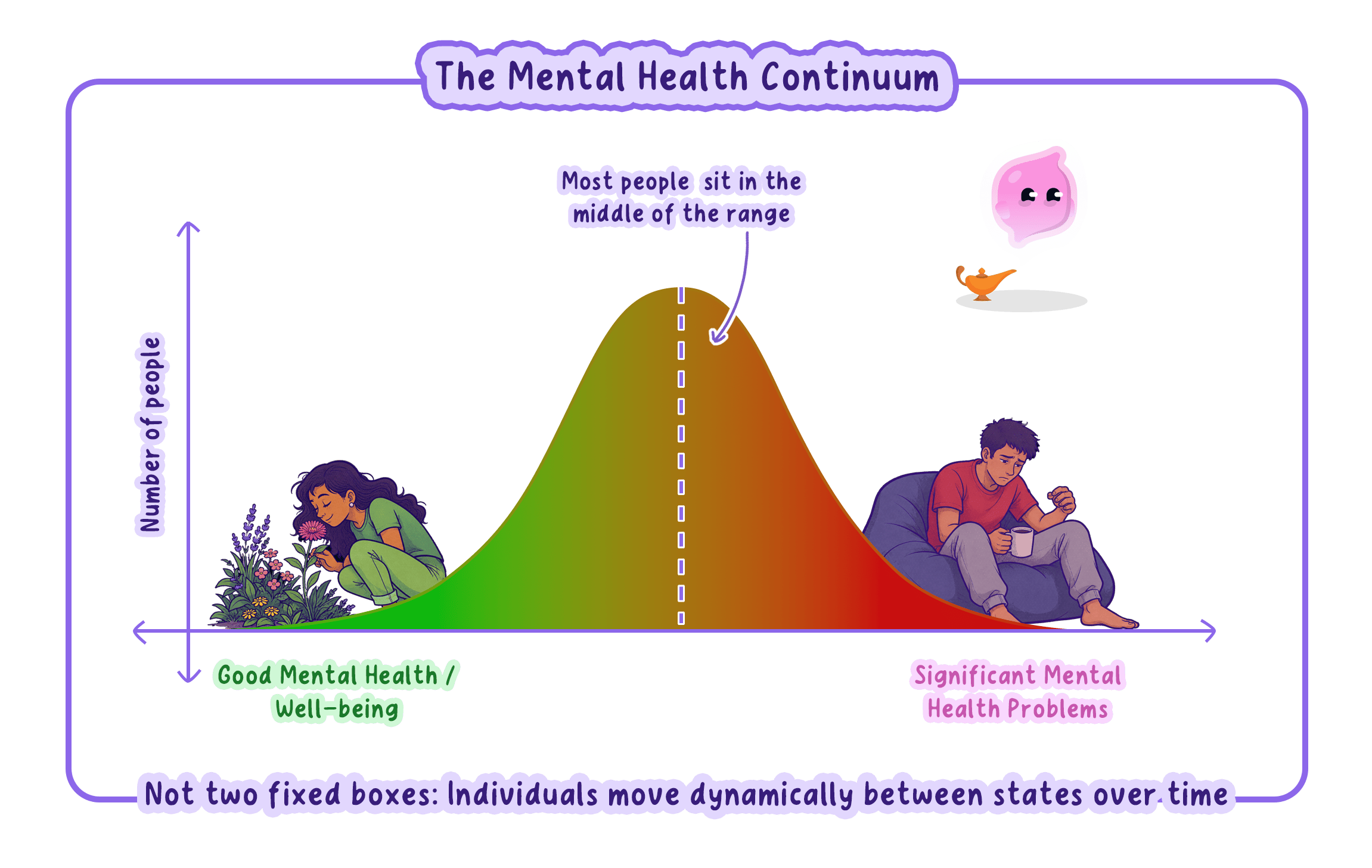
- Both definitions place people on a single scale, which is the idea behind the mental health continuum.
Key Idea
- Mental health sits on a single scale, and every person is somewhere on that scale at any moment.
- A person's position moves as stress, circumstances and support change, and it moves in both directions.
- Survey estimates suggest that roughly one in six adults in England reports a common problem such as anxiety or depression in any given week.
Signs of good mental health
- A person with good mental health engages positively with the people around them and keeps up friendships and family ties.
- They cope with everyday challenges such as a tight deadline or a difficult day.
- They can recognise their emotions and manage them.
- They recover after setbacks, which psychologists call resilience.
Example
- Picture a student in the run-up to GCSEs who feels nervous, plans their revision, talks to friends and asks a teacher for help.
- That steady coping sits near the wellbeing end of the continuum.
The mental health continuum
- The mental health continuum is a scale running from strong wellbeing at one end to significant mental health problems at the other.
- Everyone sits somewhere on the continuum at any given time.
- A person can move along the continuum as their circumstances and their support change.
- A stressful period can shift someone towards the problem end, and rest, treatment and support can move them back.
- Recovery is a normal outcome, and NHS talking therapy services report that around half of the people who finish a course of treatment recover.
Example
- Physical fitness works in a similar way, because most people sit somewhere between the two extremes.
- A person's position can change from one month to the next as their habits and circumstances change.
The prevalence of mental health problems
Definition
Prevalence
How common a condition is in a population, given as the number or proportion of people who have it at a particular time.
- Mental health problems are common, and many people who experience one recover with treatment or support.
- The charity Mind estimates that around one in four people in England experiences a mental health problem each year.
- The NHS Adult Psychiatric Morbidity Survey finds that roughly one in six adults reports a common problem such as anxiety or depression in any given week.
- Both figures are survey estimates, so quote them as approximate.
Note
- The one in four figure covers a whole year, while the one in six figure describes a single week, so the two count over different windows.
- Both come from surveys of people who chose to take part and answered questions about themselves, which is why they are given as approximate.
Prevalence and incidence
Definition
Incidence
Incidence is the number of new cases of a condition that appear in a population over a set period, such as one year.
- Prevalence counts every current case in a population, whether it began this year or ten years ago.
- Incidence counts only the new cases that appear over a set period, such as a single year.
- A condition can have high prevalence and low incidence at the same time if people live with it for years.
Common Mistake
- Prevalence covers the total number of current cases, while incidence covers the new cases only, so the two words are not interchangeable.
- A group statistic describes the population it was measured in, so it carries no information about any individual in that population.
Differences between groups
- Age: adults aged sixteen to twenty-four report common mental health problems more often than older age groups do.
- Gender: roughly one in five women and one in eight men report a common mental health problem, and men are less likely to ask for help.
- Sexual orientation: lesbian, gay and bisexual adults report higher rates than heterosexual adults in the same survey.
- Those higher rates are linked to the discrimination and minority stress these groups experience.
- Each of these figures is an average across a whole group, so it describes the group rather than the people in it.
Example
- The NHS Adult Psychiatric Morbidity Survey asks thousands of adults in England about their mental health.
- Its size allows age groups, women and men, and people of different sexual orientations to be compared on the same measure.
Limits of the recorded figures
- Many people never seek help or a diagnosis, so recorded figures probably understate how common these problems are.
- The figures come from self-report surveys, so how willing people are to disclose shapes the numbers.
- Person-first wording, such as a person with depression, is the accepted way to describe someone with a diagnosis.
Note
- A gap in recorded rates between two groups can reflect who comes forward for help and receives a diagnosis, not only who develops a problem.
- The lower recorded rate among men is the clearest case of this, because men ask for help less often.
- Recovery is a normal outcome, so a prevalence figure describes one moment rather than a fixed state.
Turning this into marks
- When two ways of defining mental health are asked for, make them genuinely separate rather than one definition rephrased.
- Name the source of a statistic, such as Mind or the Adult Psychiatric Morbidity Survey, because an unattributed figure does not secure the knowledge mark.
- The mark most often lost is describing a difference between groups without saying which group has the higher rate.
Self review
- Give two ways of defining mental health.
- What does the mental health continuum show?
- Roughly what proportion of people in England experiences a mental health problem each year?
- How does incidence differ from prevalence?
- Name the three groups whose prevalence rates differ, and give the figure for one of them.
