What an IQ test measures
Definition
Intelligence quotient (IQ)
A standardised score that compares how well you perform on a test of reasoning, language and number with the typical performance of other people your age, scaled so that 100 is the average.
- An IQ test measures intelligence and turns it into a single score.
- IQ stands for intelligence quotient.
- The original tests worked out a child's mental age from what they could answer, divided it by their real age and multiplied by 100.
- A ten-year-old who answered as well as a typical twelve-year-old would therefore score 120.
- Tests now scale the scores directly, so that 100 is set as the average for each age group.
Key Idea
- An IQ score places you against other people your own age, with 100 fixed as the average for that age group.
- The score comes from timed problems on reasoning, language and number, so it covers those skills and stops there.
- A score can therefore be stable and comparable across schools while still giving an incomplete description of a child.
How the score is produced
- You work through problems on reasoning, language and number under timed conditions.
- Your answers are compared with the typical performance of other people the same age.
- That comparison is converted into an IQ score, with 100 marking the average.
- Because the test is standardised, everyone gets the same instructions, questions and time limits, so scores can be compared fairly.
Example
- Two Year 9 pupils in the same school sit the same reasoning test, and one scores 100 while the other scores 130.
- The first pupil is exactly average for that age, and the second scored higher than almost everyone the same age.
The spread of IQ scores
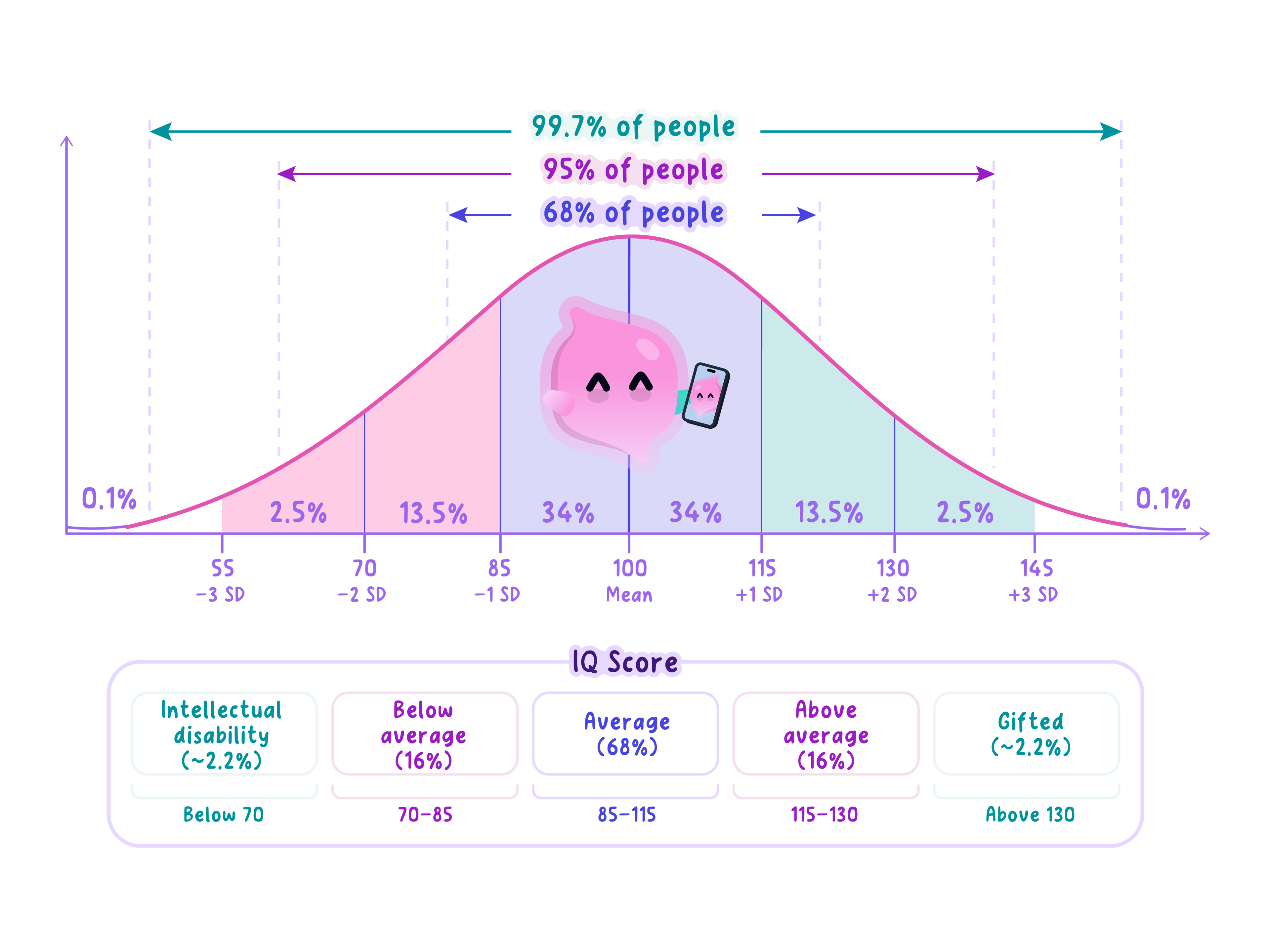
- Plot a whole population's scores and they form a normal distribution, the symmetrical bell-shaped curve.
- Most people sit close to the middle, with roughly two thirds scoring between 85 and 115.
- Very high and very low scores are rare, so 130 and above puts someone near the top of their age group.
- The middle of the curve is described with the mean, the median or the mode, and how far it stretches is described with the range.
Note
- The bell shape comes from the way the scores are scaled, because the test is built so that most people land near 100.
- Mean, median, mode and range are the same descriptive measures used for any set of results, and the curve is a clear place to see what each one tells you.
- Because the comparison is always with an age group, the same set of correct answers gives a different score at eight and at fifteen.
Strengths of IQ tests
- They are standardised, so a score of 115 means the same thing in Cardiff as it does in Manchester.
- Because the score comes from counting correct answers, the test is objective and there is less room for bias in judging ability.
- They are also reliable, since the same person tends to get a similar score when tested again.
- That makes them useful in schools for spotting a pupil who needs extra support, or one who needs stretching.
Common Mistake
- IQ is not a complete measure of how clever someone is, because it captures only a narrow slice of intelligence.
- A low score can be evidence about the test itself, such as unfamiliar vocabulary or the time limit.
Limitations of IQ tests
- IQ tests can be culturally biased, because some questions assume knowledge or vocabulary that not every group has been taught.
- They measure only certain skills, so creativity, practical ability and emotional understanding are missed entirely.
- Nerves, tiredness or not being used to tests can all drag a score down.
- Treating one number as a full measure of a developing child risks labelling them, and adults then expect less of them.
- Thinking is still maturing all through childhood, so a score taken at seven need not describe the same person at fourteen.
Note
- Reliability and validity are separate questions to ask about any test.
- An IQ test can give someone almost the same score on two occasions and still leave out most of what intelligence involves.
- Cultural bias sits in the wording and content of the questions themselves, so translating a test does not remove it.
Turning this into marks
- When a strength and a limitation are both asked for, put them on different grounds rather than one point turned around.
- Name the feature you mean, such as standardisation or cultural bias, because calling the test fair or unfair does not secure the knowledge mark.
- The mark most often lost is explaining what an IQ score is without saying that 100 is the average for the age group.
- A bell curve of IQ scores may be given to you to interpret, so be ready to name the average and describe the spread.
Self review
- What does IQ stand for, and what score is set as the average?
- How was IQ originally worked out from mental age and real age?
- Why does standardising a test let you compare scores fairly?
- Give one strength of IQ tests as a measure of intelligence.
- Give one limitation of using an IQ score to judge a developing child.
