Piaget's four stages
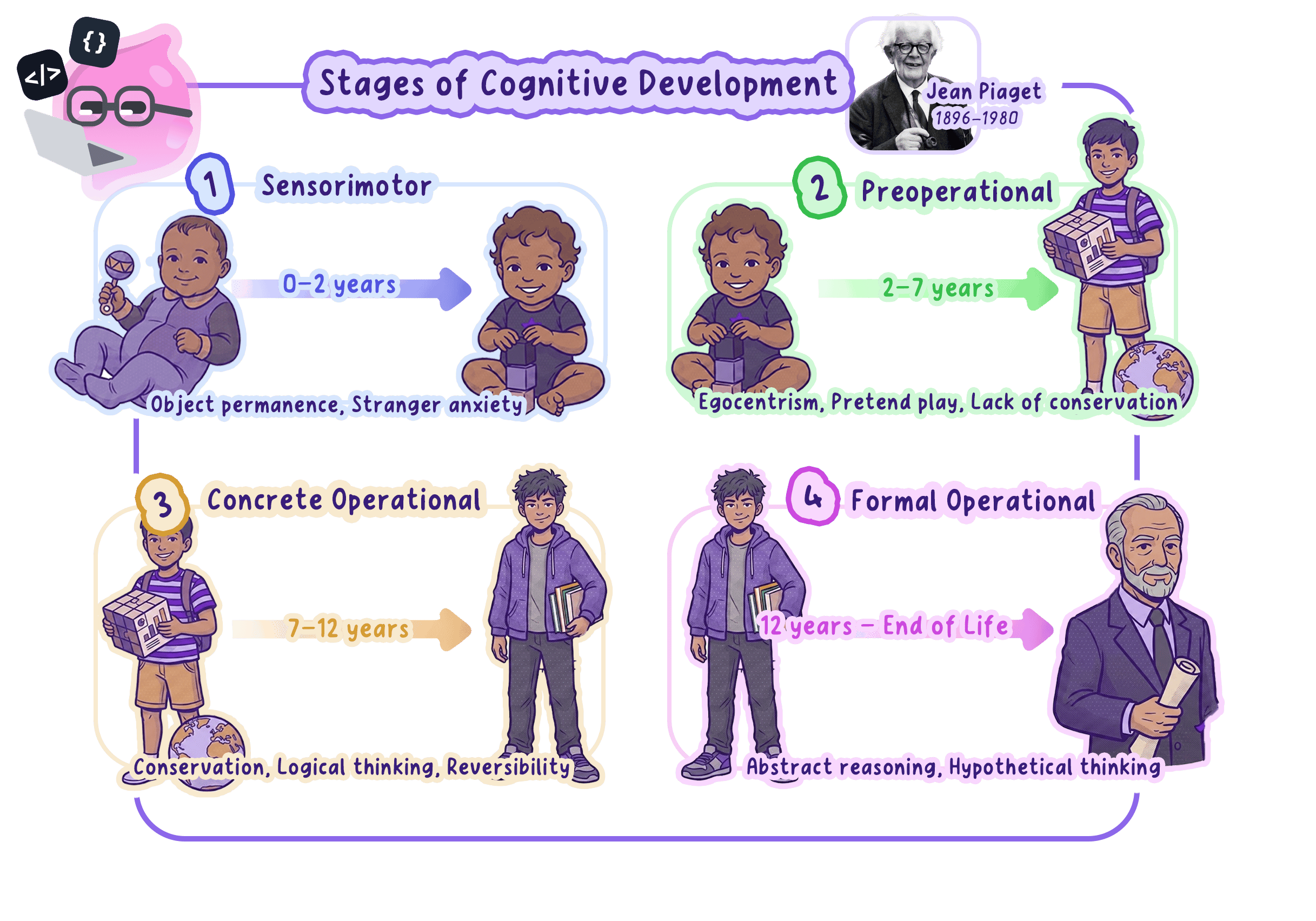
- Piaget said every child passes through four stages of cognitive development: sensori-motor, pre-operational, concrete-operational and formal operational.
- The stages are invariant, which means every child goes through them in the same fixed order.
- Piaget also called the stages universal, claiming the same four appear in the same order for children everywhere.
- No stage can be skipped, because each one is built out of the thinking developed in the stage before it.
- The shift from one stage to the next is qualitative, so a child in a new stage reasons in a way they could not before.
- The ages attached to each stage are rough guides, because children reach them at different times.
Key Idea
- Every child moves through sensori-motor, pre-operational, concrete-operational and formal operational thinking in that order.
- A stage cannot be skipped, because each one is assembled out of the thinking the child built in the stage before.
- Each move brings reasoning the child did not have before, such as searching under a blanket for a hidden toy or holding the height and the width of a glass in mind together.
What happens in each stage
Definition
Object permanence
The understanding that an object still exists even when you can no longer see, hear or touch it. Piaget argued this develops towards the end of the sensorimotor stage.
- Sensori-motor: birth to about two
- The baby explores the world through the senses and through movement, by looking, grasping, mouthing and shaking.
- Thinking is tied to whatever is physically present, so at first a hidden object is treated as gone.
- Object permanence arrives towards the end of the stage, from around eight months, when a baby will search for a toy that has been covered up.
- Pre-operational: about two to seven
- The child can now use language and other symbols, so a stick becomes a sword and a cardboard box becomes a rocket.
- Thinking is egocentric, so the child assumes you see the situation exactly as they do.
- It is also animistic, so a teddy is treated as though it has feelings.
- The child cannot yet conserve, so a change in how something looks convinces them the amount has changed.
- Concrete-operational: about seven to eleven
- The child can now think logically, as long as the problem involves real objects they can picture or handle.
- Conservation, reversibility and decentration all arrive, and animism drops away.
- Purely abstract or hypothetical problems are still beyond them.
- Formal operational: about eleven onwards
- Thinking becomes abstract, so a problem can be worked through in the head with no objects to handle.
- The young person can reason about hypothetical situations and test possibilities in an organised way.
Example
- A two-year-old, a five-year-old and a fourteen-year-old are sitting in the back of the same car.
- The toddler leans down to hunt for a dropped toy, because they know it still exists.
- The five-year-old insists the longer row of sweets has more in it.
- The fourteen-year-old argues about what would happen if the driver took a different route.
Why the order is fixed
Definition
Conservation
In Piaget's theory, understanding that the quantity of something stays the same even when its appearance changes, such as its shape or the way it is arranged.
- Conservation needs two features of a display held in mind at once, so it waits for the concrete-operational stage.
- Hypothetical reasoning is built on logical reasoning about real objects, so formal operational thinking follows concrete-operational thinking.
- Piaget put the pace down to biological maturation, so teaching cannot push a child into a stage before they are ready for it.
Note
- Later researchers using simpler, more familiar tasks found children showing conservation and perspective-taking earlier than Piaget's age ranges suggest.
- How a task is worded and set up affects when a child appears to pass it, so the ages belong to the method as much as to the child.
- These four stages describe thinking, so the physical and social changes of childhood sit outside them.
Turning this into marks
- When two stages are asked for, give each one an ability of its own rather than the same ability reworded.
- Use Piaget's own label for the stage, because writing about a five-year-old does not secure the knowledge mark for the pre-operational stage.
- The mark most often lost is giving the age range instead of the ability that defines the stage.
- Use the word invariant when a question asks why a stage cannot be skipped, and add that each stage is built on the one before.
Self review
- Name Piaget's four invariant stages in order.
- What does it mean to say the stages are invariant?
- What key ability appears towards the end of the sensori-motor stage?
- In which stage can a child first conserve?
- What kind of thinking becomes possible in the formal operational stage?
