How the brain forms before birth
Definition
Maturation
The unfolding of development according to a genetically programmed timetable, so that abilities appear in a fixed order as the body and brain grow, largely regardless of practice.
- The brain starts to form about three weeks after conception, long before birth.
- A ridge of cells folds into a hollow neural tube, and that tube becomes the brain and the spinal cord.
- Neurons are produced from the walls of the tube and then migrate to their proper place, so the layers of the brain are laid down in a set order.
- A baby is born with almost every neuron it will ever have.
Key Idea
- A baby is born with nearly all the neurons it will ever have, so development after birth is mostly a matter of the connections between them.
- A new ability appears once the structures behind it have both matured and been used.
- That is why the brainstem is already running at birth while planning and self-control arrive in the teenage years.
The nervous system
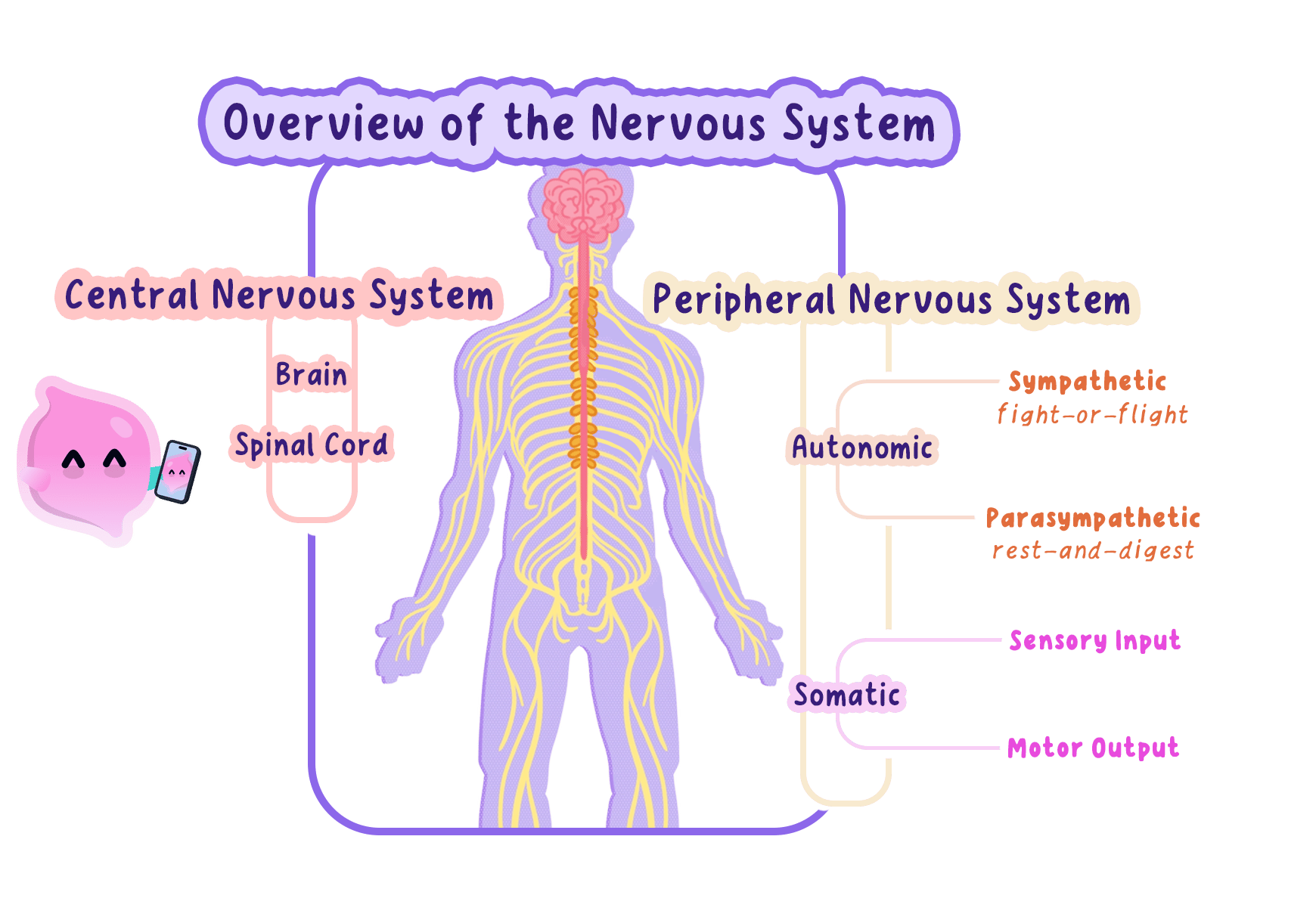
- The nervous system is the network that detects information, processes it and controls the body.
- Central nervous system: the brain and the spinal cord, where information is processed and decisions are made.
- Peripheral nervous system: the nerves branching out to the muscles, skin and organs, carrying messages in from the senses and instructions back out.
- Both divisions grow from the same early neural tissue, the walls of the neural tube.
Common Mistake
- The brain and spinal cord are always the central nervous system.
- Everything outside those two is the peripheral nervous system.
The three main divisions of the brain
- Cerebrum
- This is the large, folded outer part, and by far the biggest of the three.
- It handles thinking, memory, language, the senses and voluntary movement.
- Its sub-parts include the frontal lobe for planning and self-control, the temporal lobes for hearing and language, and the hippocampus for laying down new memories.
- Cerebellum
- This sits underneath, at the back of the brain.
- It co-ordinates balance, posture and smooth, skilled movement, so riding a bike eventually feels automatic.
- Brainstem
- This joins the brain to the spinal cord, and its sub-parts include the pons and the medulla.
- It controls automatic functions such as breathing, heart rate and arousal.
Example
- The brainstem is working from birth, so a newborn can breathe and swallow.
- The frontal lobe is still being wired through the teenage years, so planning and self-control arrive last.
Neurons and synapses
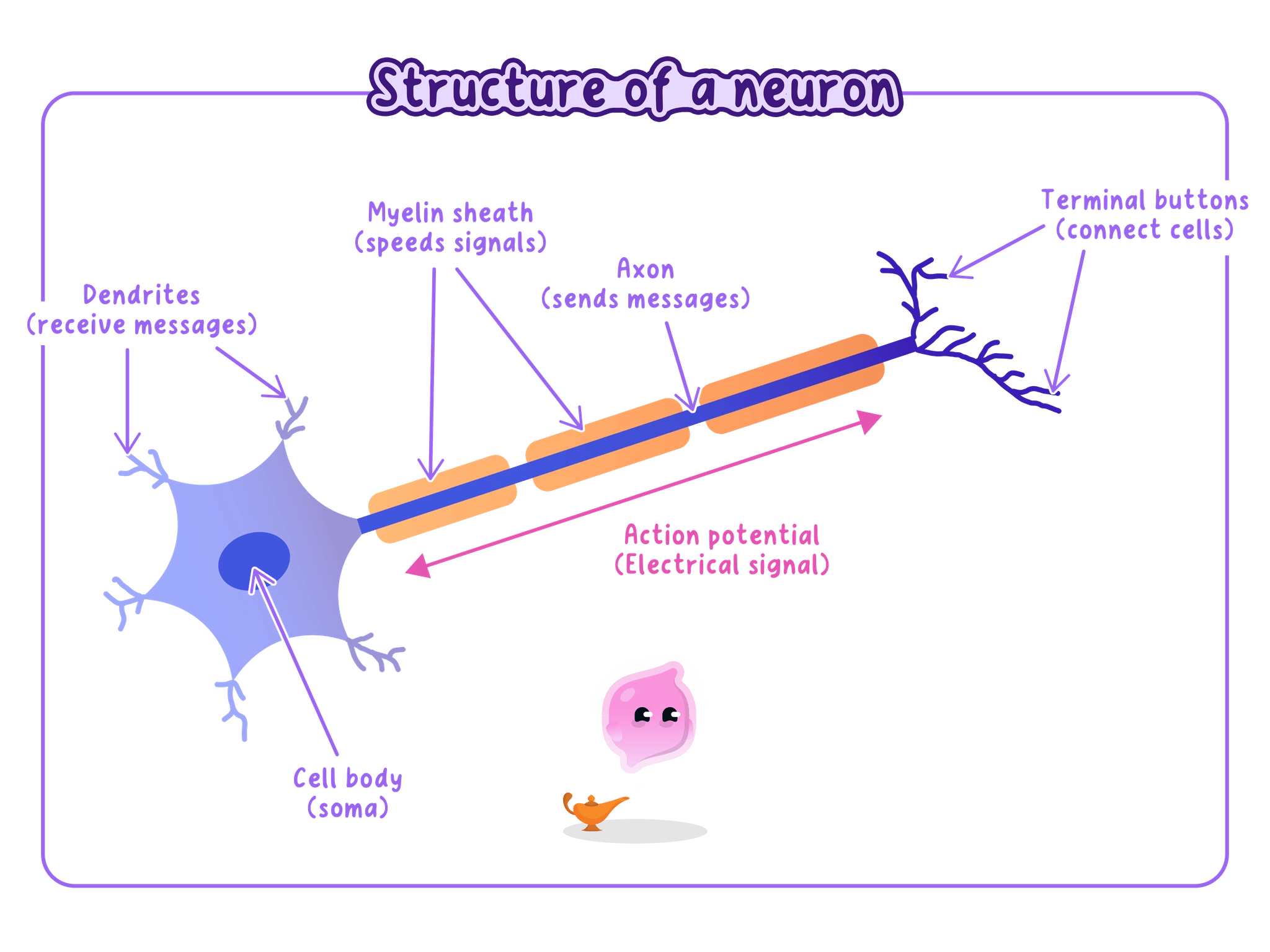
- Neurons: nerve cells that carry information around the body as electrical impulses.
- Dendrites receive the signal and the axon carries it away from the cell body.
- Axons become wrapped in myelin, a fatty insulating layer that makes the impulse travel much faster.
- Synapses: the tiny gaps between one neuron and the next.
- When the impulse reaches the end of the axon, the neuron releases chemicals called neurotransmitters into the gap.
- The neurotransmitters cross the synapse and bind to receptors on the next neuron.
- If enough of them bind, that neuron fires its own electrical impulse and the message carries on.
Common Mistake
- A neuron is a cell and a synapse is the gap between two of them, so the two words are not interchangeable.
- Inside a neuron the signal is an electrical impulse travelling down the axon.
- Across a synapse the signal is neurotransmitter molecules binding to receptors.
How synapses change with experience
- Development after birth is mainly the forming of synapses between neurons that are already there.
- In the first years of life synapses form faster than at any later point, so a toddler's brain holds more connections than an adult's.
- Connections used again and again are strengthened.
- Connections that are rarely used are pruned away.
- The paths worn across a school field work the same way, where the routes hundreds of pupils walk every day become clear tracks and the ones nobody uses grow over.
- Myelin keeps being added through childhood and adolescence, so signals travel faster and thinking speeds up.
Note
- Losing unused connections is part of ordinary development, because it leaves the brain running on the pathways that actually get used.
- The extra synapses a toddler holds are untrimmed wiring rather than extra ability.
- Myelination is a separate change from synapse formation and pruning, and it carries on for years after the toddler stage.
Turning this into marks
- When two divisions of the brain are asked for, give each one a function of its own rather than one function reworded.
- Name neurotransmitters and receptors when you describe a synapse, because saying the message travels to the next neuron does not secure the knowledge mark.
- The mark most often lost is naming a brain part with no function attached, so pair every structure with what it does.
- In a question on development after birth, the marks are for synapse formation, pruning and myelin.
Self review
- Name the two divisions of the nervous system and say what each one does.
- Name the three main divisions of the brain and give one function of each.
- Outline how a message passes from one neuron to the next across a synapse.
- What happens to synapses that are used a lot, and to ones that are rarely used?
- Explain how neurons and synapses interact in the development of the brain.
