The four stages of development
Definition
Maturation
The unfolding of development according to a genetically programmed timetable, so that abilities appear in a fixed order as the body and brain grow, largely regardless of practice.
- Development is the pattern of physical, cognitive and social change that runs from conception to old age.
- It is split into four stages: pre-natal, childhood, adolescence and adulthood.
- Each stage brings its own physical growth and its own new ways of thinking.
- The four stages arrive in the same fixed order for everyone, because each one waits on the maturation of the body and the nervous system.
Key Idea
- The four stages always arrive in the order pre-natal, childhood, adolescence, adulthood.
- A stage can only begin once the body and nervous system have matured enough to support the thinking it involves, which is why the order never varies.
- How far a child gets inside a stage still depends on what they are taught and how much they practise.
What changes in each stage
- Pre-natal
- This runs from conception to birth.
- The body and the brain form quickly, and neurons are produced and start to connect well before birth.
- What reaches the foetus can disrupt this, including poor diet, illness, alcohol and smoking.
- A baby is born with most of its neurons already in place, and experience connects them up.
- Childhood
- This runs from birth to around eleven and is the fastest period of learning after birth.
- Movement, the senses, language and memory all develop rapidly in the early years.
- Thinking becomes steadily more logical, so a child who judges by appearances at four reasons about quantity at seven.
- In the brain, connections that get used are strengthened and unused ones are lost.
- Adolescence
- This begins with puberty, when hormones trigger a growth spurt and sexual maturity.
- The brain reorganises, and the frontal areas behind planning and self-control are the last to finish maturing.
- Abstract and hypothetical reasoning becomes possible, so a teenager can argue about ideas they cannot see or touch.
- Strong emotions and risk-taking are common while that self-control is still catching up.
- Adulthood
- Physical growth is complete and thinking is at its most efficient.
- Learning carries on, because the brain can still form new connections throughout adult life.
- In later adulthood processing can slow, although knowledge built up over a lifetime is largely kept.
Example
- A four-year-old whose juice is poured into a taller, thinner glass will say there is more to drink.
- At seven the same child says the amount has not changed.
- In Year 2 that pupil cannot plan a week of homework, and by Year 11 they can run a whole revision timetable.
Maturation and the order of the stages
- Hypothetical reasoning appears only once the brain has built the structures it runs on, so a two-year-old does not reach it however carefully they are taught.
- Children in very different countries reach the same kinds of thinking at roughly the same ages.
- Teaching and practice change how far a child gets within a stage, so two eight-year-olds can be at very different levels.
Common Mistake
- Pre-natal is a stage in its own right, so a sequence that starts at birth is missing its first stage.
The nervous system
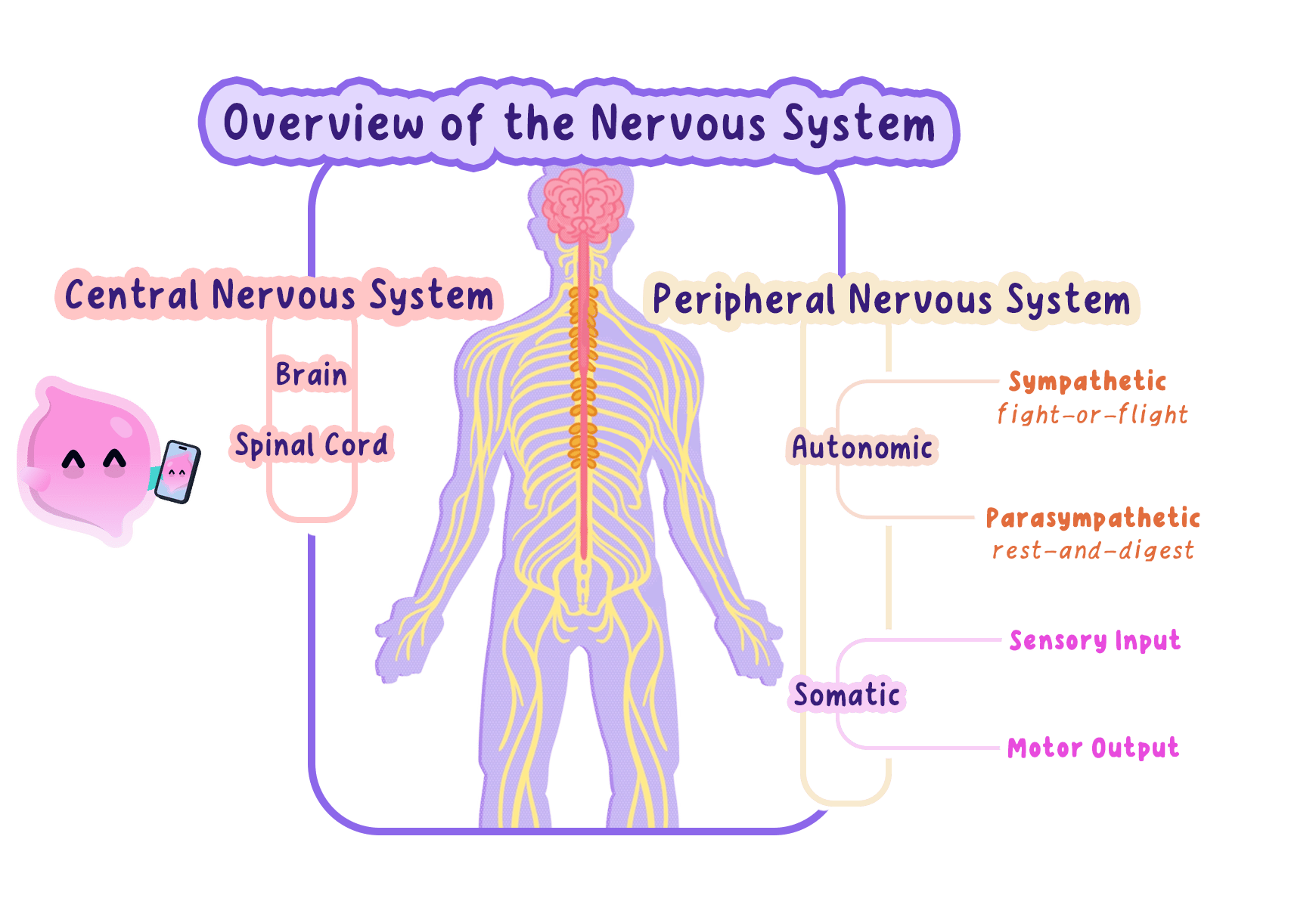
- The nervous system has two divisions: the central nervous system, which is the brain and spinal cord, and the peripheral nervous system, the nerves that run to the rest of the body.
- Both keep maturing through childhood and adolescence, and the myelin that speeds signals along the nerves is still being added into the early twenties.
Note
- The ages attached to each stage are averages, and puberty can begin two or three years either side of the typical age.
- Because myelin is still being added into the early twenties, the move from adolescence to adulthood is a gradual change rather than a single birthday.
- Detail about neurons, synapses and myelin is needed here only to explain why the stages come in a fixed order.
Turning this into marks
- When two stages are asked for, name each one and give a change that belongs to that stage alone rather than one change reworded.
- Name maturation, because saying that children grow up and get better at thinking does not secure the knowledge mark.
- The mark most often lost is giving ages instead of changes, so pair every stage you name with what develops in it.
Self review
- Name the four stages of development in order.
- What is maturation?
- Give one thing that can disrupt development during the pre-natal stage.
- Describe one change in the brain during adolescence.
- Why do children in different countries reach the same kinds of thinking at similar ages?
