What makes an explanation humanistic
- Humanistic psychology starts from the idea that people are basically good and are driven to grow towards their full potential.
- Rogers (1951) used it to explain where your self-esteem and your personality come from, and Maslow (1943) used it to explain what has to be in place before that growth can happen at all.
Definition
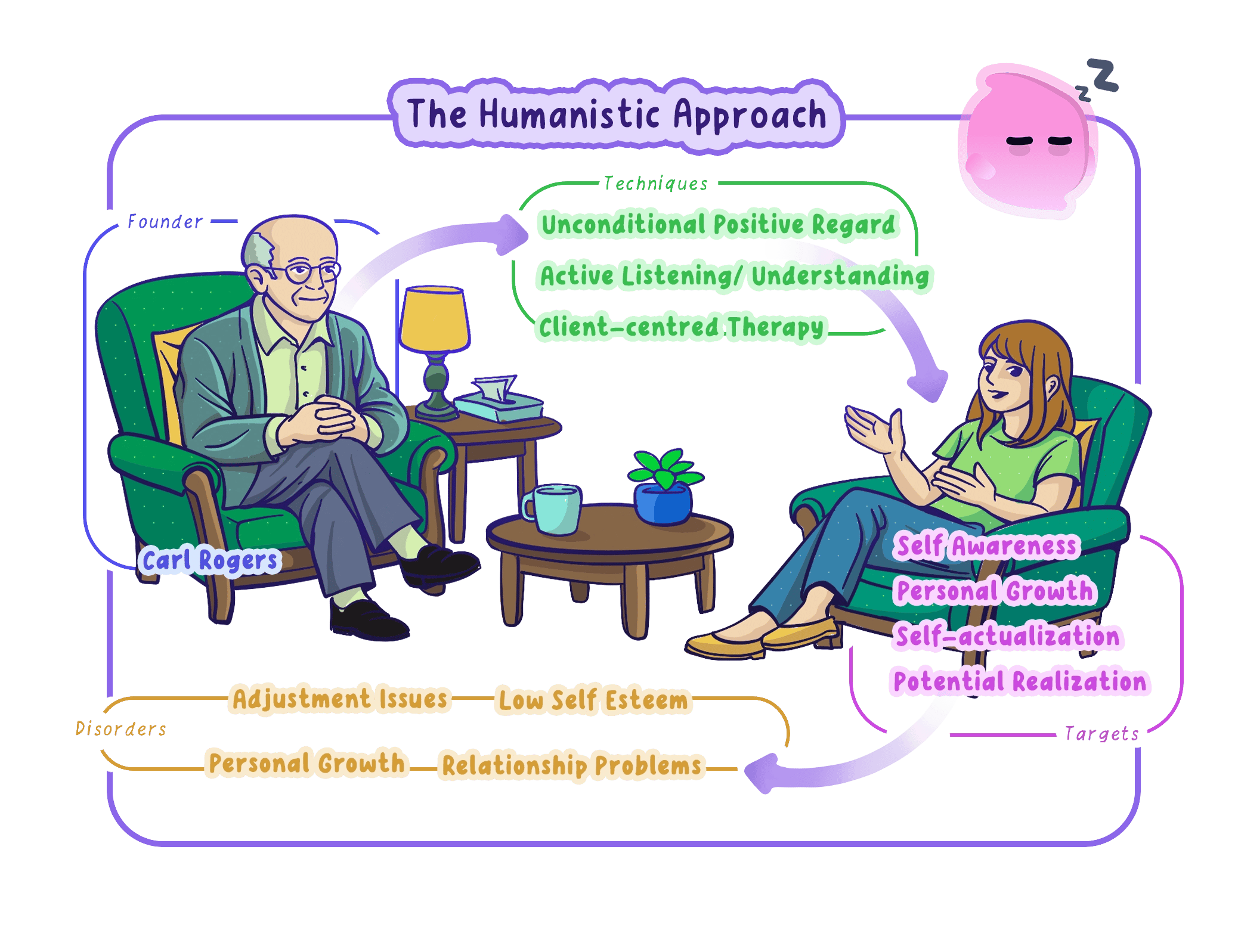
Unconditional positive regard
Being accepted and valued by others no matter what you do, with no strings attached.
The two kinds of positive regard
- Positive regard is the warmth, acceptance and approval you receive from other people.
- Unconditional positive regard is being accepted for who you are whatever you do, so a mistake never puts the acceptance itself at risk.
- Conditional positive regard is acceptance that only arrives when you behave in the way someone else wants.
Definition
Conditions of worth
The rules you come to believe you must meet in order to deserve acceptance, learned when others only value you on condition.
How conditions of worth form
- When the regard you receive is conditional, you quickly learn the rules that seem to buy it.
- Those rules become your conditions of worth, and you carry them in your own head long after the person who set them has gone.
- You then start choosing what to do in order to satisfy those conditions rather than because it fits who you actually are.
How self-esteem develops in this theory
- Your self-esteem depends on how closely your self-image, the person you see yourself as, sits to your ideal self, the person you want to be.
- Heavy conditions of worth push your ideal self up towards what others demand while your self-image stays where it is, so the two move apart.
- That gap is incongruence, and it is what Rogers said pulls self-esteem down.
- Congruence is the opposite, a close match between the two, and unconditional regard is what makes it possible.
How personality develops in this theory
- With unconditional regard and few conditions of worth, you grow into what Rogers called a fully functioning person, open to new experience, able to trust your own judgement and willing to change.
- With heavy conditions of worth the personality that develops is more guarded, because admitting anything that breaks a condition feels like losing your worth.
Definition
Hierarchy of needs
Maslow's ladder of human needs, running from basic physical needs at the bottom to self-actualisation at the top, where lower needs generally have to be met before higher ones matter.
Maslow's hierarchy of needs
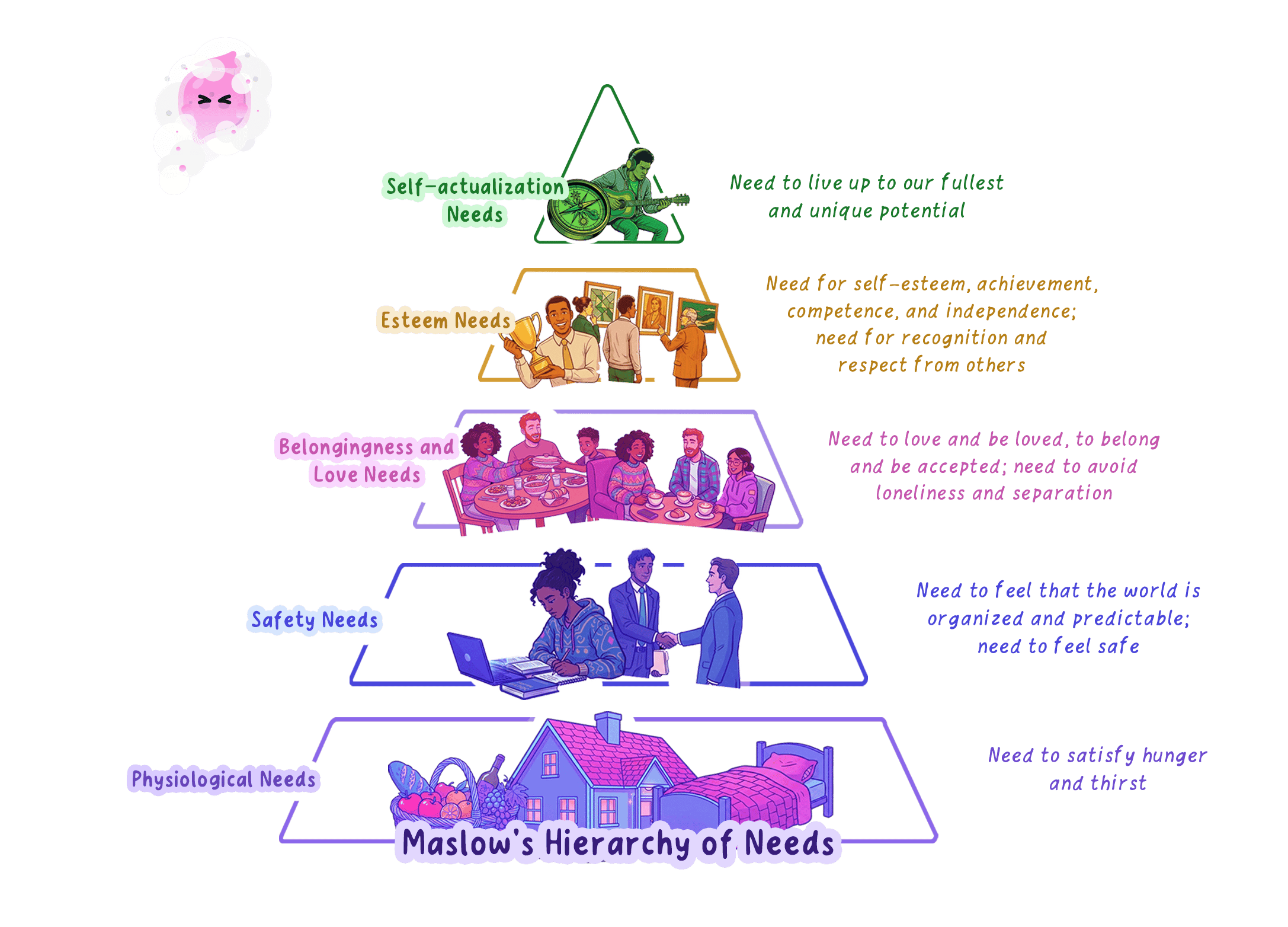
- Maslow (1943) arranged human needs as a ladder, with the most basic at the bottom and growth at the top.
- Physiological needs sit at the bottom and cover food, water, warmth and sleep.
- Safety needs come next and cover shelter, security and freedom from threat.
- Love and belonging needs follow, and they are met through friendship, family and feeling part of a group.
- Esteem needs come above those and cover respect from other people alongside your own sense of achievement and self-respect.
- Self-actualisation sits at the top and means reaching your full potential and becoming everything you are capable of being.
- Maslow argued that the lower needs generally have to be met before the higher ones start to matter, so the ladder is climbed from the bottom.
Strengths
- A strength is that it has clear real-world value, because Rogers built client-centred therapy around offering unconditional positive regard so that self-esteem can be rebuilt.
- A second strength is that Maslow's ladder is widely used in schools and workplaces, for instance in the argument that a hungry or frightened child cannot be expected to concentrate on learning.
Weaknesses
- A weakness is that the central ideas are vague and subjective, so congruence and self-actualisation are hard to measure objectively and the theory is hard to test.
- A second weakness is that the order of the ladder does not always hold, because people do pursue friendship and achievement while their basic needs are going unmet.
Turning this into marks
- Name Rogers for positive regard, conditions of worth, congruence and incongruence, and Maslow for the hierarchy of needs.
- On a scenario, quote what the parent or coach actually said and label it conditional or unconditional regard.
- The mark most often lost is raising a strength or weakness without saying what follows from it for the theory.
Self review
- What is the difference between conditional and unconditional positive regard?
- How do conditions of worth form, and what do they do to your self-image?
- Why does incongruence lower self-esteem in this theory?
- List Maslow's levels in order from the bottom of the ladder to the top.
- Give one strength and one weakness of the humanistic approach to the self.
