Two questions about who you are
- Identity is the settled sense of who you are, pulled together from your values, your roles and the groups you belong to.
- Free will is the sense that you choose your own actions rather than having them decided for you, and it is the second question this topic asks.
Definition
Free will
The idea that you are able to choose your own actions freely, rather than having them decided for you.
Erikson and the eight stages
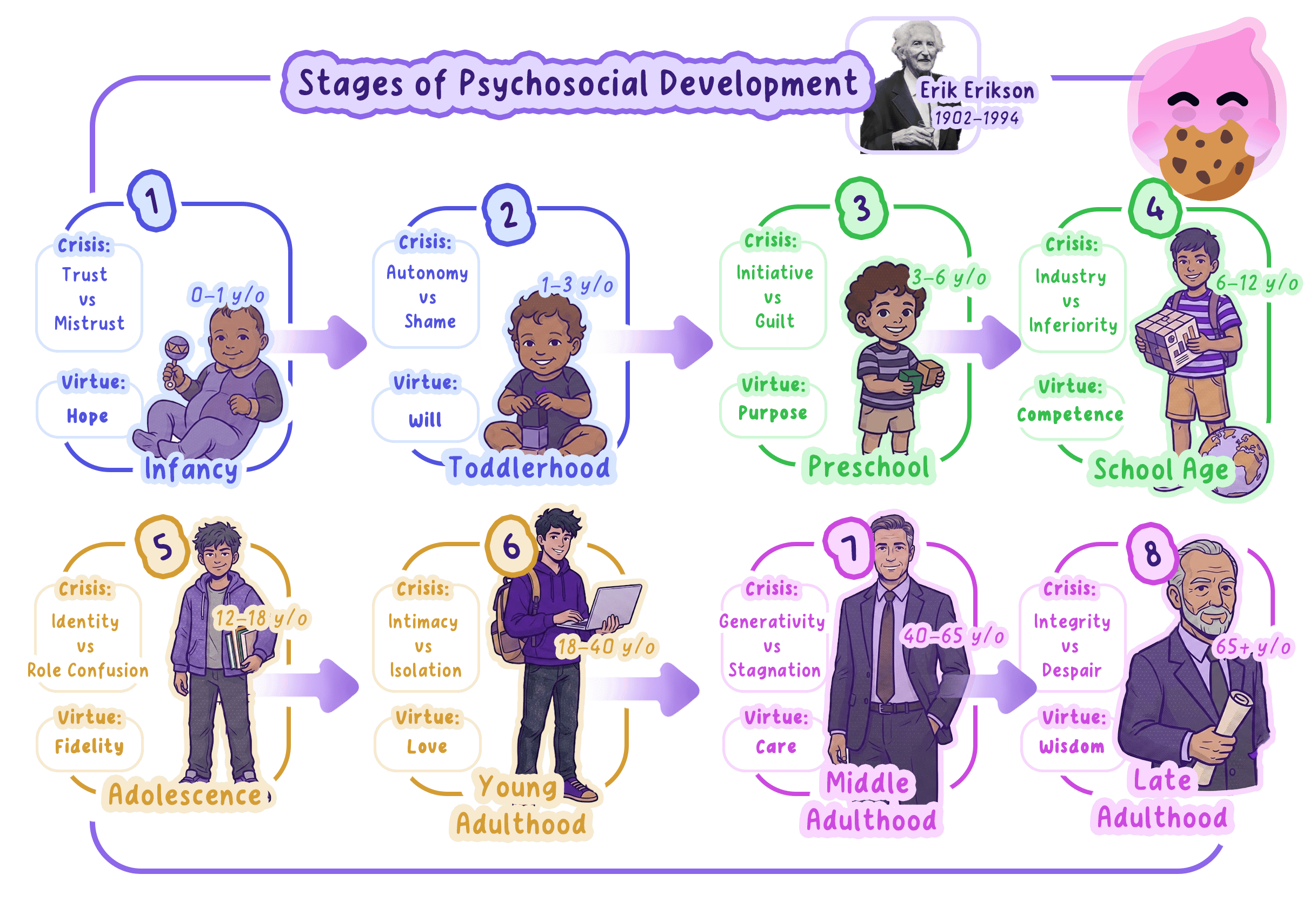
- Erikson (1959) argued that you pass through eight stages that run across your whole life, not just childhood.
- Every stage sets up a conflict between two outcomes, and coming down on the healthy side strengthens your sense of self.
- The eight conflicts run in this order.
- Trust versus mistrust in infancy, where reliable care teaches you the world can be relied on.
- Autonomy versus shame and doubt in toddlerhood, where doing things for yourself builds independence.
- Initiative versus guilt in early childhood, where starting your own games and plans builds a sense of purpose.
- Industry versus inferiority through the primary school years, where succeeding at school tasks builds a sense of being capable.
- Identity versus role confusion in adolescence, the stage that matters most for the self.
- Intimacy versus isolation in young adulthood, where close relationships are formed or avoided.
- Generativity versus stagnation in middle adulthood, where you contribute something to the next generation or feel stuck.
- Integrity versus despair in later life, where you look back on your life with acceptance or with regret.
- In the adolescent stage you try out roles, values, friendships and beliefs in order to answer the question "who am I".
- Resolve it well and you come out with a firm identity, while leaving it unresolved leaves you in role confusion, unsure which version of yourself is the real one.
Strengths of Erikson's theory
- A strength is that it covers the whole lifespan instead of stopping at childhood, so it can explain identity changing in adults as well as teenagers.
- A second strength is that the adolescent stage matches what many people recognise from their own experience, which is why the theory is used in schools and counselling.
Weaknesses of Erikson's theory
- A weakness is that ideas such as role confusion are hard to measure objectively, so the theory is difficult to test and rests on subjective interpretation of what people say.
- A second weakness is that it grew out of Western thinking, so it may not generalise to cultures where identity comes from the group rather than from personal choice.
Baumeister and the belief in free will
- Baumeister (2008) was interested in the consequences of believing in free will rather than in whether free will really exists.
- Believing you have the capacity to choose your own actions supports self-control, planning and taking responsibility for what you do.
Definition
Determinism
The idea that your actions are caused by forces outside your control, such as your biology or upbringing, rather than free choice.
What happens when that belief is weakened
- When people are pushed towards determinism, they behave less honestly and less helpfully than people whose belief in free will is left alone.
- Baumeister's explanation is that self-control takes effort, and there is little reason to make that effort if your actions were going to happen anyway.
- Vohs and Schooler (2008) tested the idea directly in their first experiment, where one group read a passage arguing that free will is an illusion before everyone did mental-arithmetic problems on a computer that secretly counted how often they cheated.
- The group whose belief in free will had been weakened cheated more, and the weaker a person's free will beliefs were, the more they cheated.
Strengths of Baumeister's account
- A strength is that it rests on controlled experiments in which the belief was manipulated and the behaviour measured, so cause and effect can be inferred rather than guessed at.
- A second strength is that the cheating was counted by the computer rather than reported by the participants, which makes the measure objective and hard to fake.
Weaknesses of Baumeister's account
- A weakness is that shifting a lifelong belief with a short passage in a laboratory is artificial, so the effect may be brief and may not reflect real convictions.
- A second weakness is that cheating on a computer task is a narrow measure of moral behaviour, so it may not generalise to the bigger choices the argument is really about.
Turning this into marks
- Name Erikson's eight conflicts in order, and Baumeister's claim that believing in free will supports self-control.
- On a scenario, name the stage or the belief that the person's behaviour shows.
- The mark most often lost is raising a strength or weakness without saying what follows from it for the theory.
Self review
- Name Erikson's eight conflicts in order.
- Which conflict belongs to adolescence, and what does resolving it well give you?
- What did Baumeister argue believing in free will does for behaviour?
- How does Vohs and Schooler's first experiment support that argument?
- Give one strength and one weakness of each of the two accounts.
