What the self and the self-concept mean
- Your self is your sense of being one continuous person who exists separately from everyone and everything else.
- Your self-concept is the picture you hold of that person, covering both what you are like and how you feel about it.
Key Idea
- Lewis (1990) divides the self into the existential self and the categorical self.
- Rogers (1959) divides the self-concept into self-image, self-esteem and the ideal self.
- The distance between your self-image and your ideal self is what Rogers calls congruence or incongruence.
Lewis and the two selves
- Lewis (1990) argued that the self appears in two steps during early childhood.
- The existential self is the basic awareness that you exist, that you are separate from other people and objects, and that you go on being the same person over time.
- This is the earliest part of the self to appear, and a child shows it when they understand that the face in the mirror belongs to them.
- The categorical self is the next step, when you realise you can be placed into categories and start describing yourself by them.
- Age and gender are usually the first categories a child uses, with size, skills and personality added later.
Definition
Self-concept
The overall view you hold of who you are, made up of your self-image, your self-esteem and your ideal self.
The three parts of your self-concept
- Rogers (1959) described the self-concept as three parts working together.
- Self-image is how you actually see yourself at the moment, including your appearance, your abilities, your roles and your personality.
- Self-esteem is how much you value and like the person you see, and it can sit anywhere between high and low.
- Rogers treated self-esteem as something built out of your experiences and able to change, rather than as a fixed fact about you.
- Ideal self is the person you would like to be, made up of the qualities, achievements and goals you are aiming at.
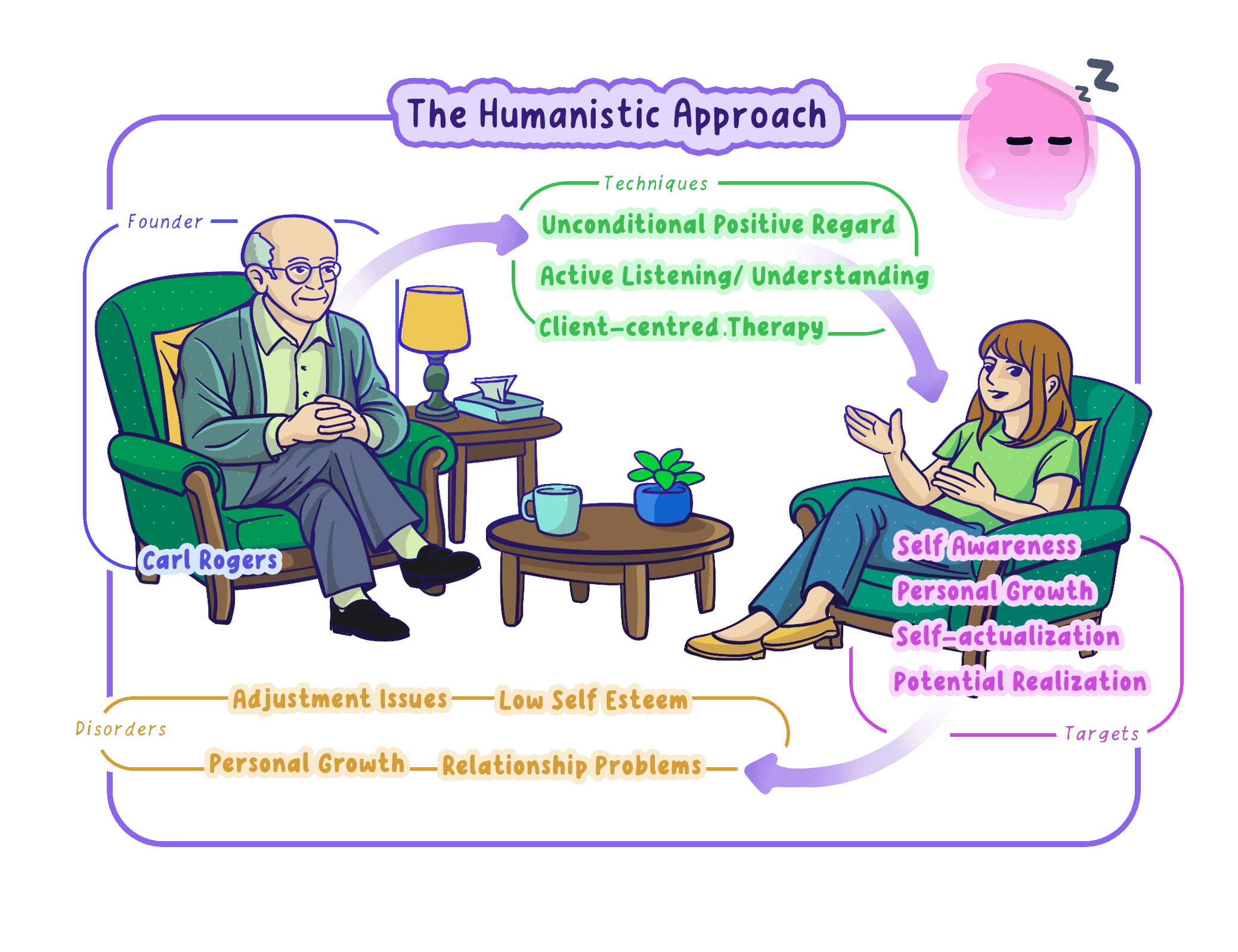
Self-actualisation
- Self-actualisation means reaching your full potential and becoming everything you are capable of being.
- Rogers treated it as the direction people naturally grow in when nothing is getting in the way.
- It is a direction of travel rather than a finishing line, so you move towards it rather than arrive at it.
Definition
Congruence
When your self-image closely matches your ideal self, which supports high self-esteem and personal growth.
When your self-image and ideal self line up
- Congruence is a close match between the person you see yourself as and the person you want to be.
- The closer that match, the higher self-esteem tends to be, because you already value the person you see.
Definition
Incongruence
When there is a large gap between your self-image and your ideal self, which lowers self-esteem.
When self-image and ideal self drift apart
- Incongruence is a wide gap between your self-image and your ideal self.
- The wider that gap, the lower self-esteem tends to fall, because you keep measuring yourself against a version of you that feels out of reach.
- Rogers saw incongruence as what holds self-actualisation back, and as a gap that can be narrowed rather than a permanent state.
Common Mistake
- Self-image and self-esteem are not the same thing.
- Self-image is how you describe yourself, and self-esteem is how much you like what you have just described.
- Self-concept is the whole picture, so do not use it as another word for self-esteem.
Turning this into marks
- Name Lewis for the existential and categorical selves, and Rogers for self-image, self-esteem and the ideal self.
- Give the meaning of a term rather than who named it, then add a short example.
- The mark most often lost is defining a term in the abstract when the question describes a named person to apply it to.
Self review
- What is the difference between the existential self and the categorical self?
- Which three parts make up the self-concept in Rogers's model?
- What does self-actualisation mean?
- How does the gap between self-image and ideal self change self-esteem?
- Define congruence and incongruence in your own words.
