Revision notes for AQA GCSE Psychology Characteristics of addiction. Open the guide for explanations and worked examples. Written against the AQA GCSE Psychology (8182) specification, so the content matches what's examinable rather than general Psychology background.
Characteristics of addiction
What you'll learn
- How substance misuse/abuse differs from addiction/dependence.
- How the International Classification of Diseases (ICD) is used to diagnose dependence syndrome.
- How to apply diagnostic features to short everyday scenarios.
- How to evaluate the usefulness and limitations of diagnostic classifications.
Starting point: what counts as a substance?
A substance is a drug or chemical that can affect the body, thoughts, mood, or behaviour. In this topic, examples could include alcohol, nicotine, cannabis, cocaine, heroin, or misused prescription medication.
Not every use of a substance is an addiction. Psychology is interested in the pattern of behaviour: whether the person has control, whether harm is happening, and whether the substance has started to dominate their life.
Definition
Substance misuse or abuse
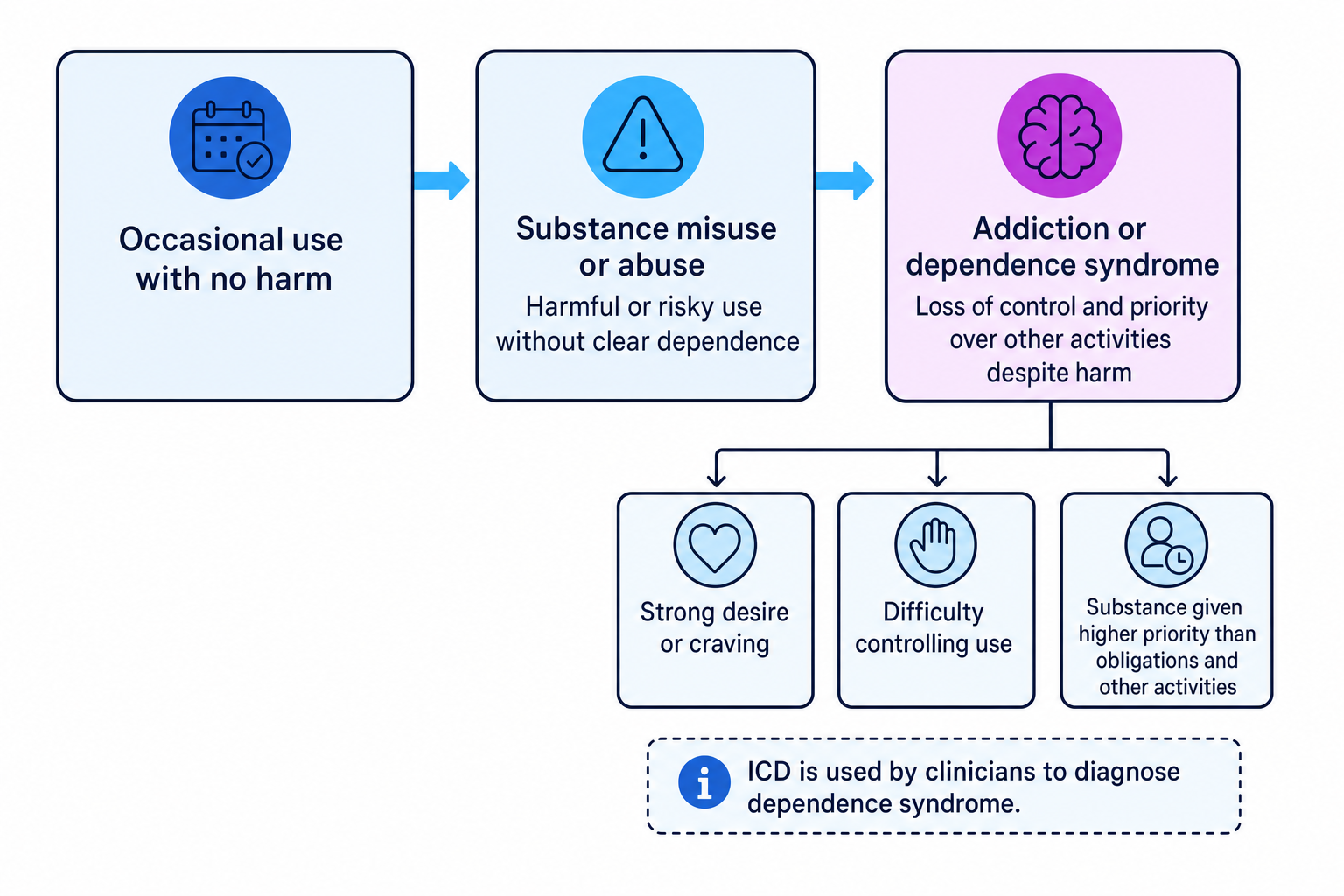
Substance misuse/abuse means using a substance in a harmful, risky, illegal, or medically inappropriate way. It can cause problems, but it does not automatically mean the person is addicted or dependent.
For example, someone might binge drink at a party and put themselves at risk. That is harmful use, so it could be described as misuse. But if it is not a persistent pattern involving craving, loss of control, and prioritising alcohol over life responsibilities, it may not be dependence.
Addiction and dependence
In GCSE Psychology, addiction is closely linked to the idea of dependence. The ICD uses the term dependence syndrome, which means a cluster of symptoms showing that a person has become strongly attached to using a substance.
Definition
Dependence syndrome
Dependence syndrome is the ICD term for addiction to a substance, where the person shows features such as strong desire to use, difficulty controlling use, and giving the substance higher priority than other activities or obligations.
The key difference is this:
| Substance misuse/abuse | Addiction/dependence |
|---|---|
| Harmful or risky use | A stronger pattern of dependence |
| The person may still have control over use | The person has difficulty controlling use |
| The substance may cause problems | The substance becomes a high priority |
| Can happen as a one-off or occasional pattern | Usually involves an ongoing pattern |
The diagram shows the basic difference between occasional use, misuse/abuse, and addiction/dependence.
Key Idea
Misuse is not the same as dependence
The main exam distinction is: misuse/abuse is harmful use, while addiction/dependence involves loss of control and the substance becoming a major priority.
Example
Separating misuse from dependence
Leah drinks heavily at one party and misses football training the next morning. She does not drink during the week and says she can easily avoid alcohol. Jay says he will only vape at weekends, but now vapes before school, feels strong cravings, spends lunch money on vapes, and has stopped going to football.
-
Leah’s case shows harmful consequences because missing training suggests alcohol has caused a problem.
-
Leah does not show clear loss of control or strong craving, because she can avoid alcohol during the week and the behaviour seems occasional.
-
Jay shows difficulty controlling use because he planned to vape only at weekends but now vapes before school.
-
Jay also gives vaping higher priority than other activities, because he spends lunch money on it and has stopped football.
-
So Leah is a better example of substance misuse/abuse, while Jay shows stronger signs of addiction/dependence.
Common Mistake
Thinking addiction means using a lot
Addiction is not judged only by the amount used. A person might use a large amount once and not be dependent, while another person may use smaller amounts but show craving, loss of control, and prioritising the substance.
The ICD: diagnosing addiction
The International Classification of Diseases, usually shortened to ICD, is a classification system published by the World Health Organization. It is used by health professionals to classify and diagnose physical and mental health conditions.
Definition
International Classification of Diseases
The ICD is a diagnostic classification system used by clinicians to identify health conditions, including addiction as dependence syndrome.
A diagnosis is a professional judgement that a person meets the criteria for a condition. For addiction, the spec focuses on these ICD features:
- a strong desire to use the substance, even when there are harmful consequences
- difficulty controlling use of the substance
- giving the substance higher priority than other activities or obligations
Strong desire to use despite harmful consequences
A strong desire is often called a craving. This means the person feels a powerful urge to use the substance.
The phrase despite harmful consequences is important. It means the person continues to use even when it is damaging their health, relationships, school, work, finances, or safety.
Examples of harmful consequences might include:
- falling behind at school because of substance use
- arguments with family or friends
- health problems, such as coughing, illness, or withdrawal symptoms
- spending money needed for food, travel, or bills
- taking risks, such as using substances in unsafe situations
Difficulty controlling use
Difficulty controlling use means the person struggles to control when they start, how much they use, or when they stop.
This may include saying “I’ll only have one” but repeatedly using much more, or promising to stop but quickly returning to the substance.
Higher priority than other activities or obligations
An obligation is something a person is expected or required to do, such as attending school, going to work, caring for family, or keeping appointments.
If the substance becomes more important than hobbies, friendships, responsibilities, sleep, schoolwork, or health, this suggests dependence.
Example
Applying ICD features to a case
Mina uses cannabis most days. She says she wants to stop because it is causing arguments at home and she is missing coursework deadlines. However, she feels a strong urge to use after school, often uses more than she planned, and has stopped going to art club so she can spend time with friends who use cannabis.
-
The harmful consequences are family arguments and missed coursework deadlines, so her use is causing real problems.
-
The strong urge after school suggests a strong desire or craving to use the substance.
-
Using more than planned shows difficulty controlling use, because her actual behaviour does not match her intention.
-
Stopping art club shows the substance has become a higher priority than other activities.
-
Mina therefore shows several ICD dependence-syndrome features. In an exam, you could say she shows signs of addiction/dependence, while remembering that a formal diagnosis must be made by a trained clinician.
Tip
Three-part ICD checklist
For GCSE answers, check for: craving, control, and priority. If a scenario gives evidence of all three, it is likely pointing towards dependence syndrome.
Why classification systems are useful
Using the ICD can make diagnosis more reliable. Reliability means consistency. If clinicians use the same diagnostic criteria, they are more likely to reach similar decisions.
It can also improve communication. For example, a GP, mental health worker, and addiction service can all understand what is meant by dependence syndrome.
ICD diagnosis can help people access support, such as medical advice, therapy, or specialist services. It can also help researchers select similar groups of participants when studying addiction.
Research methods link
If psychologists were researching addiction, they might use interviews or questionnaires based on ICD features. This could produce primary data, meaning data collected directly from participants.
However, substance use is a sensitive topic. Participants might under-report their behaviour because of embarrassment, fear of judgement, or worry about confidentiality. This can reduce validity, meaning the research may not measure the person’s real level of substance use accurately.
Ethically, researchers should follow British Psychological Society principles by gaining informed consent, protecting confidentiality, allowing the right to withdraw, avoiding harm, and giving a debrief. With young people or illegal substances, researchers must be especially careful about safeguarding and anonymity.
Limitations of diagnosing addiction
Although the ICD is useful, diagnosis is not perfect.
One issue is validity. A checklist may not capture the full reasons behind a person’s behaviour. For example, someone might use alcohol heavily because of stress, depression, peer pressure, trauma, or social environment. The ICD features describe the pattern of dependence, but they do not fully explain why it developed.
Another issue is labelling. Being diagnosed with addiction may help a person access treatment, but it can also lead to stigma. Stigma means negative judgement from others. A person might feel ashamed or avoid seeking help if they fear being labelled.
There can also be cultural and social differences. Some substances, such as alcohol, may be more accepted in certain social groups. This can make it harder to recognise harmful patterns early because people may see them as “normal”.
Key Idea
Diagnosis needs evidence over time
A single bad decision is not enough to diagnose dependence. Clinicians look for a pattern of craving, difficulty controlling use, and the substance taking priority despite harm.
AO2: applying the ideas to everyday life
In an exam scenario, you may be given a short description of someone’s behaviour. Your job is to decide whether the evidence fits misuse/abuse or dependence.
Useful clues for misuse/abuse include:
- the person uses a substance dangerously or inappropriately
- harm has happened
- the pattern may be occasional
- there is not enough evidence of craving or loss of control
Useful clues for dependence include:
- the person strongly wants or craves the substance
- they repeatedly fail to control use
- they continue despite harm
- they give the substance priority over school, work, relationships, hobbies, or responsibilities
Exam technique
In the exam
-
Define the key term first: explain that misuse/abuse means harmful use, while dependence means addiction involving loss of control and priority over other activities.
-
Use the scenario evidence: quote or refer to specific behaviours, such as cravings, failed attempts to stop, missed school, or giving up hobbies.
-
Avoid overclaiming: say someone “shows signs of dependence” unless the question clearly asks for a diagnosis, because real diagnosis is made by trained clinicians using ICD criteria.
Self review
Check yourself
- What is the difference between substance misuse/abuse and addiction/dependence?
- What are the three ICD features of dependence syndrome you need to know?
- Why might self-report data about substance use have low validity?