Revision notes for AQA GCSE Psychology Theories of addiction and interventions or therapies for addiction. Open the guide for explanations and worked examples. Written against the AQA GCSE Psychology (8182) specification, so the content matches what's examinable rather than general Psychology background.
Theories of addiction and interventions or therapies for addiction
What you'll learn
- How biological and psychological explanations account for addiction.
- What Kaij's twin study of alcohol abuse shows about genetic vulnerability.
- How aversion therapy and self-management programmes aim to reduce addictive behaviour.
- How to evaluate addiction theories and therapies using reductionist and holistic perspectives.
Starting point: what is addiction?
Definition
Addiction
Addiction is a repeated, difficult-to-control behaviour involving a substance or activity, even when it causes harm. It often includes craving, loss of control, withdrawal symptoms, and continuing despite negative consequences.
Addiction can involve substances, such as alcohol, nicotine or drugs, or behaviours, such as gambling. In GCSE Psychology, the key idea is that addiction is not explained by one simple cause. We study both nature and nurture.
Definition
Nature and nurture
Nature means biological influences, such as genes inherited from parents. Nurture means environmental influences, such as friends, family, culture and life experiences.
This topic fits together like this:
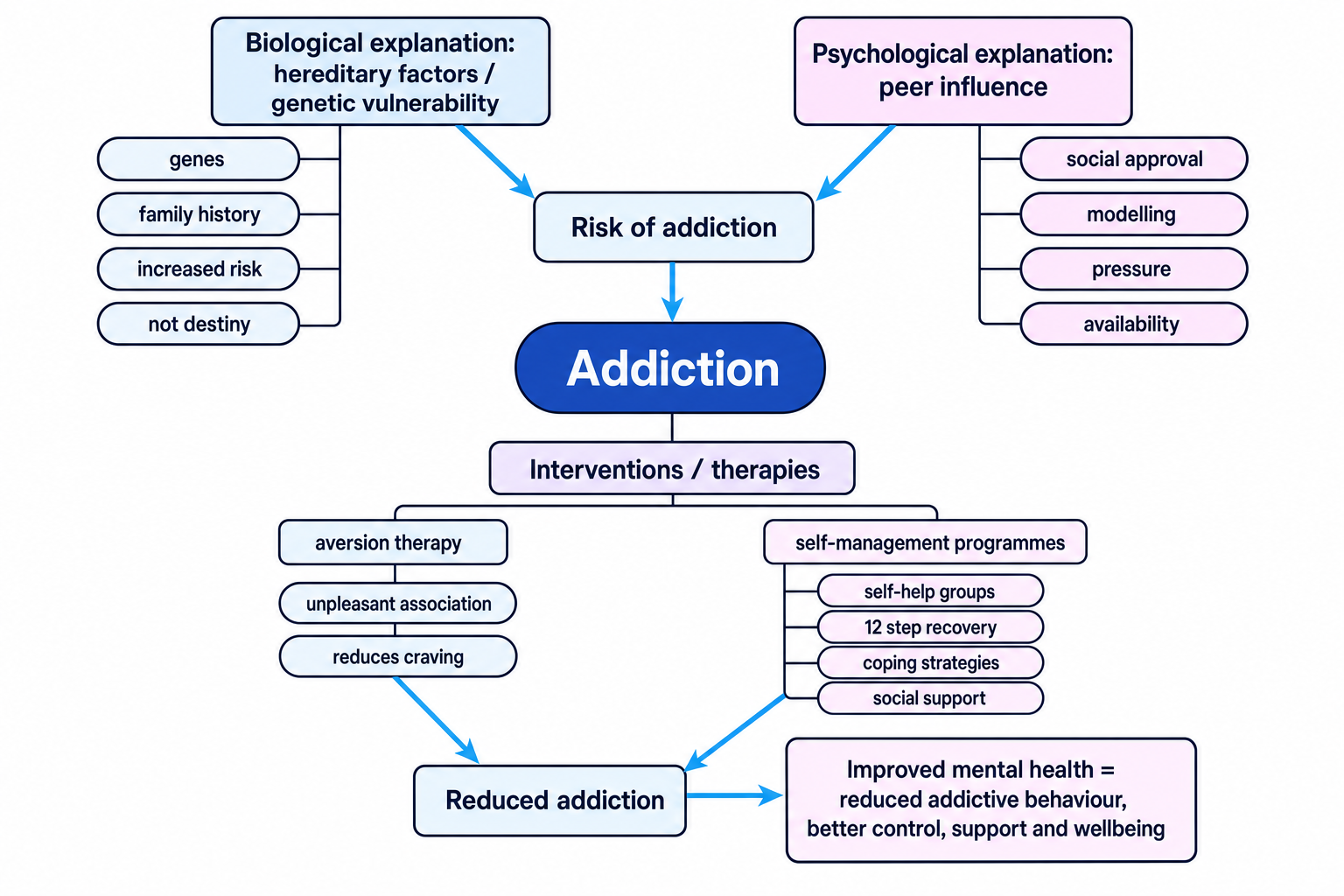
Theories of addiction
Biological explanation: hereditary factors and genetic vulnerability
The biological explanation says that addiction may be partly caused by hereditary factors. These are characteristics passed from biological parents to children through genes.
Definition
Genetic vulnerability
Genetic vulnerability means a person may inherit genes that make them more likely to develop an addiction. It does not mean addiction is guaranteed.
For example, someone with a family history of alcohol abuse may be at higher risk of developing alcohol addiction. This might be because inherited biological factors affect things like reward, impulsivity, stress responses or sensitivity to alcohol.
The key point is risk, not destiny. A person can have genetic vulnerability but never develop an addiction, especially if their environment is protective.
Key Idea
Biological explanation
The biological explanation is a nature explanation: it argues that inherited genetic factors can increase the likelihood of addiction.
Kaij's twin study of alcohol abuse
Kaij's twin study of alcohol abuse is the named study linked to the biological explanation.
Definition
Twin study
A twin study compares identical twins and non-identical twins to estimate the influence of genes and environment. Identical twins share all their genes, while non-identical twins share only some genes, like ordinary siblings.
Definition
Concordance rate
A concordance rate is the percentage of twin pairs where both twins show the same characteristic, such as alcohol abuse.
Aim
Kaij aimed to investigate whether alcohol abuse has a genetic basis by comparing alcohol abuse in identical and non-identical twins.
Method
Kaij used a twin study of Swedish twins. The study compared whether both twins in a pair showed alcohol abuse. If identical twins had higher concordance for alcohol abuse than non-identical twins, this would suggest a genetic influence.
Results
Kaij found that identical twins were more likely to both show alcohol abuse than non-identical twins.
Conclusion
This supports the biological explanation because identical twins share more genes, so higher concordance suggests inherited factors can increase vulnerability to alcohol abuse.
However, concordance was not 100%. This matters because it shows genes cannot be the only explanation. Environmental influences must also play a role.
Example
Using Kaij's study to support genetics
- Compare the two types of twins: identical twins share all their genes, while non-identical twins share fewer genes.
- Apply the result: if identical twins show higher concordance for alcohol abuse, the difference is likely to be partly linked to genetic similarity.
- Draw a balanced conclusion: the study supports genetic vulnerability, but because not every identical twin pair matched, environment also matters.
Evaluation of Kaij's twin study
A strength is that twin studies are useful for separating genetic and environmental influences. If identical twins show higher similarity than non-identical twins, this supports a biological explanation.
A weakness is that identical twins may be treated more similarly than non-identical twins. This means their similarity might be due partly to environment, not just genes. For example, identical twins may share the same friendship groups or be encouraged to behave similarly.
Another issue is generalisability. If the sample was mainly from one country or one cultural context, the findings may not apply equally to all societies.
Ethically, research on addiction can be sensitive because it may involve stigma. Researchers should protect confidentiality, gain informed consent where possible, allow the right to withdraw, and debrief participants sensitively.
Common Mistake
Genes do not mean certainty
Do not write “the addiction gene causes alcoholism.” A better GCSE answer is: genes may create a vulnerability, but addiction develops through an interaction of biological and environmental factors.
Psychological explanation: peer influence
The psychological explanation in this topic focuses on peer influence.
Definition
Peer influence
Peer influence is when people of a similar age or social group affect a person’s attitudes, choices or behaviour.
Peers can influence addiction in several ways:
- Direct pressure: friends openly encourage someone to drink, smoke or gamble.
- Modelling: a person copies peers who seem confident, popular or rewarded for addictive behaviour.
- Social approval: addictive behaviour may be seen as a way to fit in.
- Availability: peers may make it easier to access alcohol, cigarettes, drugs or gambling opportunities.
For example, a teenager may start vaping because their friendship group does it at parties. At first, the behaviour may be about belonging. Over time, it may become harder to stop.
Key Idea
Psychological explanation
Peer influence is a nurture explanation: it argues that addiction can develop through social pressure, modelling and the desire to belong.
Example
Explaining peer influence in a scenario
- Identify the social factor: the person’s friends regularly take part in the addictive behaviour and encourage it.
- Link it to behaviour: the person may copy the group because it brings approval or avoids rejection.
- Explain the risk: repeated exposure and easier access can increase the chance that the behaviour becomes habitual or addictive.
Evaluation of peer influence
A strength is that peer influence explains why addiction often begins in social situations. It is especially useful for explaining initiation, such as first drinking alcohol or first trying nicotine.
It also has practical value. If peer influence contributes to addiction, interventions can focus on resisting pressure, building confidence and changing social environments.
A weakness is that it can be difficult to prove cause and effect. People may choose friends who already share their interests, rather than being changed by those friends. This is called a problem of direction: do peers cause the behaviour, or do similar people become peers?
Peer influence also does not explain why only some people in a friendship group become addicted. Biological vulnerability, personality, stress and family background may affect who is most at risk.
Interventions or therapies for addiction
An intervention is a planned method used to reduce a problem behaviour or improve mental health. For addiction, the goal is often to reduce cravings, reduce harmful behaviour, prevent relapse and improve control.
Aversion therapy
Definition
Aversion therapy
Aversion therapy is a behavioural therapy where the addictive substance or behaviour is paired with an unpleasant experience, so the person develops a negative association with it.
Aversion therapy is based on classical conditioning, which is learning by association. If alcohol is repeatedly paired with nausea, the person may begin to feel disgust or anxiety when they think about drinking. This may reduce cravings and make relapse less likely.
For alcohol addiction, a person might be given a drug that causes sickness when alcohol is consumed. For gambling addiction, gambling-related images might be paired with an unpleasant stimulus. The aim is to make the addictive behaviour less rewarding.
Example
How aversion therapy changes an association
- Before therapy, the addictive stimulus, such as alcohol, is associated with pleasure, relaxation or reward.
- During therapy, alcohol is repeatedly paired with an unpleasant response, such as nausea.
- After repeated pairings, alcohol may trigger disgust or avoidance, reducing the desire to drink.
Evaluation of aversion therapy
A strength is that aversion therapy directly targets the addictive behaviour. It can be useful when someone is highly motivated to stop and wants a clear behaviour-change technique.
A weakness is that it may not deal with the deeper causes of addiction, such as stress, peer pressure or genetic vulnerability. This means relapse can happen if the person returns to the same triggers.
There are also ethical concerns. Aversion therapy deliberately creates discomfort, so therapists must gain informed consent, protect the person from harm, monitor distress and allow them to withdraw.
Common Mistake
Aversion therapy is not just punishment
Aversion therapy is based on learning by association. The key idea is that the addictive stimulus becomes linked with an unpleasant response.
Self-management programmes
Definition
Self-management programme
A self-management programme helps a person monitor and control their own addictive behaviour using strategies such as goal setting, coping skills, support networks and relapse prevention.
Self-management programmes can include self-help groups, where people with similar difficulties support each other, and 12 step recovery programmes, which use a structured set of recovery steps. These often include admitting there is a problem, seeking support, avoiding triggers and helping others in recovery.
Self-management programmes may help because they:
- give social support from people who understand addiction
- reduce isolation and shame
- teach coping strategies for cravings and stress
- encourage responsibility and long-term behaviour change
- provide role models who show recovery is possible
Example
Choosing a self-management strategy
- Consider the trigger: if a person drinks when lonely, the problem is not only alcohol but also isolation.
- Match the strategy: a self-help group could provide social support and reduce loneliness.
- Link to recovery: with support and coping strategies, the person may manage cravings without returning to alcohol.
Evaluation of self-management programmes
A strength is that self-management programmes are more holistic than aversion therapy. They can address behaviour, thoughts, emotions and social support.
They are also often accessible and low cost. A person may continue attending support groups for months or years, which can help with relapse prevention.
A weakness is that they rely on motivation and regular attendance. If someone is not ready to change, or feels embarrassed in groups, the programme may be less effective.
There may also be confidentiality issues in group settings. Members should respect privacy, and facilitators should make expectations clear. People should also feel able to leave without pressure.
How interventions improve mental health
Both aversion therapy and self-management programmes aim to improve mental health by reducing addictive behaviour and increasing control.
Reduced addiction can improve:
- mood and self-esteem
- relationships with family and friends
- physical health and sleep
- school, work or daily routines
- feelings of hope and independence
However, the therapies work in different ways. Aversion therapy focuses mainly on changing the learned association with the addictive behaviour. Self-management focuses more on the person’s wider life, including triggers, support and coping strategies.
Reductionist and holistic perspectives
Definition
Reductionist and holistic
A reductionist explanation reduces behaviour to one main factor, such as genes or learned associations. A holistic explanation considers several interacting factors, such as biology, thoughts, emotions, relationships and culture.
The biological explanation can be seen as reductionist because it focuses on genes. This is useful because it is clear and scientific, but it may ignore peer pressure and life experiences.
Peer influence is also partly reductionist if it explains addiction only through friends. It may ignore why some people resist peer pressure while others do not.
Aversion therapy is reductionist because it focuses on one learned association. Self-management programmes are more holistic because they can include social support, coping skills, motivation, identity and relapse prevention.
Tip
Best evaluation phrase
A strong answer often says: “This explanation is useful, but addiction is likely to involve an interaction between nature and nurture.”
Exam technique
In the exam
- For theory questions, clearly label whether the explanation is biological/nature or psychological/nurture.
- For Kaij, include aim, method, results and conclusion, then link the higher twin concordance to genetic vulnerability.
- For therapy questions, evaluate both effectiveness and appropriateness: does it work, and is it suitable and ethical for the person?
Self review
Check yourself
- Why does Kaij's twin study support a genetic explanation of alcohol abuse?
- How can peer influence increase the risk of addiction?
- Which therapy is more holistic: aversion therapy or self-management programmes?