Revision notes for AQA GCSE Psychology Theories of depression and interventions or therapies for depression. Open the guide for explanations and worked examples. Written against the AQA GCSE Psychology (8182) specification, so the content matches what's examinable rather than general Psychology background.
Theories of depression and interventions or therapies for depression
What you'll learn
- How biological and psychological explanations try to explain depression.
- What serotonin, negative schemas and attributions mean.
- How antidepressant medication and CBT aim to improve mental health.
- What Wiles' study of the effectiveness of CBT found, and how to evaluate it.
Before we start: what is depression?
Depression is more than feeling sad for a day. In psychology, it is treated as a mental health problem involving a pattern of symptoms that can affect mood, thoughts, behaviour, sleep, appetite and everyday functioning.
Definition
Depression
Depression is a mental health disorder involving persistent low mood and/or loss of interest or pleasure, often alongside changes in thinking and behaviour.
For GCSE Psychology, you do not need to diagnose depression. You need to understand two explanations for it and two ways it can be treated.
Theories of depression
A theory is an explanation of why something happens. The spec focuses on two broad explanations of depression:
- a biological explanation, linked to nature
- a psychological explanation, linked to nurture
Nature and nurture
Nature means biological factors, such as genes, hormones, brain structures or brain chemicals. Nurture means factors from experience and environment, such as learning, relationships, life events and patterns of thinking.
Key Idea
Two different levels of explanation
The biological explanation focuses on what is happening in the brain and body. The psychological explanation focuses on how a person thinks about themselves, events and the future.
Biological explanation: imbalance of neurotransmitters
The biological explanation says depression may be linked to an imbalance of neurotransmitters in the brain, especially serotonin.
Definition
Neurotransmitter
A neurotransmitter is a chemical messenger that carries signals between nerve cells in the brain and nervous system.
Serotonin is involved in regulating mood, sleep and appetite. If serotonin activity is too low or not working normally, mood regulation may be disrupted. This could make a person more likely to experience symptoms of depression.
This is a nature explanation because it focuses on internal biological processes rather than learned thinking patterns or life experiences.
Evaluating the biological explanation
A strength is that it is scientific and can be linked to medical treatments. For example, some antidepressants increase serotonin activity, and many people’s symptoms improve when taking them. This supports the idea that brain chemistry is involved.
A weakness is that it can be reductionist. This means it may explain a complex mental health problem using just one factor, such as serotonin. Depression is often affected by many things, including stress, relationships, trauma, thinking style and social support.
Common Mistake
Do not oversimplify serotonin
Avoid writing “depression is caused by not enough serotonin” as if that is always true. A better GCSE answer is: “Depression may be linked to an imbalance of neurotransmitters, such as serotonin.”
Psychological explanation: negative schemas and attributions
The psychological explanation focuses on how a person interprets events. It suggests depression can be linked to negative schemas and negative attributions.
Definition
Schemas and attributions
- A schema is a mental framework that helps us organise and interpret information.
- A negative schema is a biased belief system, such as “I am worthless” or “things always go wrong for me”.
- An attribution is an explanation a person gives for why something happened.
A person with depression may have negative schemas about:
- themselves: “I am a failure”
- the world: “Nobody can be trusted”
- the future: “Nothing will ever improve”
They may also make negative attributions. For example, after failing a test, they might think, “It is all my fault, I always fail, and I will fail at everything.” This type of attribution is:
- internal: blaming themselves
- stable: thinking it will always be this way
- global: thinking it affects everything
Example
Spotting negative attributions
- A student gets a low mark and thinks, “I failed because I am stupid.” This is internal because the student blames something about themselves.
- The student then thinks, “I will always be bad at school.” This is stable because they believe the problem will not change.
- They also think, “This proves I am useless at everything.” This is global because they apply one event to their whole life.
- The psychological explanation would predict that this thinking pattern could lower mood and lead to behaviours like giving up revision or avoiding friends.
Evaluating the psychological explanation
A strength is that it explains why two people can experience the same event differently. One person may see a bad test result as disappointing but fixable, while another may see it as proof they are worthless.
Another strength is that it leads directly to cognitive behaviour therapy, which aims to change unhelpful thoughts and behaviours.
A weakness is that negative thinking may be a symptom of depression rather than the original cause. It can be difficult to know whether negative thoughts caused depression or whether depression caused negative thoughts.
Tip
AO3 comparison phrase
For evaluation, you can compare the explanations: the biological explanation is more reductionist because it focuses on brain chemistry, while the psychological explanation considers thinking patterns shaped by experience.
Interventions or therapies for depression
An intervention or therapy is a treatment used to improve mental health. The spec focuses on:
- antidepressant medication
- cognitive behaviour therapy, usually shortened to CBT
Reductionist and holistic perspectives
A reductionist perspective breaks a complex issue down into one main factor. For example, treating depression mainly as a serotonin imbalance is reductionist.
A holistic perspective looks at the whole person, including biology, thoughts, behaviour, relationships and environment. Combining medication with CBT can be seen as more holistic because it targets both brain chemistry and thinking/behaviour patterns.
Key Idea
How treatments improve mental health
Antidepressants aim to improve mental health by changing brain chemistry. CBT aims to improve mental health by changing unhelpful thoughts and behaviours.
Antidepressant medications
Definition
Antidepressants
Antidepressants are drugs prescribed to reduce symptoms of depression, often by altering neurotransmitter activity in the brain.
A common type is an SSRI, which stands for selective serotonin reuptake inhibitor. Reuptake is when serotonin is reabsorbed by the nerve cell that released it. SSRIs reduce this reabsorption, so serotonin stays available for longer between nerve cells.
This may help improve mood, motivation and sleep over time.
Evaluating antidepressants
Antidepressants can be effective, especially for people with moderate or severe depression. They can also be useful when someone feels too low or exhausted to engage with talking therapy.
However, they may have side effects, they do not work for everyone, and symptoms can return after stopping. They also do not directly teach coping skills or challenge negative thinking.
Common Mistake
Medication is not instant
Do not say antidepressants “cure depression straight away”. They usually take time to work and should be prescribed and monitored by a medical professional.
Cognitive behaviour therapy (CBT)
Definition
CBT
Cognitive behaviour therapy is a talking therapy that aims to change unhelpful thoughts and behaviours in order to improve feelings and mental health.
CBT is based on the idea that thoughts, feelings and behaviours influence each other. If someone thinks “I am a failure”, they may feel hopeless and withdraw from others. That withdrawal can then make their mood worse, creating a vicious cycle.
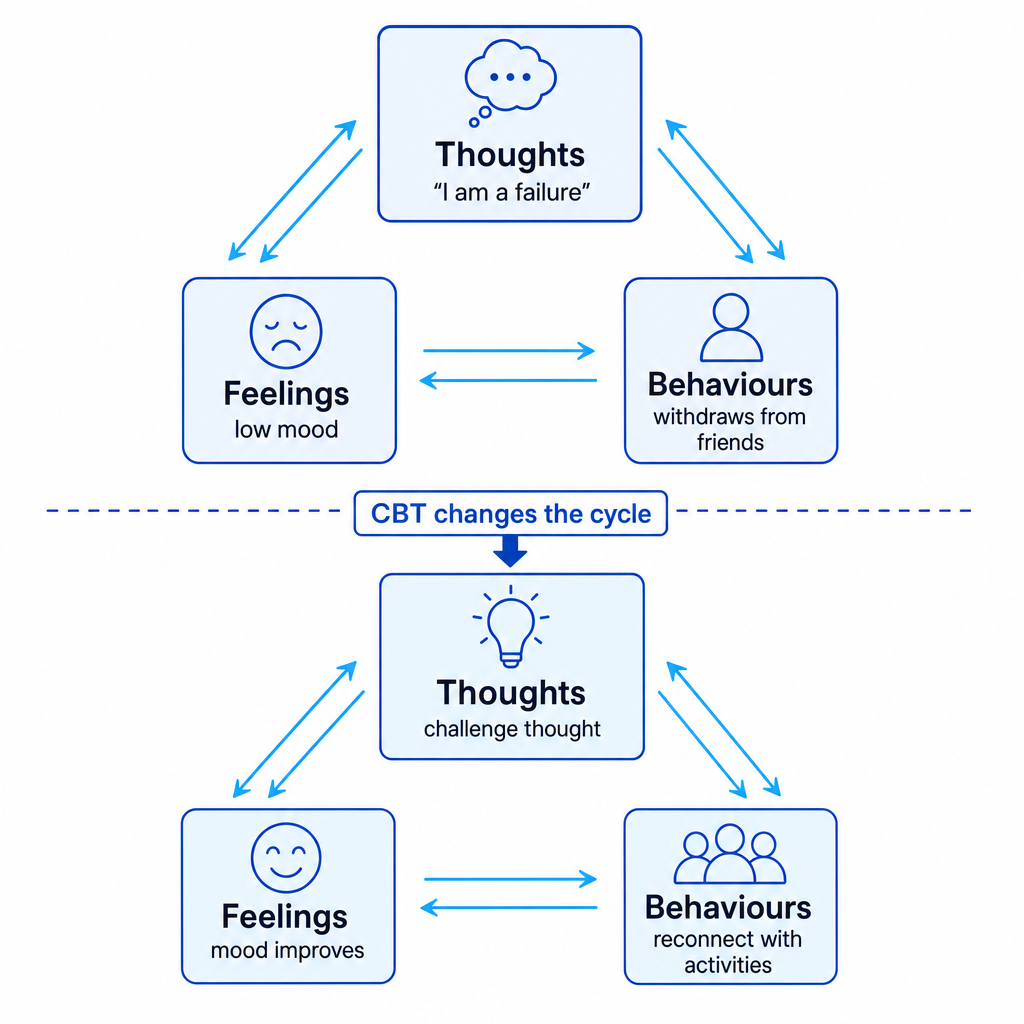
CBT tries to break this cycle by helping the person identify negative automatic thoughts, test whether they are realistic, replace them with more balanced thoughts, and gradually re-engage in helpful activities.
Example
Using CBT to break a vicious cycle
- A person thinks, “Nobody wants me around,” then feels low and avoids replying to messages. This links a negative thought to a feeling and a behaviour.
- In CBT, they examine evidence for and against the thought, such as times friends have invited them out or checked in on them.
- They develop a more balanced thought, such as “Some people do care about me, even if I feel unwanted right now.”
- They set a small behavioural goal, such as replying to one friend. If the interaction goes well, this can improve mood and weaken the original negative schema.
Evaluating CBT
CBT can be effective because it teaches skills the person can keep using after therapy ends. It also avoids drug side effects and targets the negative schemas and attributions linked to the psychological explanation.
However, CBT requires effort, motivation and access to trained therapists. It may be difficult for someone with very severe depression to complete homework tasks or attend sessions regularly. It may also be less appropriate if the person’s main difficulties come from ongoing social problems, such as unsafe housing or abuse, unless those wider issues are also addressed.
Wiles' study of the effectiveness of CBT
Wiles' study of the effectiveness of CBT is the named study for this part of the spec.
Aim
The aim was to investigate whether CBT, added to usual care, was effective for people with depression who had not responded well to antidepressant medication.
Method
Wiles used a randomised controlled trial. Participants with depression were randomly allocated to one of two groups:
- usual care only, such as continuing antidepressant treatment through their GP
- usual care plus CBT, involving a course of CBT sessions
The study collected quantitative data about depression symptoms, including whether participants showed a clear improvement over time.
Results
A higher percentage of participants improved in the group receiving CBT plus usual care compared with usual care alone. For example, after six months, about 46% of the CBT plus usual care group responded to treatment, compared with about 22% of the usual care group.
Example
Interpreting Wiles' results
- Compare the two response rates: 46%−22%=24 percentage points46\% - 22\% = 24\text{ percentage points}46%−22%=24 percentage points.
- The CBT plus usual care group had a higher improvement rate, so adding CBT appeared to help more participants.
- Because participants were randomly allocated, the difference is more likely to be due to CBT, although it still does not prove CBT works for every individual.
Conclusion and link to theory
Wiles concluded that CBT can be an effective treatment for depression, especially when added to usual care for people who have not improved enough with antidepressants alone.
This supports the psychological explanation because changing thoughts and behaviours can reduce depressive symptoms. It also supports a more holistic approach because CBT was used alongside medication rather than replacing it completely.
Evaluation of Wiles' study
A strength is the use of a randomised controlled trial. Random allocation reduces participant differences between groups, making the comparison fairer.
Another strength is that the study used real patients receiving care through ordinary health services, so it has good real-world relevance.
A limitation is that participants knew whether they were receiving CBT, so expectations may have affected results. Also, the study tested CBT plus usual care, not CBT completely on its own.
Ethically, participants were a potentially vulnerable group, so researchers needed informed consent, confidentiality, the right to withdraw, protection from harm and appropriate support. The control group still received usual care, which helped reduce the ethical problem of withholding treatment.
Exam technique
In the exam
- If asked to describe an explanation, name it clearly: biological means neurotransmitters such as serotonin; psychological means negative schemas and attributions.
- If asked to evaluate a therapy, judge both effectiveness and appropriateness for different people or situations.
- For Wiles' study, include aim, method, results and conclusion, then link it back to CBT and the idea of a holistic approach.
Self review
Check yourself
- How does serotonin link to the biological explanation of depression?
- What is the difference between a negative schema and a negative attribution?
- Why does Wiles' study support CBT, but not prove CBT works for everyone?
You've reached the end
Test yourself on this topic, or move on to the next guide.
How was this guide?