This article covers 3.1.4 Research methods of the AQA GCSE Psychology specification.
The Normal Distribution: A Symmetrical Bell
- A normal distribution is a symmetrical, bell-shaped pattern of data.
- Most scores cluster around the middle, with fewer and fewer as you move out to each extreme.
- Many human traits, such as height and IQ, follow this pattern.
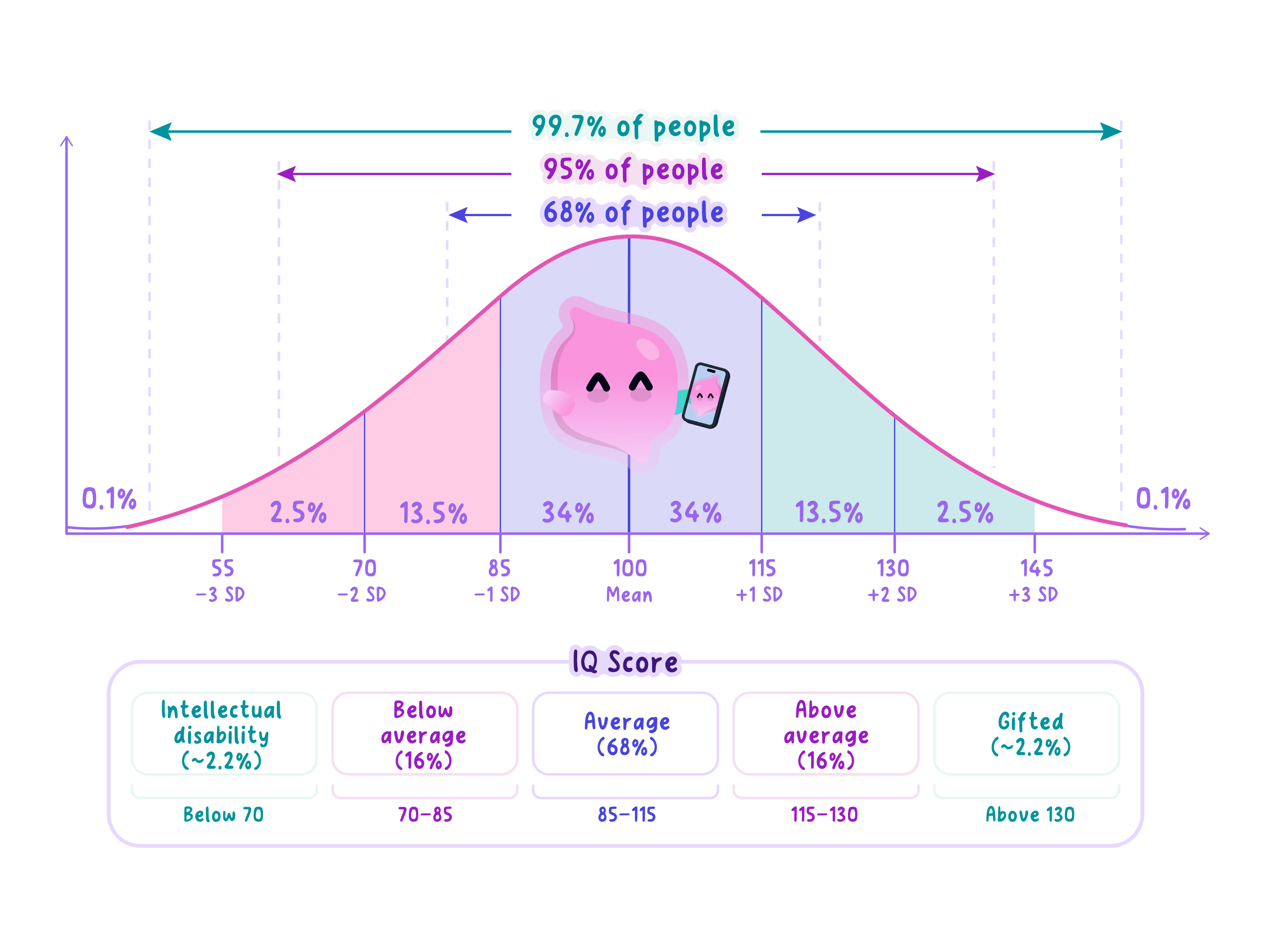
Key Idea
- The curve is symmetrical, so its left and right halves mirror each other, and the single peak sits in the middle where most scores fall.
Where the Three Averages Fall
- In a normal distribution the mean, median and mode are all equal.
- They sit together at the centre, directly under the highest point of the curve.
- That coincidence is the feature that lets you recognise the distribution.
Example
- Nine pupils score 4, 5, 5, 6, 6, 6, 7, 7 and 8 on a task; the scores are symmetric about 6.
- Mean: the nine scores total 54, and 54 divided by 9 is 6.
- Median: the fifth of nine ordered values is the middle, which is 6.
- Mode: 6 appears three times, more than any other value, so the mode is 6. All three averages meet at 6, just as a normal distribution predicts.
- On a larger scale, IQ scores form a normal distribution centred on 100, with most people near 100 and few very high or very low.
Spot It, and Do Not Mistake a Skew
- Look for the symmetrical bell shape on the graph.
- Check the peak is in the middle, not pushed to one side.
- A distribution dragged to one side is skewed, and its mean, median and mode no longer coincide.
Common Mistake
- Do not call a lopsided, one-sided curve a normal distribution.
- Do not claim the mean, median and mode are equal unless the distribution really is symmetrical.
Describe One in an Answer
- State that the curve is symmetrical and bell-shaped.
- Add that most scores lie near the middle, with few at the extremes.
- Finish by saying the mean, median and mode all lie together at the centre.
Self review
- What shape is a normal distribution?
- Where do the mean, median and mode fall in a normal distribution?
- For the scores 4, 5, 5, 6, 6, 6, 7, 7, 8, show that the mean, median and mode are equal.
- How can you tell a distribution is not normal?