This article covers 3.1.3 Development of the AQA GCSE Psychology specification.
Egocentrism: Seeing Only Your Own View
Definition
Egocentrism
A young child's tendency to see the world only from their own point of view and to assume that other people see, think and feel exactly the same things they do.
- A pre-operational child assumes that other people share their own point of view.
- This is egocentrism: being unable to picture a scene from anyone else's position.
- It is not selfishness; the child simply cannot yet take another person's perspective.
- Egocentricity reduces as the child grows and learns to decentre, usually by about seven.
Example
- Watch a three-year-old play hide and seek at a family party.
- They hide by covering their own eyes, certain that because they cannot see you, you cannot possibly see them, a neat display of egocentrism.
Conservation: Logic Beats Appearance
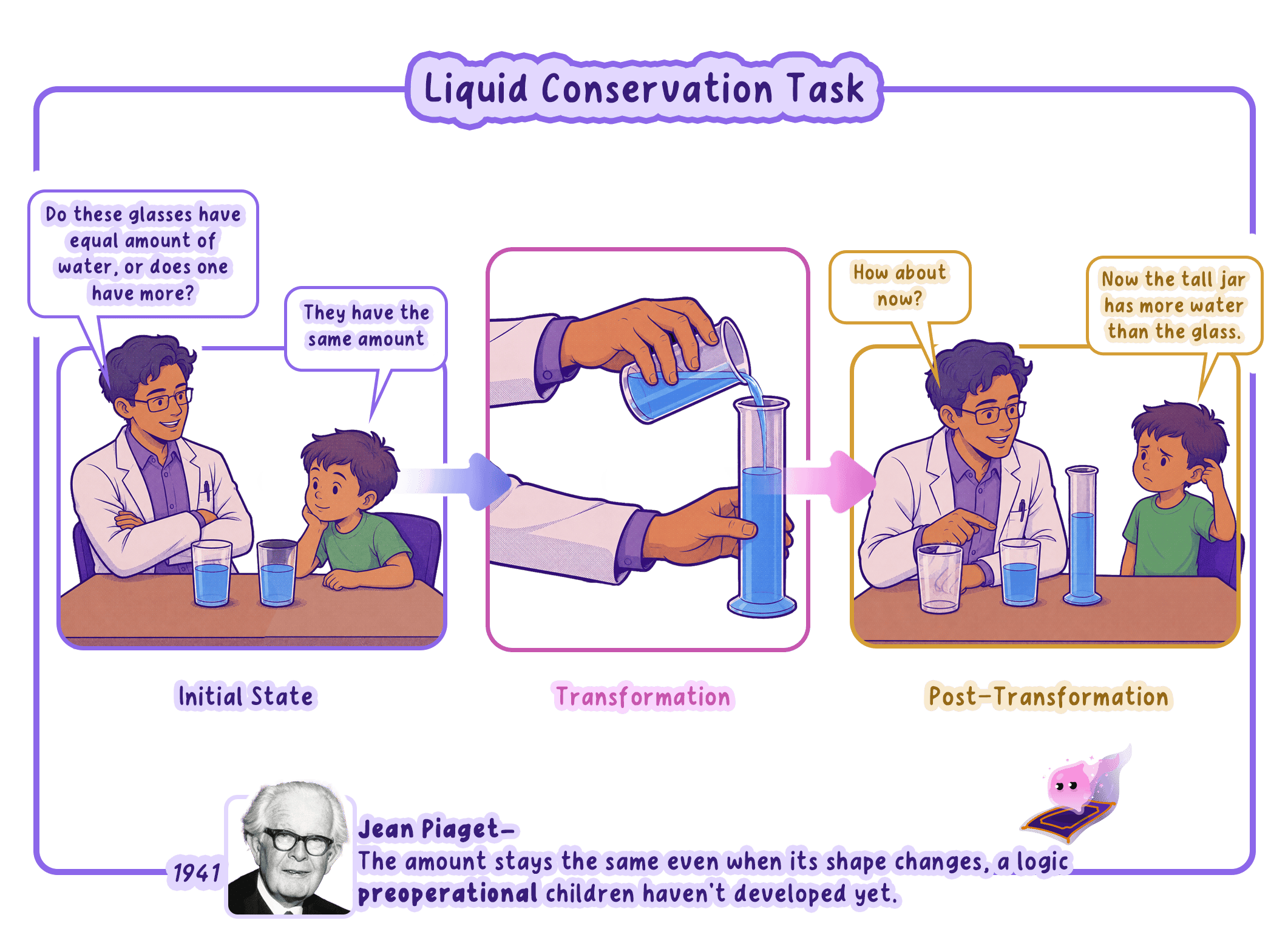
- Conservation is knowing that the amount of something stays the same when only its appearance changes.
- A pre-operational child is fooled by appearance, saying a taller, thinner glass holds more squash even though nothing was added or taken away.
- From about seven, in the concrete operational stage, the child knows the amount is unchanged.
How Conservation Develops
- Decentration
- Being able to focus on more than one feature at once, such as height and width together, so the taller glass no longer fools the child.
- Reversibility
- Being able to imagine undoing an action, such as pouring the squash back, so the child sees the amount must be the same.
Example
- Think back to primary school maths, spreading ten counters into a long line and then bunching them up tight.
- A Year 1 pupil often says the long line has more, while a Year 3 pupil counts, decentres and mentally reverses the move to see the number never changed.
Explaining These in an Answer
- Name the concept and define it in one clear sentence.
- Give an everyday example of the error a younger child makes.
- Say how it changes with age, linking the reduction of egocentricity and the ability to conserve to the move into the concrete operational stage.
Self review
- What is egocentrism, and why is it not the same as being selfish?
- What is conservation?
- How do decentration and reversibility help a child conserve?
- At about what age, and in which stage, do children usually reduce egocentricity and start to conserve?