This article covers 3.1.3 Development of the AQA GCSE Psychology specification.
Piaget's Stages: Thinking Changes in Kind
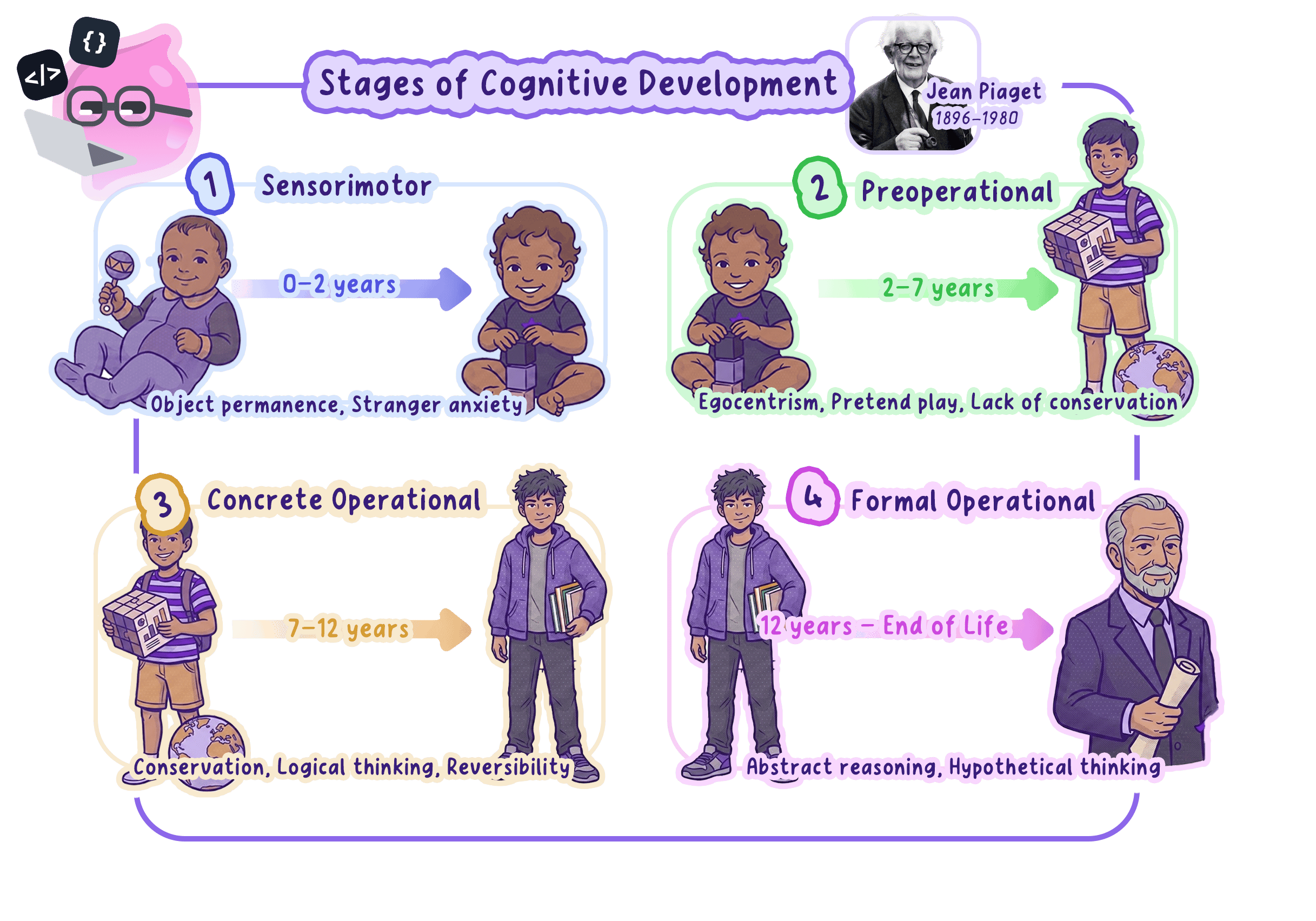
- Piaget said every child passes through four stages of cognitive development.
- The stages are invariant, which means each child goes through them in the same fixed order.
- No stage can be skipped, because each one builds on the thinking of the stage before it.
- The change between stages is qualitative, meaning the child's thinking changes in kind rather than merely in amount.
Key Idea
- Moving up a stage means thinking in a genuinely new way rather than just knowing more facts.
- The ages are rough guides, but the order is the same for everyone.
The Two Early Stages
Definition
Object permanence
The understanding that an object still exists even when you can no longer see, hear or touch it. Piaget argued this develops towards the end of the sensorimotor stage.
- In the sensorimotor stage, from birth to about two, a baby explores the world through the senses and movement.
- The key achievement here is object permanence, knowing that a hidden object still exists.
- In the pre-operational stage, from about two to seven, the child can use language and other symbols.
- Their thinking is still egocentric and they cannot yet conserve, so appearances easily fool them.
The Two Later Stages
Definition
Conservation
In Piaget's theory, understanding that the quantity of something stays the same even when its appearance changes, such as its shape or the way it is arranged.
- In the concrete operational stage, from about seven to eleven, the child can think logically about real, concrete things.
- They can now conserve, grasping that a quantity stays the same even when its appearance changes.
- In the formal operational stage, from about eleven onwards, thinking becomes abstract.
- The young person can now reason about hypothetical ideas and work problems through in their head.
Example
- Picture one family on a car journey with a two-year-old, a five-year-old and a fourteen-year-old.
- The toddler hunts for a dropped toy because they now grasp object permanence, the five-year-old insists the longer row of sweets has more, and the teenager can argue a hypothetical what-if, three stages of thinking in one back seat.
Describing the Stages in an Answer
- Name each stage with its rough age range.
- Give the main feature of thinking at each stage.
- Stress that the order is invariant and that the shifts between stages are qualitative.
Piaget in the Classroom: Match the Task to the Mind
- Piaget argued that children think in qualitatively different ways at each stage, so what a child can learn depends on the stage their thinking has reached.
- A young child in the pre-operational stage cannot yet decentre or conserve, so a lesson that assumes neat logical reasoning will simply not land.
- You therefore build teaching around the stage the child is at, handing them materials to act on rather than facts to swallow.
Key Idea
- For Piaget, a child builds understanding by acting on the world, not by being told the answer.
- So the golden rule of Piagetian teaching is to fit the task to the stage and let the child construct the idea.
Readiness
Definition
Readiness
In Piaget's theory, the idea that a child can only learn a new concept once their thinking has matured to the right stage. Teaching given before a child is ready will not be properly understood.
- Readiness means a child grasps a new idea only once their thinking has matured to the right stage, so timing matters as much as content.
- Push formal algebra onto a child still reasoning in the concrete operational stage and they may copy the steps yet never understand why they work.
- Your job is to check the child is ready, then set a challenge just beyond what they can already do so their thinking has to stretch.
Example
- In a Year 2 classroom, pupils pour the same orange squash between a tall thin beaker and a short wide one and watch the amount stay the same.
- Handling the liquid themselves lets them discover conservation, rather than being told the volume is equal and taking it on trust.
Discovery Learning and Stage-Appropriate Tasks
- Discovery learning means children learn actively by exploring and experimenting rather than being handed the answer to memorise.
- Stage-appropriate tasks match the demands of the activity to the thinking typical of the child's current stage.
- The teacher becomes a guide who sets up the environment, then lets pupils investigate, ask questions and reach the conclusion for themselves.
Note
- Think of the teacher as a gardener rather than a sculptor: you set up the right soil and light, then let each child grow at their own pace.
Evaluating Piaget in Education
- His ideas transformed UK primary teaching, encouraging hands-on maths apparatus, sand and water play and group investigation.
- But strict readiness can become an excuse to hold pupils back, because many children manage far more with the right support.
- Critics argue that good teaching can pull a child's development forward with guidance and support, a role Piaget's theory underplays.
- Discovery learning can also be slow and leave gaps if a pupil never quite stumbles onto the key idea by themselves.
Common Mistake
- Do not just describe Piaget's stages; the question asks you to apply them to the classroom.
- Always pair a benefit with a limitation when you evaluate the impact on teaching.
Writing a Strong Application Answer
- Name a Piagetian teaching idea such as readiness, discovery learning or stage-appropriate tasks.
- Link it to a concrete classroom example, like water play for conservation.
- Evaluate it with one clear strength and one clear weakness.
Self review
- Name Piaget's four stages in order.
- What does readiness mean in Piaget's approach to teaching?
- Give one classroom example of a stage-appropriate task.
- Give one criticism of applying Piaget's ideas to education.