Weight
Definition
Weight
The force acting on an object because of gravity, measured in newtons.
Definition
Newton
The unit of force, equal to the resultant force that gives a mass of one kilogram an acceleration of one metre per second squared.
- The weight of an object is the gravitational force that acts on it because it is in a gravitational field.
- Weight is a force, so it is measured in newtons, N\text{N}N, and it has a direction as well as a size.
- Weight always acts towards the centre of the object creating the field, which on Earth means vertically downwards.
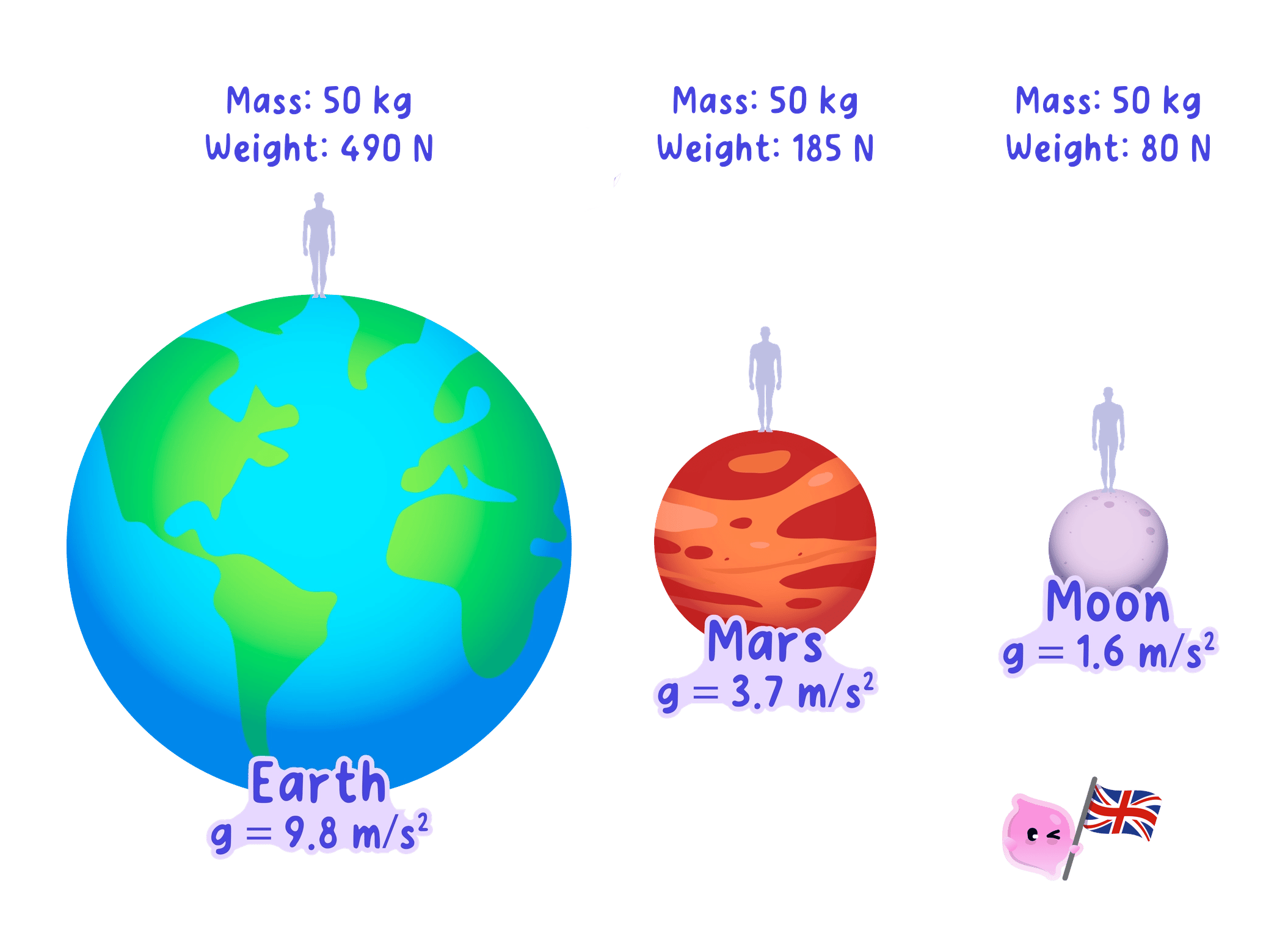
- Mass and weight are different quantities.
- Mass is the amount of matter in an object, measured in kilograms, and it is the same wherever the object is.
- Weight is a force measured in newtons, and it changes if the object moves to a place where the gravitational field is stronger or weaker.
- An astronaut with a mass of 70 kg70\ \text{kg}70 kg still has a mass of 70 kg70\ \text{kg}70 kg on the Moon, but weighs far less there because the Moon's gravitational field is weaker.
Measuring weight
Definition
Newton meter
An instrument containing a calibrated spring that measures the size of a force, such as a weight, in newtons.
- Weight is measured with a newton meter, also called a spring balance or force meter.
- A newton meter contains a spring that stretches when an object is hung from its hook.
- The spring obeys Hooke's law, so its extension is directly proportional to the weight on the hook, and the scale can be marked in evenly spaced newtons.
- Newton meters come in different ranges, such as 000 to 1 N1\ \text{N}1 N for light objects and 000 to 50 N50\ \text{N}50 N for heavy ones.
- A top-pan balance, kitchen scales and bathroom scales respond to the force an object exerts on them, but they are set up to display mass in grams or kilograms.
- These scales divide the force they detect by the Earth's gravitational field strength, so digital kitchen scales taken to the Moon would show a mass about six times too small.
Weight and gravitational field strength
Definition
Gravitational field strength
The gravitational force acting on each kilogram of mass, which is 10 N/kg10\ \text{N/kg}10 N/kg near the Earth's surface.
- The gravitational field strength, ggg, is the force that a gravitational field exerts on each kilogram of mass.
- Gravitational field strength is measured in newtons per kilogram, N/kg\text{N/kg}N/kg.
- At the Earth's surface, ggg is about 10 N/kg10\ \text{N/kg}10 N/kg, so every kilogram of mass has a weight of about 10 N10\ \text{N}10 N.
- The weight of an object is its mass multiplied by the gravitational field strength.
- For an object of fixed mass, weight is directly proportional to the gravitational field strength.
- Doubling ggg doubles the weight, and halving ggg halves the weight.
- A 2.0 kg2.0\ \text{kg}2.0 kg bag of potatoes has a weight of 2.0×10=20 N2.0\times10=20\ \text{N}2.0×10=20 N on Earth.
- The same bag on the Moon, where ggg is 1.6 N/kg1.6\ \text{N/kg}1.6 N/kg, has a weight of only 2.0×1.6=3.2 N2.0\times1.6=3.2\ \text{N}2.0×1.6=3.2 N.
- For a fixed value of ggg, weight is also directly proportional to mass, so a 4.0 kg4.0\ \text{kg}4.0 kg bag weighs twice as much as a 2.0 kg2.0\ \text{kg}2.0 kg bag in the same place.
Example
Reading a newton meter
- A newton meter with a range of 000 to 10 N10\ \text{N}10 N has 505050 equal divisions on its scale.
- The pointer rests 232323 divisions below zero when a pencil case hangs from the hook.
- The weight of the pencil case is 4.6 N4.6\ \text{N}4.6 N.
Example
Weight in a different field
- A toolbox with a mass of 5.0 kg5.0\ \text{kg}5.0 kg weighs 50 N50\ \text{N}50 N on Earth, where ggg is 10 N/kg10\ \text{N/kg}10 N/kg.
- On Mars, ggg is about 3.7 N/kg3.7\ \text{N/kg}3.7 N/kg.
- The toolbox still has a mass of 5.0 kg5.0\ \text{kg}5.0 kg on Mars, and only its weight has changed.
Practical
Measuring weight with a newton meter
- Aim: to measure the weights of several everyday objects with newton meters and to compare each weight with the object's mass.
- Apparatus: newton meters with ranges of 000 to 1 N1\ \text{N}1 N, 000 to 10 N10\ \text{N}10 N and 000 to 50 N50\ \text{N}50 N, a clamp stand with a boss and clamp, a top-pan balance, small plastic bags or string loops for holding objects, and objects such as an apple, a stapler and a pencil case.
- Method:
- Measure the mass of each object on the top-pan balance and convert it into kilograms.
- Choose the newton meter with the smallest range that the object will not exceed, so the reading uses as much of the scale as possible.
- Hang the newton meter from the clamp so that it hangs vertically, with nothing touching its hook.
- Check that the pointer reads zero, and turn the adjusting screw at the top until it does.
- Hang the object from the hook in a bag or string loop, wait until it stops swinging, and read the scale with your eye level with the pointer.
- Repeat the reading twice more, taking the object off and rehanging it each time, and calculate a mean weight.
- Divide each mean weight by the object's mass in kilograms.
- Results: each object's weight in newtons is about ten times its mass in kilograms, so a 0.150 kg0.150\ \text{kg}0.150 kg apple weighs about 1.5 N1.5\ \text{N}1.5 N.
- Conclusion: dividing weight by mass gives about 10 N/kg10\ \text{N/kg}10 N/kg for every object, which is the gravitational field strength at the Earth's surface.
- Watch out: a newton meter held at an angle or touching the bench gives a low reading, and one that has not been zeroed adds the same error to every reading.
- Safety: do not hang an object heavier than the meter's maximum reading, because this can permanently stretch the spring.
Common Mistake
- Do not give weight in kilograms, because weight is a force and is measured in newtons.
- Do not say that an object's mass changes on the Moon, because only its weight changes.
- Do not call weight gravity, because the correct terms are weight or gravitational force, and ggg is the gravitational field strength.
Exam technique
Weight answers
- Define weight as the gravitational force acting on an object, and give its unit as the newton.
- When asked how weight is measured, name the newton meter and describe hanging the object from it and reading the scale once it is still.
- Recall that ggg is 10 N/kg10\ \text{N/kg}10 N/kg at the Earth's surface whenever a question expects you to use it.
- When comparing places, say that mass stays the same while weight changes because the gravitational field strength changes.
Self review
- Define weight and give its unit.
- Name the instrument used to measure weight.
- State the gravitational field strength at the Earth's surface.
- Explain why an astronaut weighs less on the Moon than on Earth.
- Describe how weight changes when the gravitational field strength is halved.
