Definition
Gravitational field
The region around an object with mass in which any other object with mass experiences an attractive force.
Definition
Gravitational force
The attractive force that acts between any two objects that have mass.
- Every object that has mass is surrounded by a gravitational field.
- This is true of all matter, from a star or a planet down to a person, a pencil or a single atom.
- Any other object with mass inside the field experiences a gravitational force.
- The force acts without the objects touching, so gravity is a non-contact force.
- Gravitational forces are always attractive, pulling objects towards each other and never pushing them apart.
- The attraction acts on both objects, so the Earth pulls on you and you pull on the Earth with a force of the same size in the opposite direction.
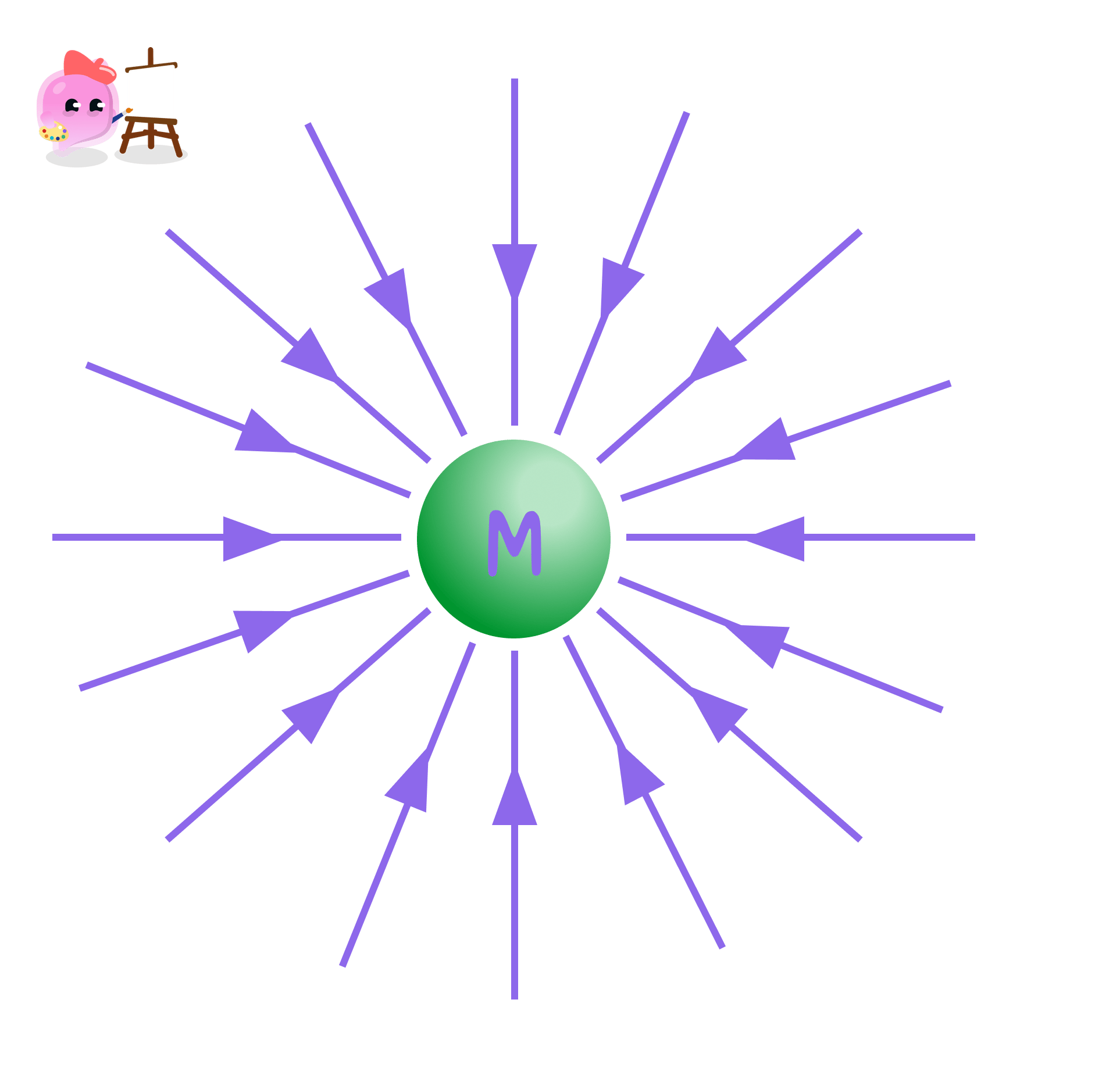
- A gravitational field is drawn with field lines that point inwards towards the centre of the object, showing the direction of the force on any other mass placed in the field.
- Where the field lines are closer together, the field is stronger.
- The lines spread further apart with distance from the object, so the field becomes weaker further away.
Field strength and mass
Definition
Gravitational field strength
The gravitational force acting on each kilogram of mass, which is 10 N/kg10\ \text{N/kg}10 N/kg near the Earth's surface.
- The strength of a gravitational field depends on the mass of the object that creates it.
- An object with a very large mass has a much stronger gravitational field than an object with a small mass.
- In physics, massive means having a large mass, not having a large size.
- The Earth has a mass of about 6×1024 kg6\times10^{24}\ \text{kg}6×1024 kg, which gives it a field strong enough to hold you on the ground and keep the Moon in orbit.
- The Moon has about one eightieth of the Earth's mass, and the gravitational field strength at its surface is only about 1.6 N/kg1.6\ \text{N/kg}1.6 N/kg, compared with 10 N/kg10\ \text{N/kg}10 N/kg at the Earth's surface.
- Jupiter, the most massive planet in the Solar System, has a gravitational field strength of about 25 N/kg25\ \text{N/kg}25 N/kg at the top of its clouds.
- The Sun holds more than 99%99\%99% of the mass of the Solar System, and its enormous field keeps every planet in orbit around it.
Attraction between everyday objects
- Two everyday objects, such as two people standing side by side, also attract each other through their gravitational fields.
- Their masses are tiny compared with the mass of a planet, so the force between them is extremely small.
- Two pupils with masses of 60 kg60\ \text{kg}60 kg standing 1 m1\ \text{m}1 m apart attract each other with a force of less than one millionth of a newton.
- Friction between their shoes and the floor is far larger than this force, so the pupils never notice it and do not move towards each other.
- The attraction between you and the Earth is large because the Earth's mass is enormous, even though your own mass is small.
- Gravitational attraction is therefore only noticeable when at least one of the objects is very massive, such as a moon, a planet or a star.
Field strength and distance
- The gravitational field of an object becomes weaker as you move further away from it.
- Close to the Earth's surface the field hardly changes over the heights you could climb, so it can be treated as uniform near the ground.
- Far from the Earth, such as halfway to the Moon, the Earth's field is much weaker, although it never quite falls to zero.
Example
Comparing the pull of different worlds
- A 1 kg1\ \text{kg}1 kg bag of sugar experiences a gravitational force of 10 N10\ \text{N}10 N at the Earth's surface.
- On the Moon, the same bag experiences a force of only 1.6 N1.6\ \text{N}1.6 N, because the Moon has far less mass than the Earth.
- At the cloud tops of Jupiter, the bag would experience a force of about 25 N25\ \text{N}25 N, because Jupiter is far more massive than the Earth.
- The bag's mass of 1 kg1\ \text{kg}1 kg is the same in all three places, and only the strength of the field acting on it changes.
Common Mistake
- Do not say that gravity can repel, because gravitational forces only ever attract.
- Do not say that only large objects have a gravitational field, because every object with mass has one, however small its mass.
- Do not use massive to mean large in size, because the strength of a field depends on how much mass an object has.
- Do not say there is no gravity in space, because the Earth's field reaches far beyond the atmosphere and only weakens with distance.
Exam technique
Describing gravitational fields
- State that all matter has a gravitational field and that the field causes attraction.
- Link field strength to mass, writing that a more massive object has a stronger field, instead of linking it to size.
- When explaining why you do not notice the attraction to another person, say that both masses are small, so the force is tiny compared with other forces such as friction.
- Use the term gravitational field strength with the unit N/kg\text{N/kg}N/kg when comparing different fields.
Self review
- State which objects have a gravitational field.
- Describe the direction of the gravitational force between two objects.
- Explain why the Earth's gravitational field is much stronger than the Moon's.
- Explain why you do not feel any attraction towards the person sitting next to you.
- State what happens to the strength of a gravitational field as you move further from the object that creates it.
