Question 6
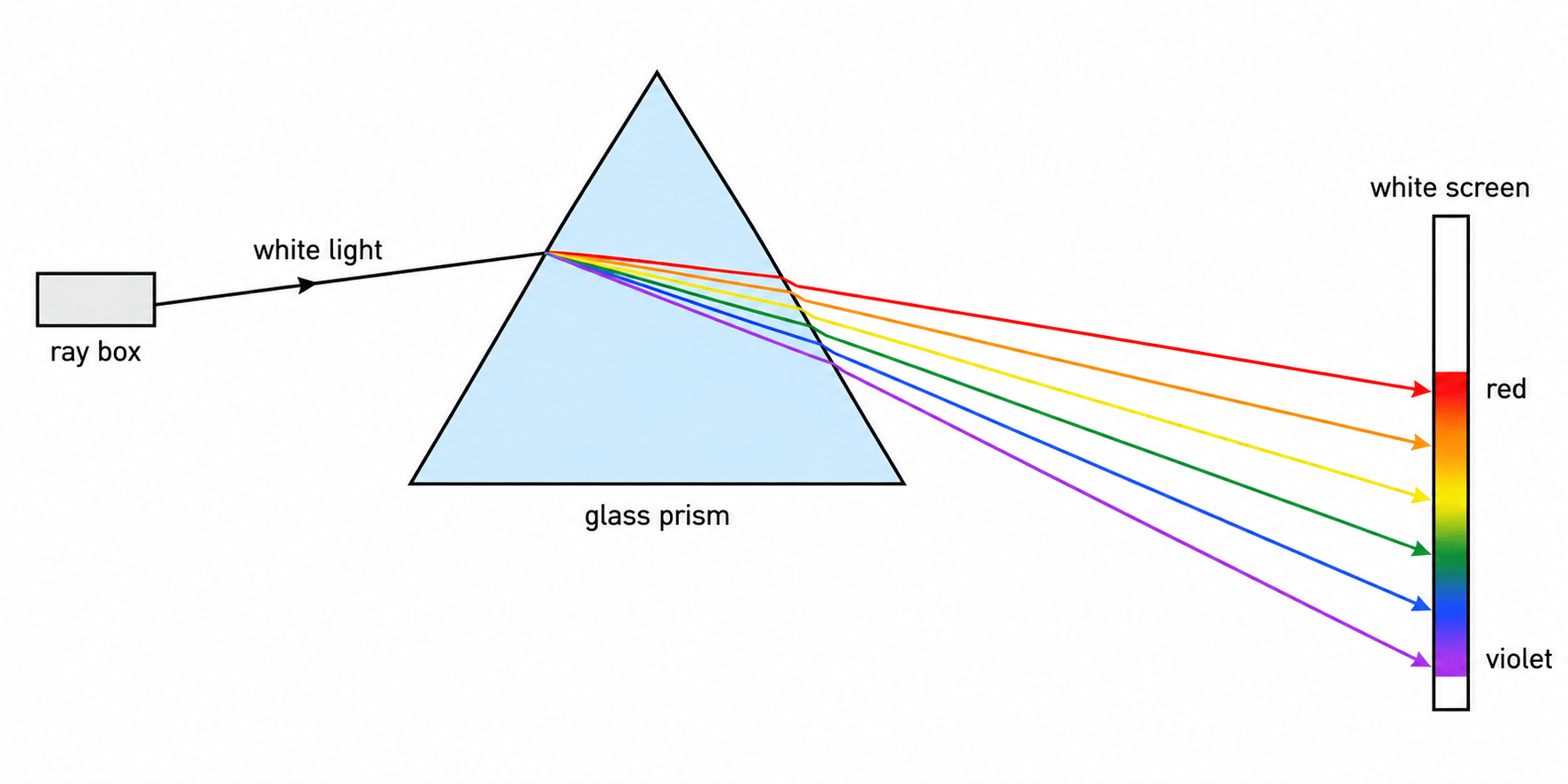
HA student shines a narrow beam of white light into a triangular glass prism. A spectrum of colours is seen on a white screen.
The Figure shows the apparatus.
Figure
a.[1]
State what this experiment shows about white light.
b.[2]
Violet light is refracted more than red light by the glass.
Explain why, in terms of the speed of light.
c.[1]
In air, red light has a wavelength of 700 nm700\ \text{nm}700 nm and violet light has a wavelength of 400 nm400\ \text{nm}400 nm.
Describe how the amount of refraction by glass depends on the wavelength of light.
d.[2]
The student places a thermometer with a blackened bulb on the screen, just beyond the red end of the spectrum. No light can be seen there, but the temperature reading rises.
Suggest an explanation for this.
5.3 Wave interactions Questions
51 exam-style questions on OCR GCSE Physics 5.3 Wave interactions, covering 5.3.1 Wavelength and how substances affect waves, 5.3.2 Wave velocity in different substances, 5.3.3 Convex and concave lenses, 5.3.4 Ray diagrams for reflection and refraction, and 5.3.5 Colour, absorption and reflection. Each one has a worked solution and a mark scheme showing where the marks go.