Wave behaviour
What you'll learn
- How a wave transfers energy without carrying matter along with it.
- What amplitude (maximum displacement), wavelength (distance from one repeat to the next), frequency (cycles per second) and period (time for one cycle) mean.
- How to use the wave equation v=fλv=f\lambdav=fλ to calculate speed, frequency or wavelength.
- How transverse waves (vibrations across the direction of travel) differ from longitudinal waves (vibrations along the direction of travel), and what happens at material boundaries.
1. Waves transfer energy
A wave is a disturbance that travels from one place to another. Waves can transfer energy and information, but the particles of the material usually only vibrate around fixed positions.
Wave, medium and mechanical wave
- A wave is a travelling disturbance that transfers energy.
- A medium is the substance or material a wave travels through, such as air, water or glass.
- A mechanical wave needs a medium to travel through, for example sound or water waves.
- An electromagnetic wave does not need a medium, so light and radio waves can travel through a vacuum.
Energy travels, not the material
In most waves in matter, the particles vibrate about their rest positions. The wave pattern and energy move on, but the water or air is not carried all the way with the wave.
2. Describing wave motion
When you draw a wave, you usually show displacement, which means how far a point is from its rest position and in which direction. A vibration is repeated motion about that rest position.
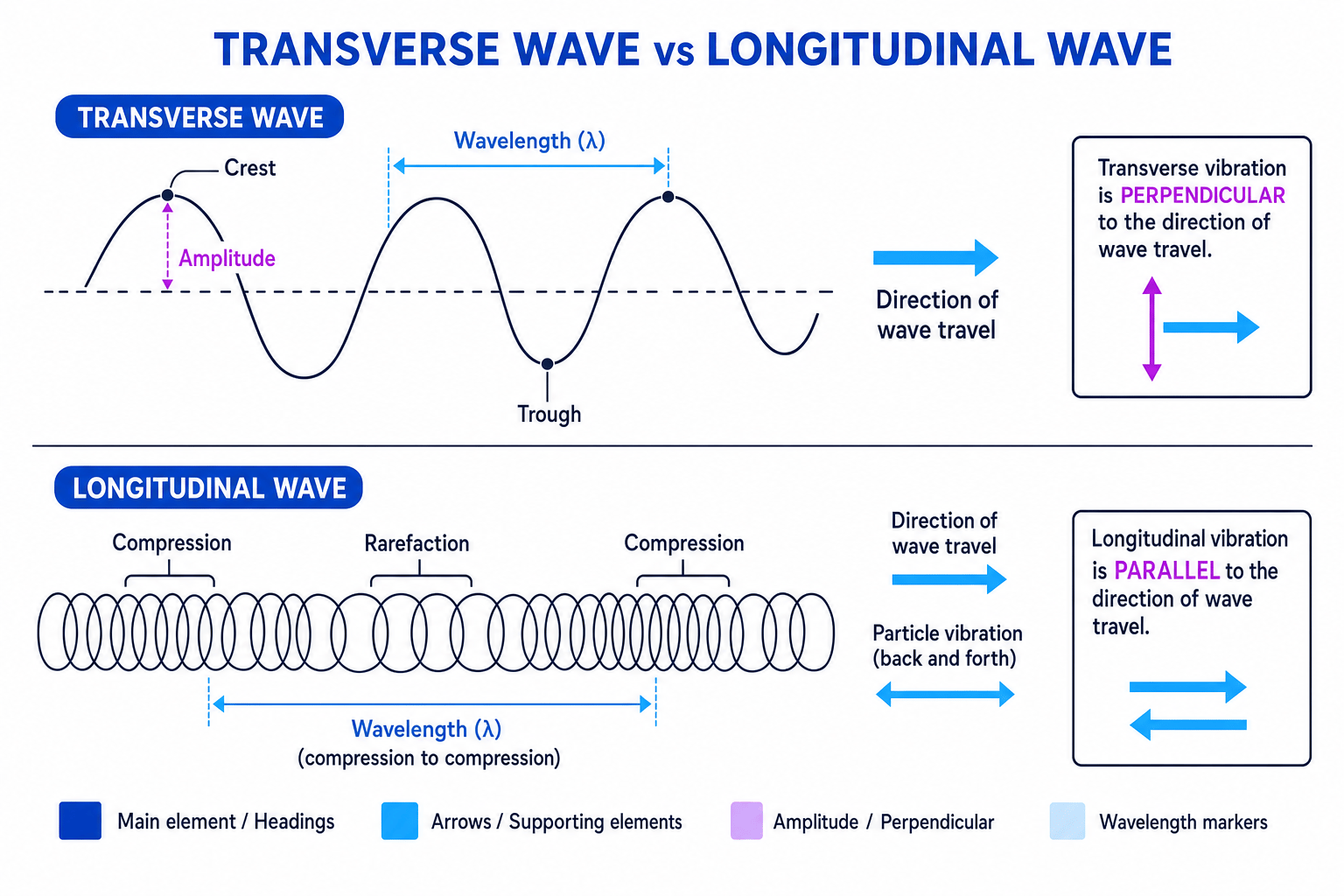
The diagram below shows the main wave measurements and compares the two main wave types.
Core wave quantities
- Amplitude is the maximum displacement from the rest position. A larger amplitude usually means more energy is being transferred.
- Wavelength, symbol λ\lambdaλ, is the distance from one point on a wave to the next matching point, such as crest to crest or compression to compression. It is measured in metres (m).
- Frequency, symbol fff, is the number of complete waves passing a point each second. It is measured in hertz (Hz).
- Period, symbol TTT, is the time taken for one complete wave or vibration. It is measured in seconds (s).
- Wave speed, symbol vvv, is the speed at which the wave pattern or energy travels. It is measured in metres per second (m/s).
Frequency and period are linked:
f=1TT=1ff=\frac{1}{T} \qquad T=\frac{1}{f}f=T1T=f1Calculating the period of a sound wave
A sound wave has frequency 250 Hz. Find its period.
- Choose the correct relationship: period is the time for one complete vibration, so use T=1fT=\frac{1}{f}T=f1.
- Substitute the frequency: T=1250 HzT=\frac{1}{250\ \text{Hz}}T=250 Hz1.
- Calculate the value: T=0.0040 sT=0.0040\ \text{s}T=0.0040 s. So one complete vibration takes 0.0040 seconds.
Mixing up wave graphs
- A displacement–distance graph is a snapshot of the whole wave at one instant, so you read wavelength from the horizontal distance between matching points.
- A displacement–time graph shows one point vibrating over time, so you read period from the time between matching points.
3. The wave speed equation
For OCR Gateway GCSE Physics, you need to recall and apply the wave speed equation:
v=fλv=f\lambdav=fλwhere:
- vvv is wave speed in m/s
- fff is frequency in Hz
- λ\lambdaλ is wavelength in m
You can rearrange it when needed:
f=vλλ=vff=\frac{v}{\lambda} \qquad \lambda=\frac{v}{f}f=λvλ=fvCalculating wave speed
A ripple has frequency 12 Hz and wavelength 0.75 m. Calculate its wave speed.
- Select the wave speed equation: v=fλv=f\lambdav=fλ.
- Substitute the values with units: v=12 Hz×0.75 mv=12\ \text{Hz}\times 0.75\ \text{m}v=12 Hz×0.75 m.
- Calculate: v=9.0 m/sv=9.0\ \text{m/s}v=9.0 m/s. The ripple travels at 9.0 metres per second.
Unit check
If frequency is in hertz and wavelength is in metres, the answer comes out in metres per second. Convert centimetres to metres before substituting into v=fλv=f\lambdav=fλ.
4. Transverse and longitudinal waves
In a transverse wave, the vibrations are perpendicular to the direction the wave travels. “Perpendicular” means at right angles. Water surface ripples are used as a GCSE model of transverse waves, and electromagnetic waves are also transverse.
In a longitudinal wave, the vibrations are parallel to the direction the wave travels. Sound waves in air are longitudinal: air particles vibrate back and forth, making compressions where particles are closer together and rarefactions where particles are further apart.
Classifying a wave from particle motion
A wave travels from left to right. The particles of the medium move up and down.
- Compare the direction of travel with the direction of vibration: the wave travels horizontally, while the particles vibrate vertically.
- Decide the relationship between the directions: horizontal and vertical are perpendicular.
- Identify the wave type: the wave is transverse because the vibration is perpendicular to the direction of travel.
5. Measuring wave speed and showing what moves
For water ripples, you can measure wave speed in a ripple tank by timing how long a crest takes to travel a known distance, or by measuring wavelength and frequency and using v=fλv=f\lambdav=fλ.
For sound in air, you can use two microphones connected to an oscilloscope or data logger. A sound reaches the first microphone, then the second; the time delay and distance between microphones give the speed.
Measuring the speed of sound
Two microphones are placed 1.70 m apart. A clap reaches the second microphone 0.0050 s after the first. Calculate the speed of sound.
- Use the distance between the microphones as the distance travelled by the sound: 1.70 m.
- Apply speed equals distance divided by time: v=1.70 m0.0050 sv=\frac{1.70\ \text{m}}{0.0050\ \text{s}}v=0.0050 s1.70 m.
- Calculate: v=340 m/sv=340\ \text{m/s}v=340 m/s. This is a sensible value for sound in air.
Evidence that the wave travels, not the material, includes a cork bobbing up and down on water as ripples pass. The cork is not carried all the way across the tank. Similarly, air particles in a sound wave vibrate backwards and forwards, passing the disturbance on to neighbouring particles.
6. Boundaries between materials
This separate Physics content in J249 looks at what happens when waves reach a material interface, which means the boundary between two materials.
At an interface, some wave energy may be reflected, some transmitted into the next material, and some absorbed by the material.
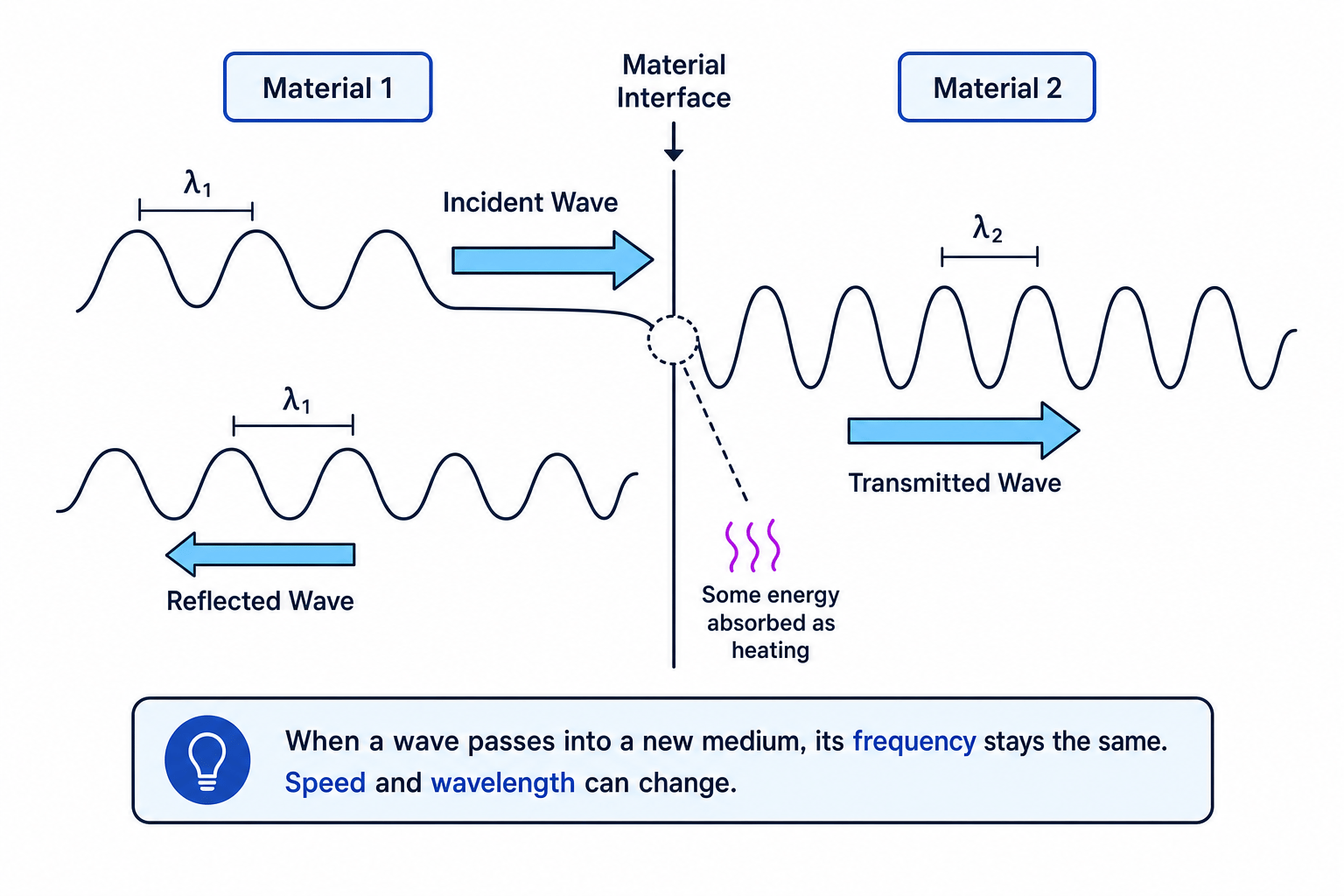
- Reflection: the wave bounces back into the original medium. Echoes are reflected sound waves.
- Transmission: the wave passes into the next medium. Its speed and wavelength may change.
- Absorption: wave energy is transferred to the material, often increasing its internal energy, so the wave’s amplitude is reduced.
Changing the frequency at a boundary
When a wave is transmitted into a new stationary medium, its frequency stays the same because the source still produces the same number of waves each second. If speed changes, wavelength changes instead.
Transmission: speed and wavelength are linked
If frequency stays the same, the equation v=fλv=f\lambdav=fλ tells you what must happen:
- if wave speed increases, wavelength increases
- if wave speed decreases, wavelength decreases
Finding wavelength after transmission
A sound wave of frequency 1000 Hz travels from air into water. Its speed is 340 m/s in air and 1500 m/s in water. Compare its wavelengths.
- Use the fact that frequency stays the same in both media: f=1000 Hzf=1000\ \text{Hz}f=1000 Hz.
- Calculate the wavelength in air: λ=vf=340 m/s1000 Hz=0.34 m\lambda=\frac{v}{f}=\frac{340\ \text{m/s}}{1000\ \text{Hz}}=0.34\ \text{m}λ=fv=1000 Hz340 m/s=0.34 m.
- Calculate the wavelength in water: λ=1500 m/s1000 Hz=1.5 m\lambda=\frac{1500\ \text{m/s}}{1000\ \text{Hz}}=1.5\ \text{m}λ=1000 Hz1500 m/s=1.5 m. The sound travels faster in water, so its wavelength is longer.
Echoes, ultrasound and sonar
Ultrasound is sound with frequency above the upper limit of human hearing, usually above 20,000 Hz. Ultrasound imaging uses reflections from boundaries inside the body. A pulse is sent in, and echoes return from tissue boundaries. The time taken tells the depth of the boundary, and the strength of the reflection helps build the image or trace.
Sonar works in a similar way, using sound waves in water. A boat sends out a sound pulse and detects the echo from the seabed or an object.
Calculating depth using a sonar echo
A sonar pulse travels through seawater at 1500 m/s. The echo returns after 0.40 s. Calculate the depth of the seabed.
- Recognise that 0.40 s is the time for the sound to travel down to the seabed and back up, so the total distance is vtv tvt.
- Calculate the total journey distance: 1500 m/s×0.40 s=600 m1500\ \text{m/s}\times 0.40\ \text{s}=600\ \text{m}1500 m/s×0.40 s=600 m.
- Halve the total distance to get the one-way depth: 600 m2=300 m\frac{600\ \text{m}}{2}=300\ \text{m}2600 m=300 m.
7. Hearing and converting vibrations
This next part is Higher Tier only in separate Physics. You need to know simple examples where wave disturbances are converted between sound waves and vibrations in solids.
A loudspeaker cone vibrates, pushing and pulling air to create a longitudinal sound wave. A microphone diaphragm does the reverse: incoming sound waves make a solid part vibrate, which is then converted into an electrical signal. The ear is a biological example of the same idea.
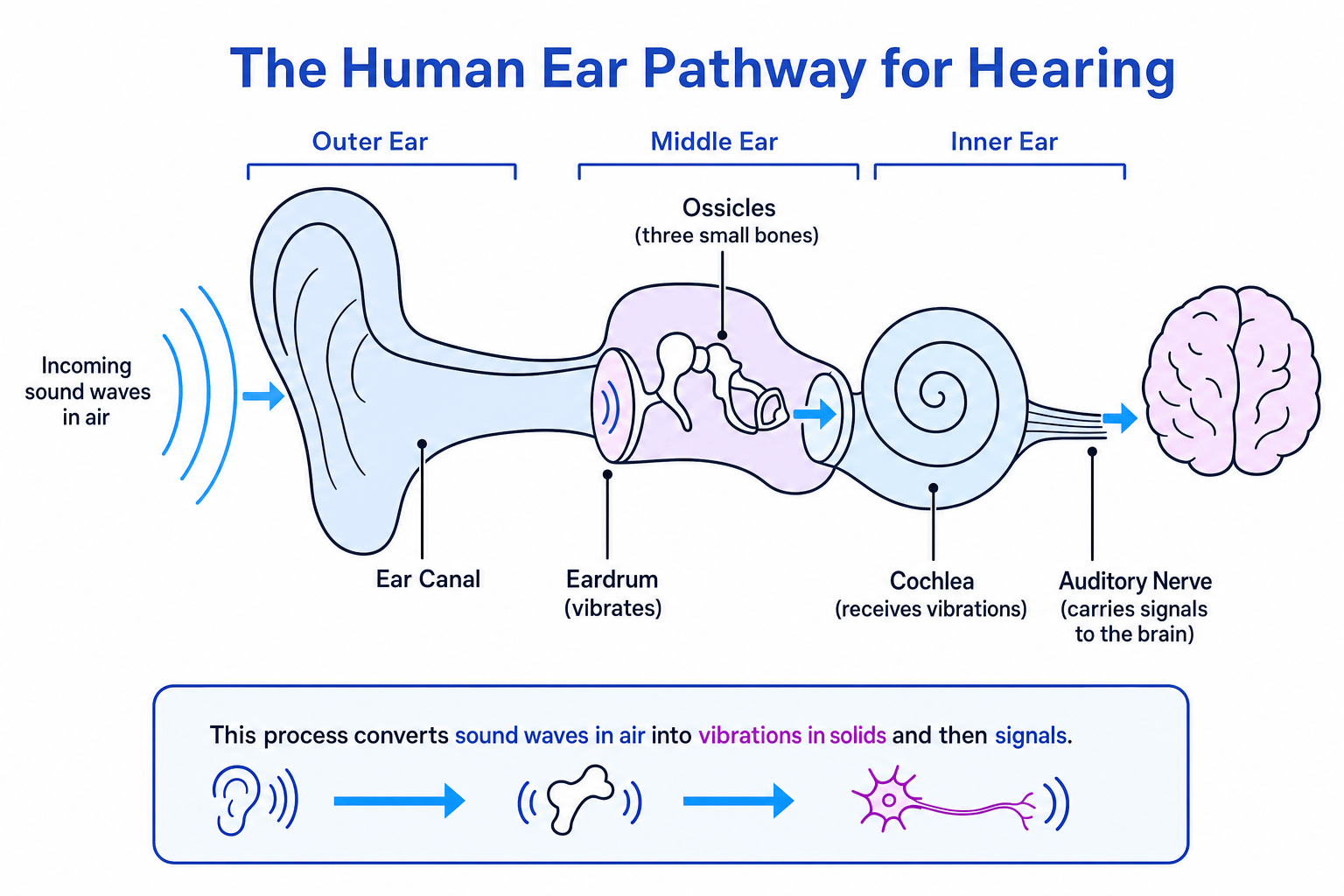
In the ear, sound waves travel along the ear canal and make the eardrum vibrate. The ossicles, three tiny bones in the middle ear, pass on these vibrations. The cochlea helps convert the vibrations into nerve signals, which travel along the auditory nerve to the brain.
Human hearing only works over a limited frequency range, roughly 20 Hz to 20,000 Hz for a young person. The ear’s structures do not respond equally well to every frequency. With ageing, hearing often becomes less sensitive, especially at high frequencies, because parts of the inner ear become less effective at detecting rapid vibrations.
Explaining why high-pitched hearing can reduce with age
- Link pitch to frequency: a high-pitched sound has a high frequency, so the vibrations are very rapid.
- Apply the limited-range idea: the ear only transfers and detects vibrations effectively over a certain frequency range.
- Explain the ageing effect: if the inner ear becomes less sensitive to high frequencies, those vibrations produce weaker nerve signals, so the sound may seem quieter or may not be heard.
In the exam
- Check the graph axes before answering: distance on the x-axis means read wavelength; time on the x-axis means read period.
- For transmission into a new medium, write that frequency stays the same, then use v=fλv=f\lambdav=fλ to link speed and wavelength.
- For echo questions, remember the wave usually travels to the object and back, so halve the total distance to find the one-way distance.
Check yourself
- What is the difference between amplitude and wavelength?
- A wave has frequency 500 Hz and speed 340 m/s. What is its wavelength?
- Why does a cork bobbing on water show that the wave travels, not the water itself?