5.2.1 Electromagnetic waves and refraction in glass (core practical)
Electromagnetic waves transfer energy
Transverse wave
A wave in which the oscillations are perpendicular to the direction of energy transfer.
- Every electromagnetic wave is transverse, including radio waves, microwaves, infrared, visible light, ultraviolet, X-rays and gamma rays.
- The changing electric and magnetic fields oscillate at right angles to the direction in which the wave transfers energy.
- Electromagnetic waves do not need particles, so they can travel through a vacuum.
- All electromagnetic waves travel through a vacuum at 3.0×10⁸ m s−13.0\times10^8\,\text{m s}^{-1}3.0×10⁸m s−1.
- The equation v=fλv=f\lambdav=fλ links wave speed vvv, frequency fff and wavelength λ\lambdaλ.
Calculating wavelength
- For a radio wave with f=2.0×10⁵ Hzf=2.0\times10^5\,\text{Hz}f=2.0×10⁵Hz in a vacuum, use λ=vf\lambda=\dfrac{v}{f}λ=fv.
- λ=3.0×1082.0×105=1.5×10³ m\lambda=\dfrac{3.0\times10^8}{2.0\times10^5}=1.5\times10^3\,\text{m}λ=2.0×1053.0×108=1.5×10³m.
Energy moves from source to observer
Electromagnetic radiation
Energy transferred through space by oscillating electric and magnetic fields.
- A source produces electromagnetic radiation and an observer or detector absorbs some of the energy it carries.
- Visible light from a lamp transfers energy to the retina or a light sensor when it is absorbed.
- Infrared radiation from a heater transfers energy to skin and increases its thermal energy store.
- Radio waves from a transmitting aerial transfer energy to a receiving aerial and can produce electrical oscillations.
For a complete explanation, identify the source, name the electromagnetic radiation and identify the observer or detector that absorbs the energy.
Refraction changes a ray's direction
Refraction
The change in direction of a wave caused by a change in speed as it passes from one medium into another.
- Light slows down when it enters glass from air and bends towards the normal.
- Light speeds up when it leaves glass for air and bends away from the normal.
- A ray travelling along the normal has i=0∘i=0^\circi=0∘, so its speed changes without a change in direction.
- For a parallel-sided rectangular block, the emergent ray is parallel to the incident ray but is laterally displaced.
- Measure the angles of incidence and refraction from the normal, not from the surface of the block.
- Do not explain a lower wave speed by saying the light has lost energy.
Investigating refraction in glass
- Apparatus: Use a ray box with a single slit or a low-power classroom laser, rectangular glass block, plain paper, sharp pencil, ruler and protractor.
- Independent variable: Change the angle of incidence iii, measured from the normal.
- Dependent variable: Measure the angle of refraction rrr, measured from the normal.
- Control variables: Keep the glass block, light colour, entry face, point of incidence and angle-measuring method the same.
- Method:
- Place the block on the paper and draw precisely around it.
- Draw a normal at 90∘90^\circ90∘ to the entry face at the chosen point of incidence.
- Use a protractor to draw an incident line at a selected value of iii.
- Direct one narrow ray along the line and mark two well-separated points on the incident ray and two on the emergent ray.
- Remove the block, join each pair of points with a ruler and connect the entry and exit points to reconstruct the ray inside the glass.
- Measure iii and rrr from the normal.
- Repeat with at least five angles spread across a suitable range, such as 20∘20^\circ20∘ to 70∘70^\circ70∘.
- Repeat each angle at least three times, identify anomalous readings and calculate a mean value of rrr.
- Processing: Record iii and mean rrr with degrees in a results table and plot mean rrr against iii if requested.
- Expected pattern: As iii increases, rrr increases, but for air to glass r<ir<ir<i because the ray slows and bends towards the normal.
- Uncertainty: A thick ray, broad pencil lines, block movement and parallax when using the protractor make the angles uncertain.
- Improvements: Use a single narrow ray, draw thin lines, keep marks far apart, hold the block fixed, align the protractor carefully and use repeat readings.
- Safety: Keep the beam below eye level, never look into it or direct it at anyone, and handle the glass block carefully.
Ray diagrams show the interaction
- Draw the normal as a dashed line perpendicular to the boundary.
- Show an arrow on each ray to indicate the direction in which the light travels.
- Label iii between the incident ray and the normal, and label rrr between the refracted ray and the normal.
- Link every observed bend to a change in speed at the boundary.
- When evaluating the method, name an improvement and state how it reduces uncertainty.
- What makes an electromagnetic wave transverse?
- What speed do electromagnetic waves have in a vacuum?
- How does electromagnetic radiation transfer energy from source to observer?
- Why does light bend towards the normal when it enters glass from air?
- How are iii and rrr measured in the refraction practical?
5.2.2 Groups of the electromagnetic spectrum
The spectrum has seven groups
Electromagnetic spectrum
The continuous range of electromagnetic waves arranged according to wavelength or frequency.
- From longest wavelength and lowest frequency to shortest wavelength and highest frequency, the order is radio waves, microwaves, infrared, visible light, ultraviolet, X-rays and gamma rays.
- The groups meet without gaps, so the spectrum is continuous even though named groups make it easier to describe.
- Moving from radio waves to gamma rays, wavelength decreases while frequency increases.
- Because v=fλv=f\lambdav=fλ and every group has the same speed in a vacuum, a higher frequency corresponds to a shorter wavelength.
Linking frequency and wavelength
If one wave has twice the frequency of another in a vacuum, its wavelength is half as large because λ=vf\lambda=\dfrac{v}{f}λ=fv.
Visible light is a narrow range
Visible light
The range of electromagnetic radiation that can be detected by the human eye.
- Within visible light, the order from longest to shortest wavelength is red, orange, yellow, green, blue, indigo and violet.
- Red light has the longest wavelength and lowest frequency in the visible range.
- Violet light has the shortest wavelength and highest frequency in the visible range.
- Infrared lies beyond the red end and ultraviolet lies beyond the violet end, but neither can be detected by the eye.
Do not reverse the trends: from radio waves to gamma rays, frequency increases while wavelength decreases.
Ordering answers need both trends
- An order based on decreasing wavelength runs from radio waves to gamma rays.
- An order based on increasing frequency also runs from radio waves to gamma rays.
- If the direction is reversed, both trends reverse, so gamma rays to radio waves means increasing wavelength and decreasing frequency.
- Write all seven group names rather than initials in a final answer.
- For visible colours, anchor the order with red at the long-wavelength end and violet at the short-wavelength end.
- What are the seven electromagnetic groups from longest to shortest wavelength?
- How do frequency and wavelength change from radio waves to gamma rays?
- Why is the electromagnetic spectrum continuous?
- Which visible colour has the longest wavelength?
- What part of the spectrum can the human eye detect?
5.2.3 Wavelength-dependent behaviour of EM waves
A material's response depends on wavelength
Absorption
The transfer of energy from electromagnetic radiation to a material when the radiation is taken in rather than reflected or transmitted.
- A substance can absorb, transmit, reflect or refract electromagnetic waves, and its response can change with wavelength.
- Absorbed radiation transfers energy to the material and may increase its thermal energy store or cause changes in its particles.
- Transmitted radiation passes through the material, although its speed and wavelength may differ from their values in a vacuum.
- Reflected radiation changes direction at the surface and returns into the original substance.
- Refracted radiation changes direction because its speed changes at a boundary.
The same material treats wavelengths differently
Transmission
The passage of electromagnetic radiation through a substance or across a boundary.
- Ordinary window glass transmits much of the visible range, which is why objects can be seen through it.
- The same glass absorbs much of the ultraviolet reaching it, so transmission cannot be predicted from transparency to visible light alone.
- A red filter transmits a band of red wavelengths and absorbs much of the other visible wavelengths.
- A shiny metal surface reflects a large proportion of visible and infrared radiation but may respond differently at other wavelengths.
- Water can transmit visible light over short distances while absorbing parts of the infrared range strongly.
Selecting radiation for a material
- A detector behind a material records a strong visible-light signal but a weak ultraviolet signal from equally intense sources.
- The evidence supports the conclusion that the material transmits visible wavelengths more effectively and absorbs or reflects more ultraviolet.
Evidence must identify the interaction
- A lower detector reading after a wave meets a material shows that less radiation was transmitted.
- The missing transmitted energy may have been absorbed or reflected, so transmission data alone cannot separate those two processes.
- A temperature rise in the material provides evidence that some radiation was absorbed.
- A detector placed on the incident side can provide evidence for reflection.
Do not claim that a material is completely transparent or opaque without naming the wavelength or electromagnetic group.
- Use comparative language such as more strongly absorbed, a greater proportion transmitted or less reflected.
- Do not use the vague statement that different waves behave differently without naming the interaction and wavelength range.
- What four interactions can occur when electromagnetic radiation meets a material?
- What happens to energy when radiation is absorbed?
- Why can a material transmit visible light but absorb ultraviolet?
- What extra evidence distinguishes absorption from reflection?
- How should a wavelength-dependent comparison be written?
5.2.4 Velocities of EM waves in different substances
Wave speed changes at a boundary
Refraction
The change in direction of a wave caused by a change in speed as it passes from one medium into another.
- Electromagnetic waves travel at 3.0×10⁸ m s−13.0\times10^8\,\text{m s}^{-1}3.0×10⁸m s−1 in a vacuum but usually travel more slowly in transparent substances.
- When a wave crosses a boundary, its frequency remains constant because the source fixes the frequency.
- The relationship v=fλv=f\lambdav=fλ means that a lower speed at constant frequency produces a shorter wavelength.
- A higher speed at constant frequency produces a longer wavelength.
Calculating wavelength in glass
- Light has frequency 6.0×10¹⁴ Hz6.0\times10^{14}\,\text{Hz}6.0×10¹⁴Hz and speed 2.0×10⁸ m s−12.0\times10^8\,\text{m s}^{-1}2.0×10⁸m s−1 in glass.
- Use λ=vf=2.0×1086.0×1014=3.3×10⁻⁷ m\lambda=\dfrac{v}{f}=\dfrac{2.0\times10^8}{6.0\times10^{14}}=3.3\times10^{-7}\,\text{m}λ=fv=6.0×10142.0×108=3.3×10⁻⁷m.
Speed determines the direction of bending
- A ray entering a slower substance at an angle bends towards the normal.
- A ray entering a faster substance at an angle bends away from the normal.
- A ray crossing along the normal changes speed and wavelength but does not change direction.
- The greater the change in speed between two substances, the greater the change in direction for the same angle of incidence.
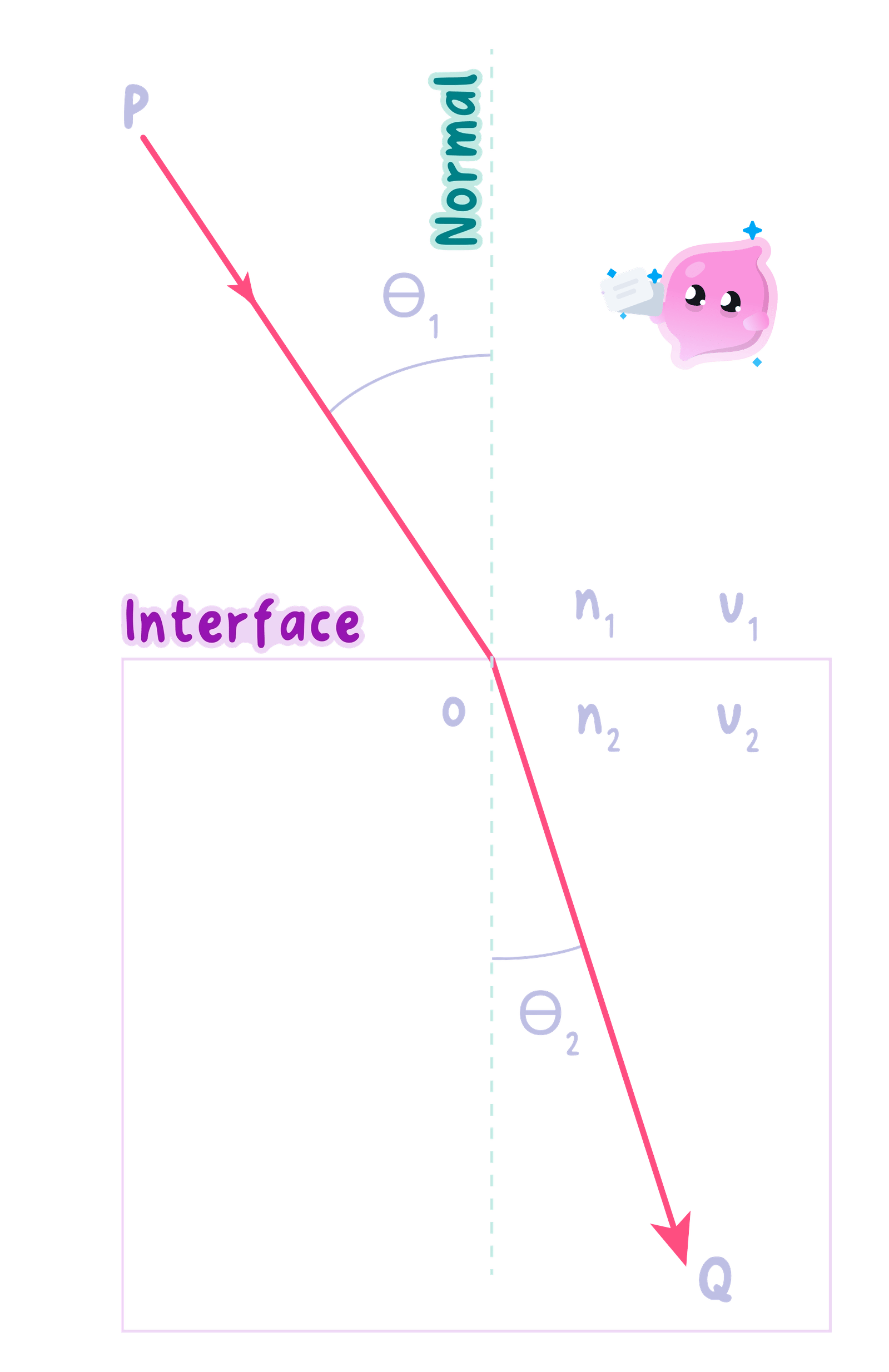
Frequency stays fixed across the boundary
Frequency
The number of complete waves or oscillations passing a point each second.
- Wave crests cannot accumulate or disappear at a boundary, so the number of cycles crossing each second is unchanged.
- For light entering glass from air, speed decreases, frequency stays constant and wavelength decreases.
- For light leaving glass for air, speed increases, frequency stays constant and wavelength increases.
Comparing wavelengths
- A wave travels at 3.0×10⁸ m s−13.0\times10^8\,\text{m s}^{-1}3.0×10⁸m s−1 in air and 2.0×10⁸ m s−12.0\times10^8\,\text{m s}^{-1}2.0×10⁸m s−1 in glass.
- At constant frequency, λglassλair=vglassvair=2.03.0\dfrac{\lambda_{\text{glass}}}{\lambda_{\text{air}}}=\dfrac{v_{\text{glass}}}{v_{\text{air}}}=\dfrac{2.0}{3.0}λairλglass=vairvglass=3.02.0, so the wavelength in glass is two-thirds of the wavelength in air.
Ray explanations need a complete chain
- First state whether the wave speed increases or decreases on entering the new substance.
- Then state that the frequency is unchanged.
- Use v=fλv=f\lambdav=fλ to determine whether wavelength increases or decreases.
- Finally state whether the ray bends towards or away from the normal when it meets the boundary at an angle.
- Do not say that frequency decreases when light slows down in glass; frequency remains constant and wavelength decreases.
- Do not describe bending for a ray travelling along the normal.
Calculations use one consistent set of units
- Use wave speed in m s−1\text{m s}^{-1}m s−1, frequency in Hz\text{Hz}Hz and wavelength in m\text{m}m.
- Convert nanometres using 1 nm=1×10⁻⁹ m1\,\text{nm}=1\times10^{-9}\,\text{m}1nm=1×10⁻⁹m before substituting into v=fλv=f\lambdav=fλ.
- A correct numerical answer should include a unit and an appropriate number of significant figures.
- For an explanation, link speed change, constant frequency, wavelength change and direction of bending.
- For a calculation, show the rearrangement before substitution and keep powers of ten in standard form.
- What happens to the speed of light when it enters glass from air?
- Why does frequency stay constant at a boundary?
- How does wavelength change when speed decreases at constant frequency?
- When does a ray bend towards the normal?
- What units are used in v=fλv=f\lambdav=fλ?
