a.[4]
Complete the sentences about the structure and behavior of atoms.
Use words from the list.
You may use each word once, more than once, or not at all.
- Electrons
- Mass
- Negative
- Neutrons
- Nucleus
- Positive
- Protons
- Repel
- Volume
- Zero
- In an atom, the particle that has a negative charge is the ................................................ .
- Compared to a proton, a neutron has an electrical charge of ................................................ .
- The vast majority of the atom's ................................................ is concentrated in the nucleus.
- Particles with like charges, such as two protons, will naturally ................................................ each other.
b.[2]
A block of titanium has a mass of 11250 kg11250\text{ kg}11250 kg and a volume of 2.5 m32.5\text{ m}^32.5 m3.
Calculate the density of titanium.
Use the equation: density=massvolume\text{density} = \frac{\text{mass}}{\text{volume}}density=volumemass
Density = ................................................ kg/m3\text{kg/m}^3kg/m3
c.[1]
The diagrams, A, B and C, show the particles in three states of matter.
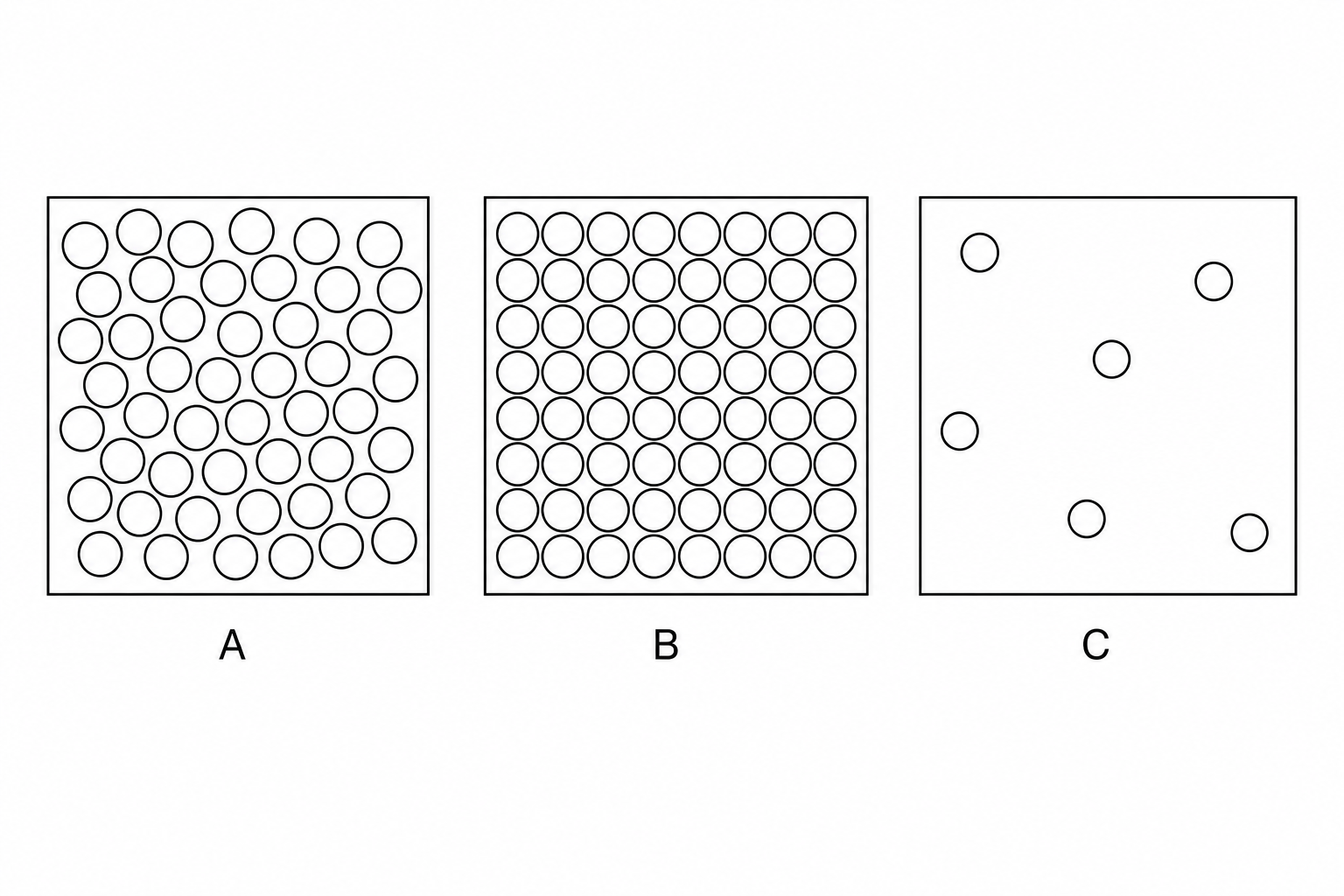
Write the letters in the boxes to give the correct order of density, from least to most dense.
Least dense →\rightarrow→ Most dense: [ ] [ ] [ ]
d.[2]
Explain why you chose the order in (b)(ii).