Question 2
FA student finds the density of a small stone with an irregular shape.
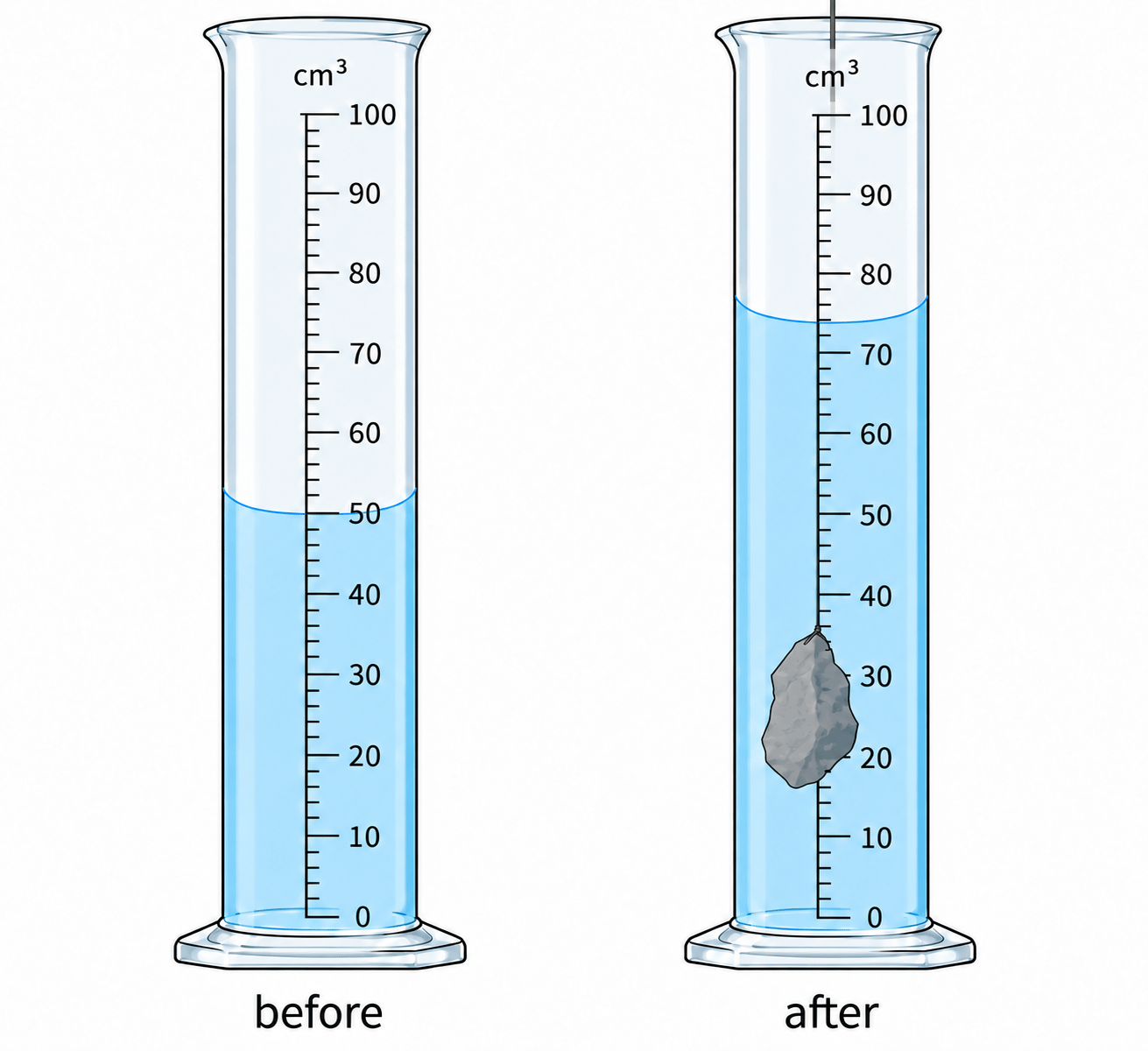
She pours some water into a measuring cylinder. She then lowers the stone into the water on a thread until it is completely covered.
The Figure shows the measuring cylinder before and after the stone is added.
Figure
a.[1]
Use the Figure to determine the volume of the stone.
b.[3]
The mass of the stone is 60 g.
Use the equation: density=massvolume\text{density} = \dfrac{\text{mass}}{\text{volume}}density=volumemass
Calculate the density of the stone. Give the unit.
c.[2]
Another student reads both volumes from the top of the meniscus instead of the bottom.
Explain the effect this has on the volume of the stone that this student calculates.
d.[1]
Suggest why the student lowers the stone on a thread instead of dropping it into the water.
1.1 The particle model Questions
44 exam-style questions on OCR GCSE Physics 1.1 The particle model, covering 1.1.1 Development of the atomic model, 1.1.2 Structure of the atom, 1.1.3 The size of atoms and small molecules, 1.1.4 Density, 1.1.5 Density and the states of matter, and 1.1.6 Density, mass and volume. Each one has a worked solution and a mark scheme showing where the marks go.