Question 3
FLight from the Sun travels through space to the Earth. Light is an electromagnetic wave.
Electromagnetic waves are transverse waves.
The Figure shows a transverse wave. Three arrows, A, B and C, are drawn on the wave.
Figure
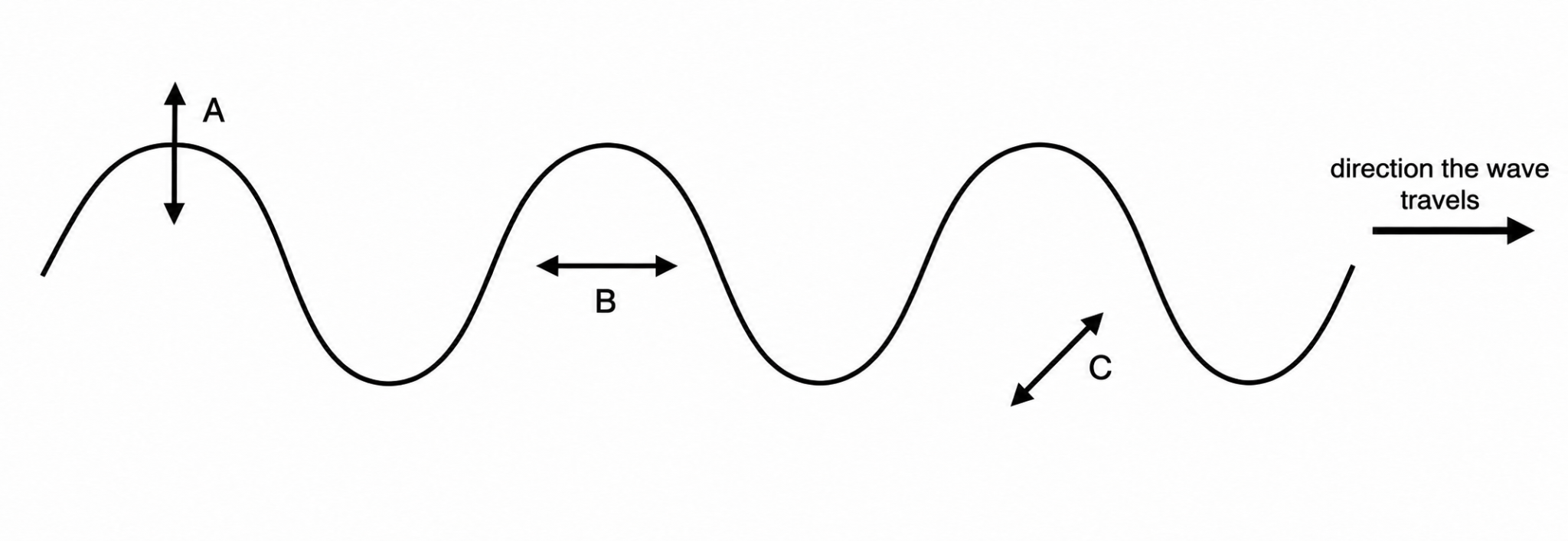
a.[1]
Which arrow, A, B or C, shows the direction of the vibrations in this wave?
b.[1]
Describe what is meant by a transverse wave.
c.[1]
There is no air in space.
Explain how light can still travel from the Sun to the Earth.
d.[2]
The Sun is 1.5 × 10¹¹ m from the Earth. The speed of light in space is 3.0 × 10⁸ m/s.
Use the equation: time=distancespeed\text{time} = \dfrac{\text{distance}}{\text{speed}}time=speeddistance
Calculate the time it takes light to travel from the Sun to the Earth.
e.[2]
Sunlight falls on a person's skin and warms it.
Describe the energy transfer that takes place.
5.2 The electromagnetic spectrum Questions
48 exam-style questions on OCR GCSE Physics 5.2 The electromagnetic spectrum, covering 5.2.1 Electromagnetic waves in space, 5.2.2 Energy transfer by electromagnetic waves, 5.2.3 Frequency and wavelength across the spectrum, 5.2.4 Groups of the electromagnetic spectrum, 5.2.5 Visible light and the limits of human sight, 5.2.6 Light as an electromagnetic wave, 5.2.7 Uses of electromagnetic waves, 5.2.8 Hazards of ultraviolet, X-rays and gamma rays, 5.2.9 Ultrasound and imaging inside the body, and 5.2.10 Radio waves and oscillating circuits. Each one has a worked solution and a mark scheme showing where the marks go.