Net resistance
Definition
Net resistance
The overall resistance of a combination of components, which decides the current drawn from the supply.
- When several resistors are connected together, their combined effect on the circuit is described by their net resistance.
- For a supply with a fixed potential difference, a larger net resistance means a smaller current is drawn from the supply.
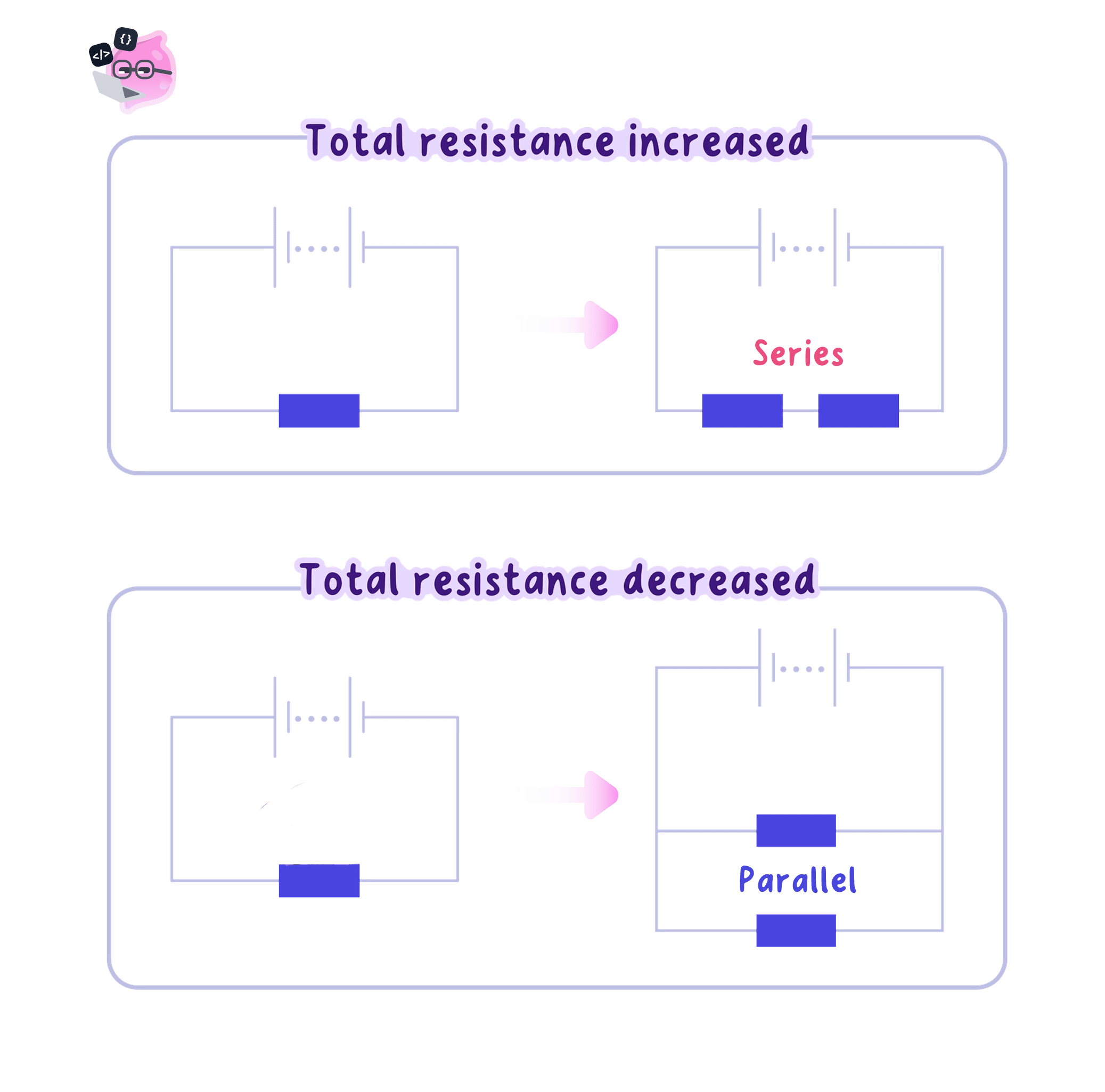
- Adding a resistor can either increase or decrease the net resistance, depending on whether it is added in series or in parallel.
Resistors in series
- When a second resistor is added in series, there is still only one path, so all of the charge must pass through both resistors one after the other.
- Each resistor opposes the flow of charge, so the charge meets more opposition in total than it did with one resistor.
- The net resistance increases, and it is larger than the resistance of either resistor on its own.
- With the same supply potential difference, the larger net resistance means the current in the circuit falls.
- The supply potential difference is now shared between the two resistors, so the potential difference across the first resistor is smaller than before.
- Adding a third resistor in series increases the net resistance again, so every extra resistor in series makes the current smaller.
Resistors in parallel
- When a second resistor is added in parallel, it provides an extra path through which charge can flow.
- Each branch is connected directly across the supply, so each resistor has the full supply potential difference across it and carries its own current.
- The current through the first resistor does not change, but the second branch adds its own current, so the total current from the supply increases.
- A larger total current flowing for the same potential difference means that the net resistance has decreased.
- The net resistance of resistors in parallel is smaller than the resistance of the smallest resistor on its own.
- Every extra resistor added in parallel adds another path, so the net resistance keeps falling and the total current keeps rising.
Lamps in series and in parallel
- Identical lamps connected in series to a supply glow more dimly than one lamp on its own.
- The net resistance is larger, so the current is smaller, and the supply potential difference is shared, so each lamp transfers energy more slowly.
- Identical lamps connected in parallel to the same supply each glow as brightly as one lamp on its own.
- Each lamp has the full supply potential difference across it and carries the same current as a single lamp would.
- The lamps in parallel draw a larger total current, so a battery powering them goes flat more quickly than the same battery powering lamps in series.
Example
Adding a resistor to a circuit
- A 6.0 V6.0\ \text{V}6.0 V supply is connected to a single 10 Ω10\ \Omega10 Ω resistor, and an ammeter in the main lead records the current.
- A second resistor is added in series, so the net resistance becomes larger than 10 Ω10\ \Omega10 Ω and the ammeter reading falls.
- The second resistor is instead added in parallel, so it forms a new branch with the full 6.0 V6.0\ \text{V}6.0 V across it.
- The current through the original 10 Ω10\ \Omega10 Ω branch stays the same, but the new branch adds extra current, so the ammeter reading in the main lead rises.
- A larger current for the same 6.0 V6.0\ \text{V}6.0 V shows that the net resistance of the parallel pair is smaller than 10 Ω10\ \Omega10 Ω.
Practical
Brightness of lamps in series and in parallel
- Aim: to compare the brightness of identical filament lamps connected in series and in parallel to the same supply.
- Apparatus: two identical 3.5 V3.5\ \text{V}3.5 V filament lamps in holders, a battery of two 1.5 V1.5\ \text{V}1.5 V cells, a switch, a digital ammeter, a digital voltmeter, a light sensor and data logger or a light meter, a cardboard tube to fit over each lamp, and connecting leads.
- Method, a single lamp:
- Connect one lamp, the switch and the ammeter in series with the battery, with the voltmeter across the lamp.
- Fix the light sensor at the open end of the cardboard tube, 5.0 cm5.0\ \text{cm}5.0 cm from the lamp, so that background light is kept out.
- Close the switch and record the light reading, the current and the potential difference across the lamp.
- Method, two lamps in series:
- Add the second lamp in series with the first, keeping the same battery and the same sensor position on the first lamp.
- Record the light reading from the first lamp, the current and the potential difference across each lamp.
- Method, two lamps in parallel:
- Rebuild the circuit so that each lamp is on its own branch between the same two junctions.
- Record the light reading from the first lamp, the current in the main lead and the potential difference across each lamp.
- Repeat each arrangement three times and calculate mean values.
- Variables: the independent variable is the way the lamps are connected, the dependent variable is the brightness of the lamp, and the control variables are the battery, the type of lamp and the distance between the lamp and the sensor.
- Results: the lamps in series are much dimmer than the single lamp and each has about half of the battery potential difference across it, while each lamp in parallel is about as bright as the single lamp and has the full battery potential difference across it.
- Conclusion: lamps in series share the potential difference and have a larger net resistance, so they are dimmer, whereas lamps in parallel each receive the full potential difference and are brighter.
- Watch out: if you judge brightness by eye, results are only qualitative, so a light sensor in a tube at a fixed distance gives fairer, numerical readings.
- Safety: open the switch between readings to save the battery, and let the lamps cool before handling them.
Common Mistake
- Do not say that adding more resistors always increases the resistance, because adding resistors in parallel decreases the net resistance.
- Do not say that lamps in parallel are dimmer because the current is split between them, because each branch has the full supply potential difference and carries its own full current.
- Do not say that the current in a series circuit is shared between the components, because the current is the same through each of them.
Exam technique
Explaining net resistance
- Explain series and parallel resistance with a cause and a consequence, such as charge has to pass through both resistors, so the net resistance increases.
- For parallel resistors, mention the extra path, the larger total current and the same potential difference, because the last two together show that the net resistance has fallen.
- Explanations of net resistance only need words, so focus on the reasoning rather than on numbers.
Self review
- State what happens to the net resistance when a resistor is added in series.
- Explain why adding a resistor in parallel decreases the net resistance.
- Compare the net resistance of two resistors in parallel with the resistance of the smaller resistor.
- Explain why identical lamps in series are dimmer than the same lamps in parallel.
- Name two control variables in an investigation into the brightness of lamps.
