Radioactive emissions
What you'll learn
- How the nucleus of an atom is written using nuclear notation.
- What isotopes are, and why some nuclei are unstable.
- How alpha, beta, gamma and neutron emissions change a nucleus.
- How half-life links random decay to predictable patterns.
The atom: where radioactivity starts
An atom has a tiny central nucleus with electrons arranged around it. The nucleus contains protons and neutrons.
A proton has a positive relative charge of +1. A neutron has relative charge 0. An electron has relative charge -1.
Nucleus
The nucleus is the small, dense, positively charged centre of an atom. It contains protons and neutrons.
Each element has a characteristic positive nuclear charge because each element has a fixed number of protons. For example, every carbon atom has 6 protons. If the number of protons changes, it is no longer carbon.
Protons decide the element
The number of protons in the nucleus determines the element. Neutrons can vary, but protons cannot if the atom is still the same element.
Isotopes and nuclear notation
Atoms of the same element can have different numbers of neutrons. This means their nuclei have different masses, even though they are the same element.
Isotopes
Isotopes are atoms of the same element with the same number of protons but different numbers of neutrons.
A nucleon is a proton or neutron. The mass number, AAA, is the total number of protons and neutrons. The atomic number, ZZZ, is the number of protons.
The conventional nuclear notation is:
ZAX{}^{A}_{Z}\text{X}ZAXwhere:
- X\text{X}X is the chemical symbol.
- AAA is the mass number.
- ZZZ is the atomic number.
- Number of neutrons is A−ZA - ZA−Z.
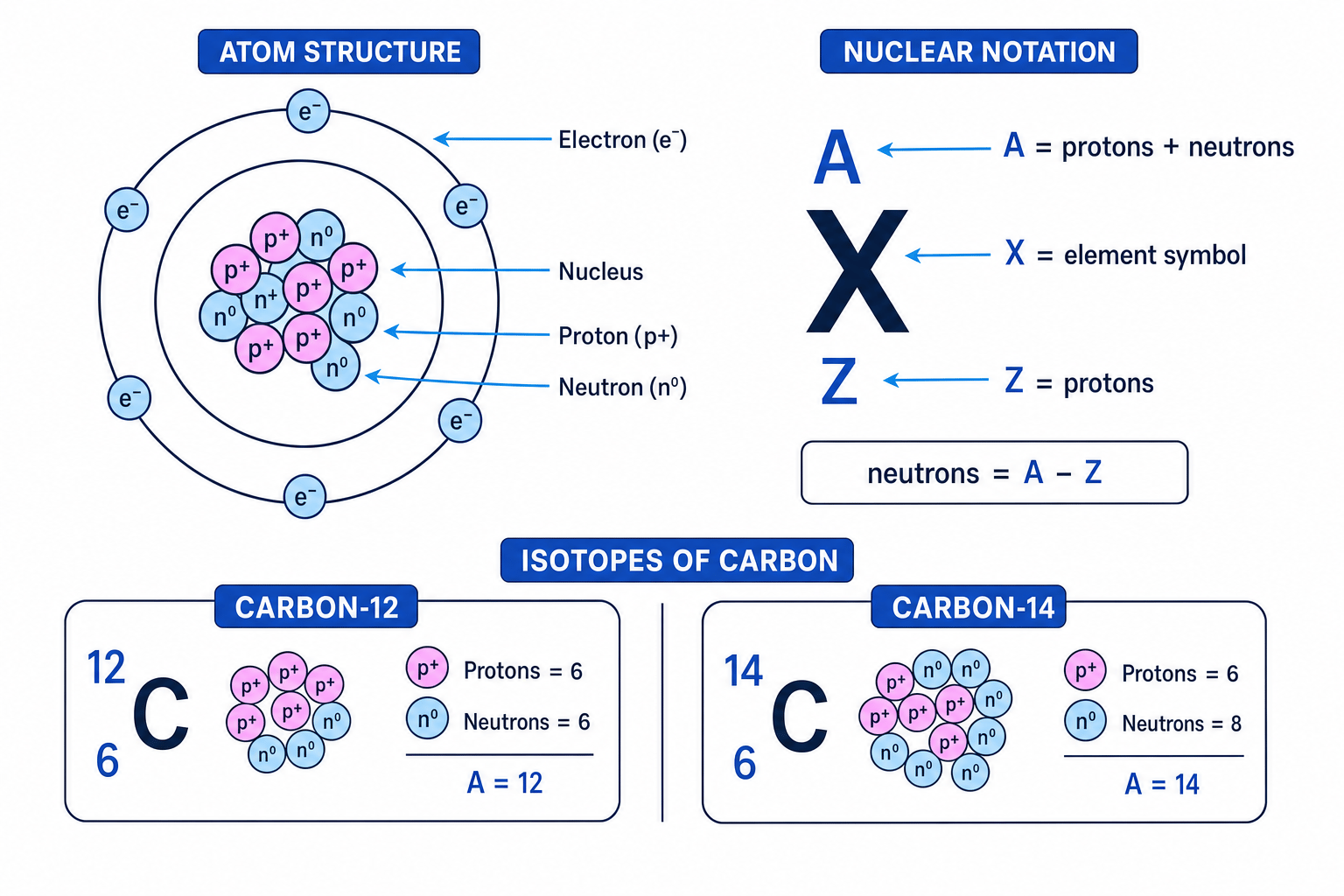
Finding protons and neutrons from nuclear notation
For the nucleus 92238U{}^{238}_{92}\text{U}92238U:
- The bottom number is the atomic number, so uranium has 92 protons.
- The top number is the mass number, so the total number of protons and neutrons is 238.
- Calculate neutrons using A−ZA - ZA−Z: 238−92=146238 - 92 = 146238−92=146, so this nucleus has 146 neutrons.
Mass number is not the periodic table decimal
In nuclear equations, the top number is the mass number of that specific isotope, not the decimal relative atomic mass from the periodic table.
Unstable nuclei and radioactive decay
Some nuclei are unstable. This means the nucleus may change by emitting radiation.
Radioactive decay
Radioactive decay is the process where an unstable nucleus emits radiation and changes into a more stable nucleus.
The original unstable nucleus is called the parent nucleus. The nucleus formed after decay is called the daughter nucleus.
Radiation can be emitted as particles, such as alpha particles, beta particles or neutrons, or as electromagnetic radiation, such as gamma rays.
Radioactive decay is random. You cannot predict exactly when one particular nucleus will decay. However, if you have a very large number of unstable nuclei, the overall pattern is predictable.
Random does not mean patternless
You cannot predict which individual nucleus decays next, but you can predict the average behaviour of a large sample.
Irradiated does not mean radioactive
An object that has been irradiated has been exposed to radiation. This does not automatically make it radioactive. It only becomes a radioactive source if radioactive material is actually inside it or on it.
Alpha, beta, gamma and neutron emissions
Different emissions change the nucleus in different ways. The important exam skill is tracking what happens to the mass number AAA and atomic number ZZZ.
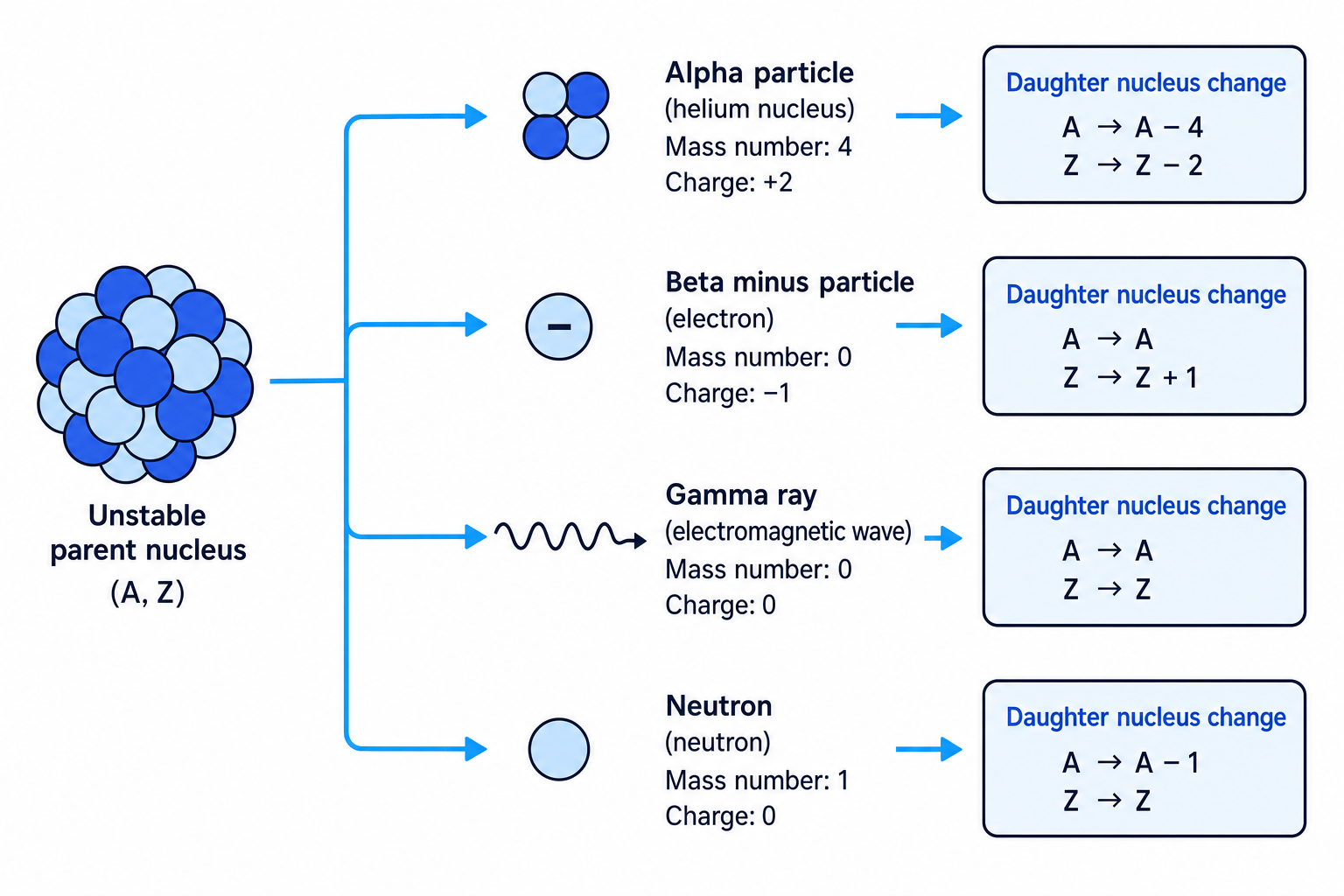
Alpha emission
An alpha particle is a helium nucleus: 2 protons and 2 neutrons.
It has:
- mass number 4
- relative charge +2
- symbol 24α{}^{4}_{2}\alpha24α or 24He{}^{4}_{2}\text{He}24He
When alpha is emitted:
- AAA decreases by 4
- ZZZ decreases by 2
Beta emission
At GCSE, beta usually means beta minus radiation. A beta particle is a fast-moving electron emitted from the nucleus.
It has:
- mass number 0
- relative charge -1
- symbol −10β{}^{0}_{-1}\beta−10β
In beta minus decay, a neutron in the nucleus changes into a proton and a beta particle. So:
- AAA stays the same
- ZZZ increases by 1
Gamma emission
A gamma ray is electromagnetic radiation from the nucleus. It is not a particle with mass.
It has:
- mass number 0
- relative charge 0
- symbol 00γ{}^{0}_{0}\gamma00γ
When gamma is emitted:
- AAA stays the same
- ZZZ stays the same
Gamma often happens after alpha or beta decay, when the nucleus loses extra energy.
Neutron emission
A neutron emission is when a neutron leaves the nucleus.
It has:
- mass number 1
- relative charge 0
- symbol 01n{}^{1}_{0}\text{n}01n
When a neutron is emitted:
- AAA decreases by 1
- ZZZ stays the same
Writing balanced nuclear equations
In a nuclear equation, the top numbers must balance and the bottom numbers must balance.
This is similar to conservation: nucleons and charge are accounted for.
For alpha decay:
ZAX→Z−2A−4Y+24α{}^{A}_{Z}\text{X} \to {}^{A-4}_{Z-2}\text{Y} + {}^{4}_{2}\alphaZAX→Z−2A−4Y+24αFor beta minus decay:
ZAX→Z+1AY+−10β{}^{A}_{Z}\text{X} \to {}^{A}_{Z+1}\text{Y} + {}^{0}_{-1}\betaZAX→Z+1AY+−10βFor gamma emission:
ZAX∗→ZAX+00γ{}^{A}_{Z}\text{X}^{*} \to {}^{A}_{Z}\text{X} + {}^{0}_{0}\gammaZAX∗→ZAX+00γThe star means the nucleus is excited, meaning it has extra energy.
For neutron emission:
ZAX→ZA−1X+01n{}^{A}_{Z}\text{X} \to {}^{A-1}_{Z}\text{X} + {}^{1}_{0}\text{n}ZAX→ZA−1X+01nCompleting a beta decay equation
Complete:
614C→ZAX+−10β{}^{14}_{6}\text{C} \to {}^{A}_{Z}\text{X} + {}^{0}_{-1}\beta614C→ZAX+−10β- Balance the top numbers: 14=A+014 = A + 014=A+0, so A=14A = 14A=14.
- Balance the bottom numbers: 6=Z+(−1)6 = Z + (-1)6=Z+(−1), so Z=7Z = 7Z=7.
- Atomic number 7 is nitrogen, so the completed equation is:
Beta minus feels backwards
In beta minus decay, the emitted beta particle has bottom number -1, so the daughter nucleus must have a bottom number one higher to keep the equation balanced.
Electrons can absorb and emit radiation too
Radioactivity is about the nucleus, but atoms can also interact with radiation through their electrons.
Electrons are arranged at different distances from the nucleus. You can think of these as different energy levels.
If an electron absorbs electromagnetic radiation, it may move to a higher energy level. This is called excitation.
Excitation
Excitation happens when an electron absorbs energy and moves to a higher energy level without leaving the atom.
When the electron drops back down to a lower energy level, it emits electromagnetic radiation.
If an outer electron gains enough energy to leave the atom completely, the atom becomes an ion. This process is called ionisation.
Ionisation
Ionisation is the process where an atom becomes charged because it loses or gains electrons.
Changes in atoms and nuclei can generate or absorb radiation over a wide range of frequencies. Frequency means the number of waves passing a point each second, measured in hertz, Hz. Gamma rays are one part of the electromagnetic spectrum.
Distinguishing excitation and ionisation
An atom absorbs ultraviolet radiation. Later, one of its outer electrons leaves the atom.
- If an electron moves to a higher energy level but stays in the atom, that part is excitation.
- If the electron later drops back down, electromagnetic radiation is emitted.
- If an outer electron leaves the atom completely, the atom has been ionised and becomes a positive ion.
Penetrating power
The different emissions have different penetrating powers, meaning how far they can travel through materials before being absorbed.
Alpha particles are the least penetrating. They are stopped by paper, skin, or a few centimetres of air.
Beta particles are more penetrating than alpha. They can pass through paper but are stopped by thin aluminium.
Gamma rays are the most penetrating of these three. They are reduced by thick lead or concrete, but not usually stopped completely.
Gamma is reduced, not simply stopped
In exams, avoid saying “lead stops all gamma radiation”. A better answer is that thick lead or concrete greatly reduces gamma radiation.
A Geiger-Müller tube can be used to detect ionising radiation. It gives a count rate, usually in counts per second. If the setup stays the same, a higher count rate means more radiation is being detected.
Identifying an emission from absorbers
A source gives a count rate of 500 counts per second. When paper is placed between the source and detector, the count rate falls to the background level.
- The paper has removed almost all the radiation coming from the source.
- Alpha radiation is stopped by paper, while beta and gamma are more penetrating.
- The source is therefore emitting alpha radiation, or alpha is the main detected emission.
Half-life
The activity of a radioactive source is the rate at which unstable nuclei decay. It is measured in becquerels, Bq. One becquerel means one decay per second.
A detector measures count rate, which is the number of detections per second. Count rate is linked to activity, but it may be lower because the detector does not catch every emission.
Half-life
The half-life of a radioactive isotope is the time taken for the number of undecayed nuclei, or the activity, to fall to half its original value.
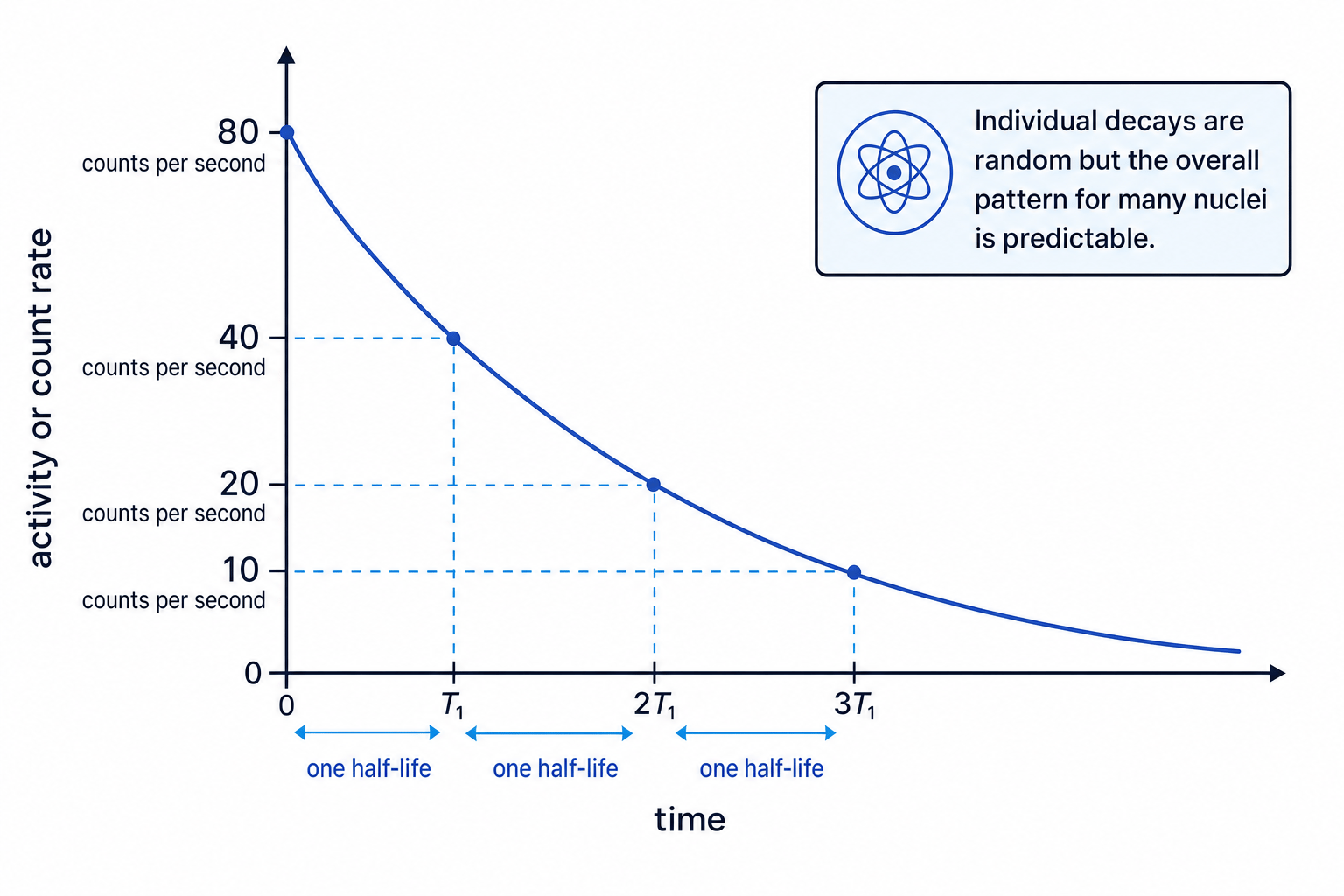
Half-life is linked to randomness. You cannot predict when a single nucleus decays, but in a large sample, about half the remaining unstable nuclei decay in each half-life.
Half-life is repeated halving
Half-life does not mean the activity drops by the same amount each time. It halves: 80 becomes 40, then 20, then 10.
There is no equation-sheet formula you need to memorise for half-life here. For whole numbers of half-lives, work by repeated halving.
This next ratio idea is Higher Tier only: after nnn half-lives, the fraction remaining is 12n\frac{1}{2^n}2n1. The original-to-final ratio is 2n:12^n:12n:1.
Calculating activity after whole half-lives
A radioactive source has an activity of 640 Bq. Its half-life is 5 hours. Calculate its activity after 15 hours.
- Work out how many half-lives have passed: 15÷5=315 \div 5 = 315÷5=3 half-lives.
- Halve the activity three times: 640 Bq to 320 Bq to 160 Bq to 80 Bq.
- The activity after 15 hours is 80 Bq. The original-to-final ratio is 640:80640:80640:80, which simplifies to 8:18:18:1.
Ratio wording
Check whether the question wants original:final or final:original. After 3 half-lives, original:final is 8:18:18:1, but final:original is 1:81:81:8.
In the exam
- For nuclear equations, balance the top numbers and bottom numbers separately.
- For half-life questions, count the number of half-lives and halve repeatedly; subtract background count first if it is given.
- For penetration questions, remember: paper stops alpha, thin aluminium stops beta, and thick lead or concrete reduces gamma.
Check yourself
- What stays the same, and what changes, when an isotope emits an alpha particle?
- Why does beta minus decay make the daughter nucleus have an atomic number one higher?
- A sample’s count rate falls from 240 counts per second to 30 counts per second. How many half-lives have passed?