Revision notes for OCR GCSE Physics Uses and hazards. Open the guide for explanations and worked examples. Written against the OCR GCSE Physics (J249) specification, so the content matches what's examinable rather than general Physics background.
Uses and hazards
Radioactive materials are a natural part of our environment, but they can also be highly dangerous if not handled correctly. However, when we understand how they behave, we can harness them for life-saving medicine, safety devices, and low-carbon energy.
This guide covers everything you need to know about radioactive hazards, how we use radiation in medicine, and the powerful nuclear processes of fission and fusion.
What you'll learn
- The vital difference between being irradiated and being contaminated.
- How an isotope's half-life and radiation type determine its hazard level.
- How nuclear radiation is used to diagnose and treat illnesses in medicine.
- How nuclear fission and fusion release vast amounts of energy by manipulating atomic nuclei.
1. Irradiation vs. Contamination
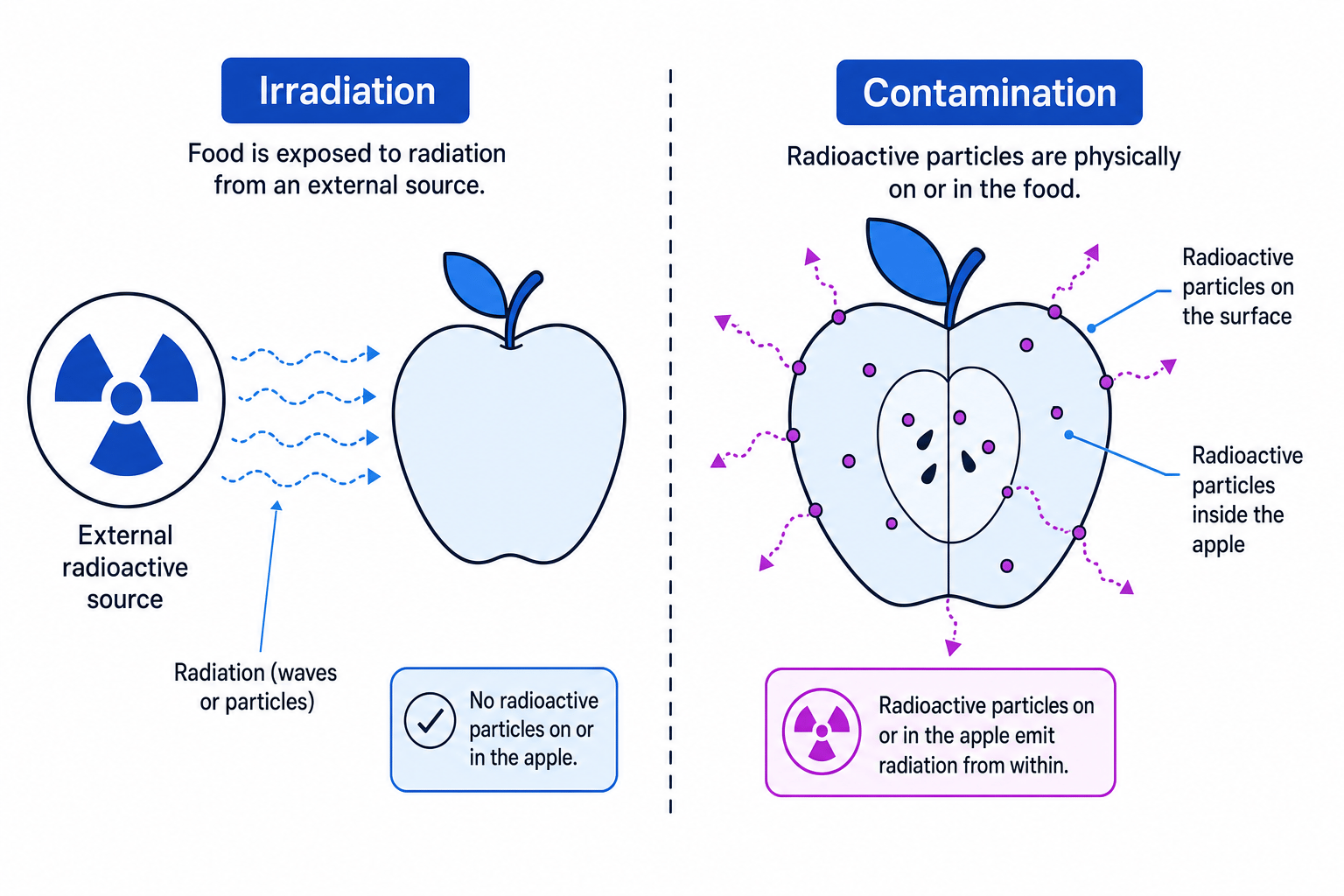
A common misconception is that anything exposed to radiation automatically becomes radioactive. To understand why this is false, we must distinguish between irradiation and contamination.
Definition
Irradiation
Irradiation is the process of exposing an object to nuclear radiation. The irradiated object does not come into contact with the radioactive source itself, and it does not become radioactive.
Definition
Contamination
Contamination is the unwanted presence of materials containing radioactive atoms on other materials. Once an object is contaminated, it becomes radioactive because the radioactive atoms on or inside it continue to decay and emit radiation.
Comparing the Hazards
The hazard to a person depends heavily on whether they are irradiated or contaminated, and what type of radiation is involved (alpha, beta, or gamma):
-
When irradiated from an external source:
- Gamma and beta radiation are the most hazardous because they are highly penetrating. They can pass through clothing and skin to reach vital organs.
- Alpha radiation is the least hazardous because it has a very low penetrating power. It is easily blocked by the skin or a few centimetres of air, meaning it cannot reach deep internal organs.
-
When contaminated internally (ingested or inhaled):
- Alpha radiation becomes extremely hazardous. Because alpha particles are highly ionising, they cause intense localized damage to cells and DNA within a very small area, leading to mutations and cancer.
- Beta and gamma radiation are less hazardous internally because they are less ionising. A significant portion of their energy escapes the body without being absorbed by tissues.
Common Mistake
Irradiation vs. Contamination
A very common exam mistake is saying that an irradiated object "becomes radioactive". It does not! If you are exposed to X-rays or gamma rays at a hospital, the radiation passes through you and is gone. You do not emit radiation afterward. You only become radioactive if radioactive dust or liquid physically gets on your skin or inside your body (contamination).
2. Half-Life and Radioactive Hazards
(Note: The remaining sections of this topic are for students taking Separate GCSE Physics (J249) only. They do not appear in Combined Science).
The danger of a radioactive source is not constant—it changes over time depending on the source's half-life (the time it takes for half of the unstable nuclei in a sample to decay).
Short Half-Life vs. Long Half-Life
- Short half-life: The activity of the source starts very high, meaning it emits intense radiation in a short space of time. While it is initially extremely hazardous, the danger passes quickly as the nuclei decay rapidly.
- Long half-life: The activity remains low but stable over a very long period. Although it emits less radiation per second, it remains radioactive and hazardous for decades, centuries, or even millennia, making long-term storage and disposal a major challenge.
Everyday Application: Smoke Detectors
Household smoke detectors use an alpha-emitting isotope called Americium-241 (241Am^{241}\text{Am}241Am).
- Why Alpha? Alpha particles ionise the air inside a small chamber in the detector, creating a small electrical current. If smoke particles enter, they absorb the alpha particles, breaking the current and triggering the alarm. Alpha radiation is perfect because its low penetration means it cannot escape the plastic housing of the alarm, making it completely safe for residents.
- Why a Long Half-Life? Americium-241 has a half-life of 432 years. This is essential because the activity of the source remains virtually constant over your lifetime. If it had a short half-life of a few weeks, the detector would lose its activity quickly, and you would constantly have to replace the radioactive source!
3. Medical Uses of Nuclear Radiation
Nuclear radiation is an invaluable tool in modern medicine. It is used in two main ways: exploration (diagnosing issues) and treatment (destroying unwanted tissues).
Exploring Internal Organs (Radioactive Tracers)
To examine how an internal organ is functioning without surgery, doctors inject or have the patient swallow a radioactive isotope called a medical tracer.
- The tracer travels to specific organs.
- A detector outside the body (such as a gamma camera) tracks where the tracer goes and builds an image.
- Choosing the right isotope:
- It must emit gamma radiation because gamma is highly penetrating and can easily pass out of the patient's body to be detected. Alpha or beta would be absorbed by body tissues, harming the patient and failing to reach the detector.
- It must have a short half-life (typically a few hours) so that it decays quickly after the scan is complete, minimizing the radiation dose the patient receives.
Control and Destruction of Unwanted Tissue (Radiotherapy)
Cancerous tumours can be treated using high doses of radiation to kill the cancer cells. This is called radiotherapy.
- External radiotherapy: High-energy gamma rays are aimed directly at the tumour from multiple angles. This concentrates the radiation dose at the tumour while minimizing damage to surrounding healthy tissue.
- Internal radiotherapy: An beta or alpha emitter is placed directly inside or next to the tumour (e.g., using radioactive implants or targeted drugs). Alpha emitters are highly effective here because their short range means they destroy the targeted cancer cells without damaging healthy tissue further away.
Example
Selecting a Medical Tracer Isotope
A medical team needs to choose an isotope to monitor blood flow through a patient's kidneys. They have three options:
- Isotope A: Alpha emitter, half-life of 6 hours.
- Isotope B: Gamma emitter, half-life of 6 hours.
- Isotope C: Gamma emitter, half-life of 8 days.
Determine which isotope is most suitable, justifying your choice by evaluating each option.
- Analyze Isotope A: Isotope A is an alpha emitter. Alpha radiation has extremely low penetrating power and will be completely absorbed by kidney and muscle tissue. It will not escape the body to reach the external detector, and its highly ionising nature will cause severe tissue damage. Therefore, Isotope A is unsuitable.
- Analyze Isotope C: Isotope C emits gamma radiation, which can easily penetrate through body tissue to reach the external detector. However, its half-life of 8 days is far too long. The patient would remain highly radioactive for several weeks, receiving an unnecessarily high dose of ionizing radiation. Therefore, Isotope C is unsuitable.
- Analyze and Select Isotope B: Isotope B emits gamma radiation, meaning the radiation can escape the body and be detected outside. Its half-life of 6 hours is long enough to complete the medical scan (which takes less than an hour) but short enough that the isotope will decay to negligible levels within a day, ensuring patient safety. Therefore, Isotope B is the ideal choice.
4. Nuclear Fission
Nuclear power stations generate electricity by tapping into the energy stored inside atomic nuclei. The main process they use is nuclear fission.
Definition
Nuclear Fission
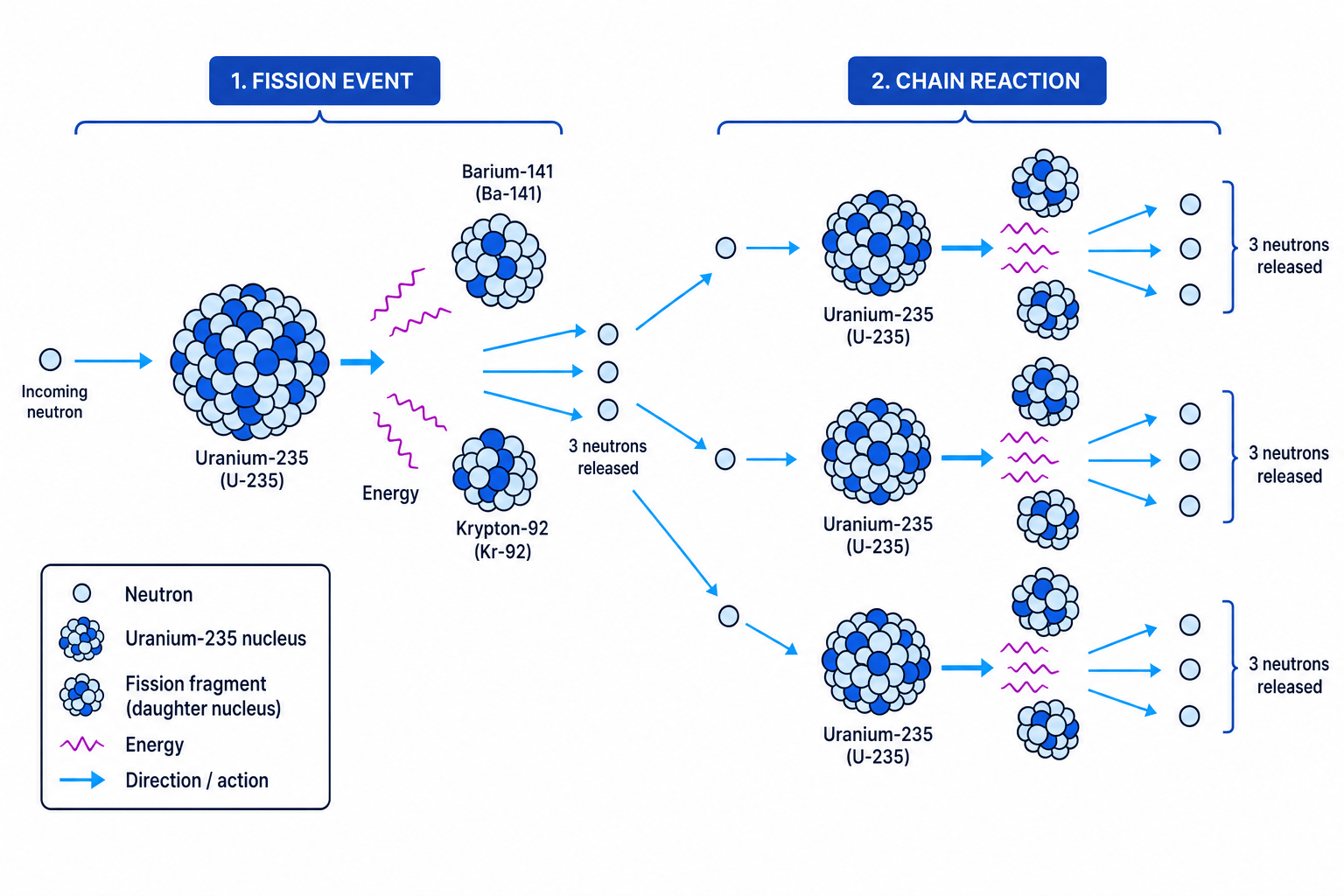
Nuclear fission is the splitting of a large, unstable atomic nucleus (such as Uranium-235) into two smaller, more stable nuclei, releasing neutrons and a large amount of energy.
How Fission Works
Fission rarely happens spontaneously. For fission to occur, a heavy, unstable nucleus must usually first absorb a neutron.
- A slow-moving neutron is absorbed by a Uranium-235 (235U^{235}\text{U}235U) nucleus.
- This makes the nucleus extremely unstable, causing it to split into two smaller daughter nuclei (often isotopes of barium and krypton).
- The split releases two or three high-speed neutrons, along with a massive amount of energy carried away as kinetic energy of the particles and gamma radiation.
Chain Reactions
Because one fission event releases multiple neutrons, those neutrons can go on to be absorbed by other nearby Uranium-235 nuclei. This causes further fission events, which release even more neutrons. This self-sustaining cycle is called a chain reaction.
- Controlled chain reactions: In a nuclear power reactor, control rods (made of materials like boron) absorb excess neutrons to keep the chain reaction steady, releasing energy at a safe, constant rate to boil water, spin turbines, and generate electricity.
- Uncontrolled chain reactions: If the reaction is not controlled, the number of fission events grows exponentially in fractions of a second. This releases an immense explosion of energy, which is how nuclear weapons work.
5. Nuclear Fusion
There is another way to release nuclear energy: by doing the exact opposite of fission.
Definition
Nuclear Fusion
Nuclear fusion is the joining together of two light, small nuclei to form a single, larger, heavier nucleus, releasing energy in the process.
Mass to Energy Conversion
During nuclear fusion, the total mass of the resulting heavier nucleus is slightly less than the combined mass of the two starting light nuclei. This "lost" mass has been converted directly into energy, which is carried away as radiation.
Mass of Reactants>Mass of Products ⟹ Difference converted to Energy \text{Mass of Reactants} > \text{Mass of Products} \implies \text{Difference converted to Energy} Mass of Reactants>Mass of Products⟹Difference converted to EnergyThis mass-to-energy conversion is described by Einstein's famous equation:
E=mc2 E = mc^2 E=mc2The Challenge of Fusion
Fusion is the process that powers stars, including our Sun. In the Sun, hydrogen nuclei (protons) fuse to form helium nuclei.
However, replicating fusion on Earth to generate electricity is incredibly difficult because:
- Nuclei are positively charged (due to their protons), so they strongly repel each other (electrostatic repulsion).
- To overcome this repulsion and get close enough to fuse, the nuclei must be moving at extremely high speeds.
- This requires extremely high temperatures and pressures, which are incredibly difficult and expensive to contain safely in a power plant.
Exam technique
In the exam
- Do not confuse irradiation and contamination. If a question mentions a tool sterilised by gamma rays or a patient getting a scan, state clearly that they do not become radioactive.
- When evaluating medical isotopes, always structure your answer in three parts: Explain why the radiation type is appropriate, why the half-life is appropriate, and why the other options are dangerous or ineffective.
- Use correct terminology for nuclear reactions. In fission, the nucleus absorbs a neutron before splitting into daughter nuclei and releasing more neutrons. In fusion, light nuclei join to form a heavier nucleus.
Self review
Check yourself
- Explain why a radioactive source with an alpha emitter is safe to use in a home smoke detector, but highly dangerous if swallowed.
- A patient is injected with a medical tracer that has a half-life of 2 minutes. Why is this isotope impractical for hospital use?
- Why does nuclear fusion require much higher temperatures than nuclear fission to initiate?

Recap questions
Test yourself with 5 quick questions on this guide. Answer them all correctly to complete it.
Radioactivity
Guide 2 of 2
You've reached the end
Test yourself on this topic, or move on to the next guide.
How was this guide?