Wave interactions
What you'll learn
- How electromagnetic waves can be absorbed, transmitted, reflected or refracted by materials.
- How to draw simple ray diagrams for reflection, refraction, and lenses.
- Why convex and concave lenses affect light differently.
- How filters and surfaces produce colour by selecting which wavelengths they absorb, transmit or reflect.
Because you are studying OCR Gateway separate Physics J249, the ray diagrams, lenses and colour explanation in this topic are relevant for you. Some of the material about wavelength-dependent behaviour and wave speed in substances is Higher Tier only; I’ll flag it gently as we go.
The basic idea: waves meeting materials
An electromagnetic wave is a wave that can travel through a vacuum, such as visible light, ultraviolet, infrared, microwaves and X-rays. These waves have different wavelengths, meaning the distance from one wave peak to the next, and different frequencies, meaning how many waves pass a point each second.
When an electromagnetic wave reaches a material, several things can happen.
Wave interactions
- Absorption: the wave’s energy is taken in by the material, often heating it or causing another effect.
- Transmission: the wave passes through the material.
- Reflection: the wave bounces off the surface.
- Refraction: the wave changes direction as it crosses from one material into another.
A material does not have to treat all wavelengths in the same way. This part is Higher Tier only: different substances may absorb, transmit, refract or reflect electromagnetic waves differently depending on the wavelength. For example, glass transmits most visible light but absorbs much ultraviolet; bone absorbs X-rays more strongly than soft tissue.
Materials can be selective
A material might be transparent to one part of the electromagnetic spectrum but absorb or reflect another part. So always ask: which wavelength or colour is involved?
Choosing what happens to different wavelengths
A window glass pane lets visible light through but blocks much ultraviolet radiation. What interactions are happening?
- Visible light passes through the glass, so for visible wavelengths the main interaction is transmission.
- Much ultraviolet does not pass through, so for ultraviolet wavelengths the glass is mainly causing absorption.
- The same material is behaving differently for different wavelengths, which is the key Higher Tier idea.
Ray diagrams: representing light paths
A ray diagram is a simple drawing that shows the direction light travels using straight lines with arrows. It is not showing the wave peaks themselves — it is a convenient way to track the path of light.
A normal is an imaginary line drawn at right angles to a surface at the point where the ray meets it. In reflection and refraction diagrams, angles are measured from the normal, not from the surface.
Reflection
Reflection happens when light bounces off a surface. For a flat mirror, the angle of incidence equals the angle of reflection:
θi=θr\theta_i = \theta_rθi=θrHere, θi\theta_iθi is the angle of incidence, and θr\theta_rθr is the angle of reflection. Both are measured from the normal.
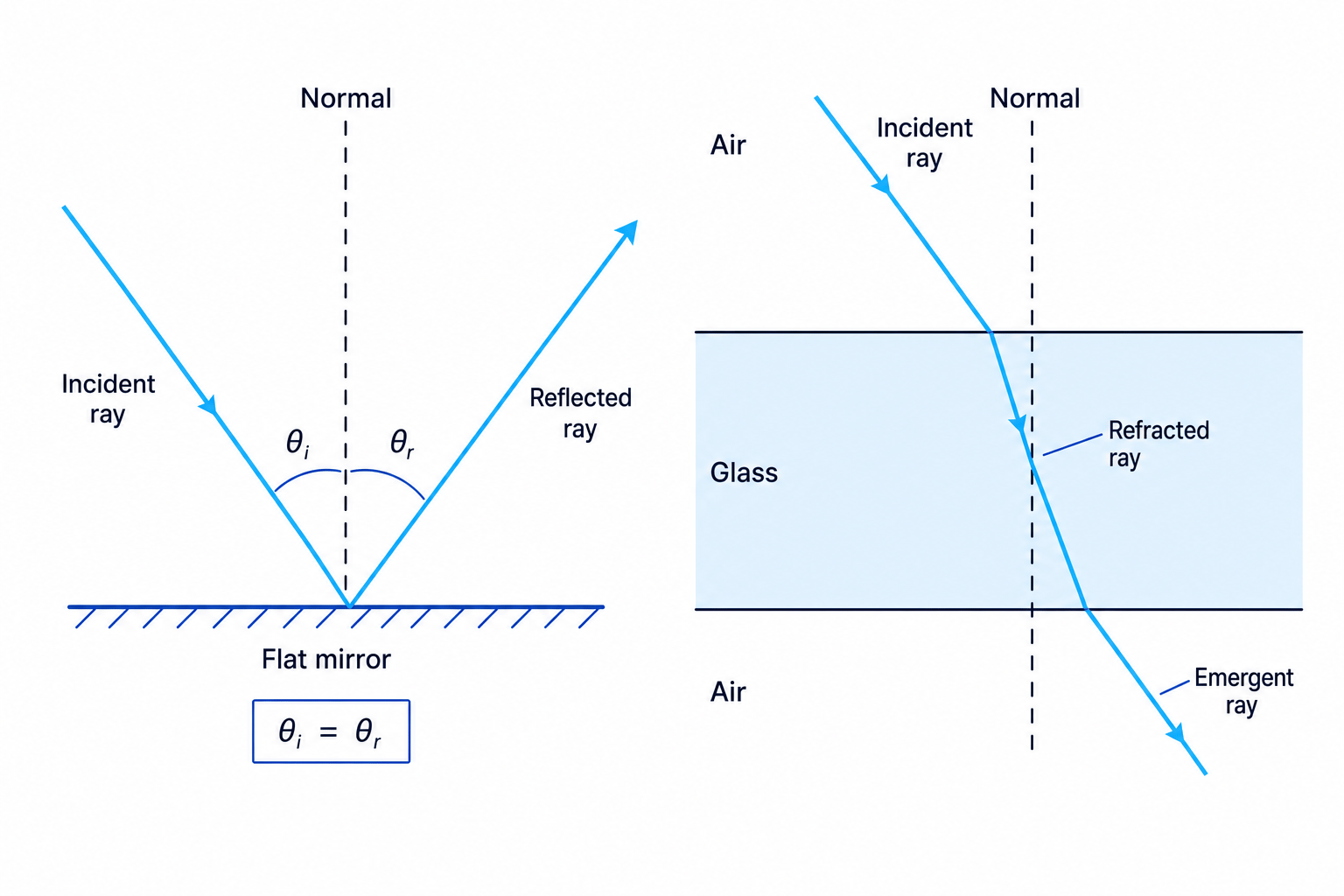
Specular reflection and scattering
Specular reflection happens from a smooth surface, such as a mirror, so parallel rays stay parallel and a clear image can form. Scattering happens when light is reflected in many directions, often from a rough surface or tiny particles, so no clear image forms.
Drawing a reflected ray
A light ray hits a plane mirror at an angle of incidence of 35°. What should the reflected ray look like?
- Measure the angle from the normal, not the mirror surface, so the incident angle is 35° from the normal.
- Apply the law of reflection: θi=θr\theta_i = \theta_rθi=θr, so the reflected ray must also be 35° from the normal.
- Draw the reflected ray on the other side of the normal with an arrow pointing away from the mirror. The angle between the incident and reflected rays is 35∘+35∘=70∘35^\circ + 35^\circ = 70^\circ35∘+35∘=70∘.
Measuring from the surface
Students often measure reflection angles from the mirror surface. In ray diagrams, always measure the angle between the ray and the normal.
Refraction
Refraction is the change in direction of a wave when it crosses a boundary between two materials, such as air and glass.
For Higher Tier, you should link refraction to velocity: electromagnetic waves travel at different speeds in different substances. When light changes speed at a boundary, it can change direction.
A simple rule for light rays:
- If light enters a material where it travels more slowly, such as from air into glass, it bends towards the normal.
- If light enters a material where it travels faster, such as from glass into air, it bends away from the normal.
- If the ray hits the boundary along the normal, it does not bend because the path is symmetrical.
Refraction rule
Light bends towards the normal when it slows down, and away from the normal when it speeds up.
Tracing refraction through a glass block
A ray travels from air into a rectangular glass block, then leaves back into air. Describe the path.
- At the first boundary, the ray goes from air into glass, so it slows down and bends towards the normal.
- Inside the glass, the ray travels in a straight line until it reaches the second boundary.
- At the second boundary, the ray goes from glass into air, so it speeds up and bends away from the normal.
- Because the two sides of a rectangular block are parallel, the emergent ray is parallel to the original incident ray, but shifted sideways.
No refraction calculations needed here
For this OCR section, ray diagrams for reflection and refraction are qualitative only. You do not need equations for calculating refraction angles.
Lenses: bending rays in useful ways
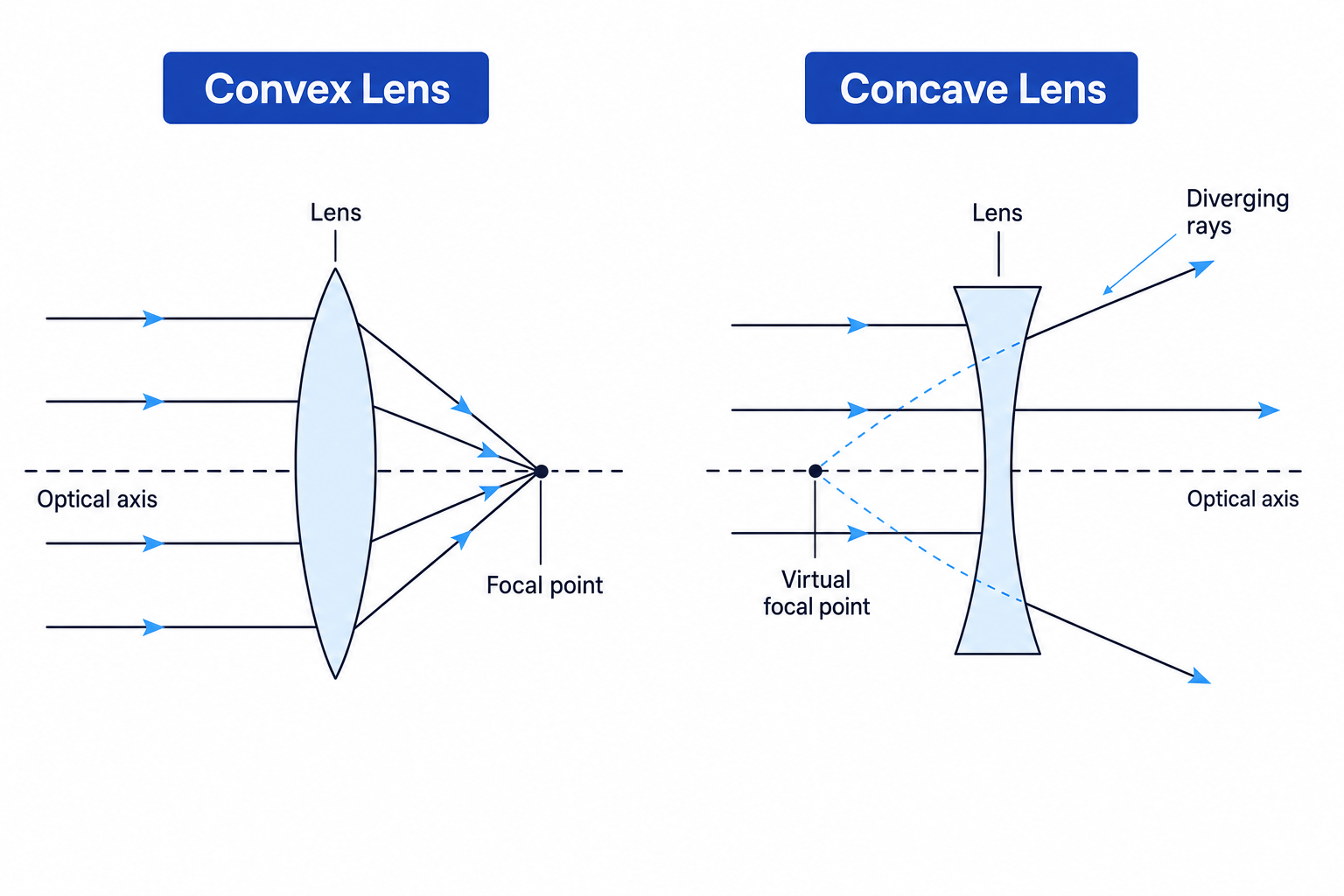
A lens is a transparent object, usually made of glass or plastic, that refracts light to change the direction of rays. The middle line through a lens is called the optical axis.
A convex lens is thicker in the middle than at the edges. It makes parallel rays converge, meaning they come together. A concave lens is thinner in the middle than at the edges. It makes parallel rays diverge, meaning they spread out.
The focal point is the point where rays meet, or appear to have come from, after passing through a lens.
Convex lenses
A convex lens can focus parallel light rays to a real focal point. This is useful in cameras, projectors, magnifying glasses and the eye.
For vision correction, a convex lens can help with long-sightedness, where nearby objects would otherwise focus behind the retina. The convex lens starts converging the rays before they enter the eye.
Concave lenses
A concave lens spreads rays out. The rays do not meet at a real point after the lens, but they appear to have come from a virtual focal point on the same side as the incoming light.
For vision correction, a concave lens can help with short-sightedness, where distant objects would otherwise focus in front of the retina. The concave lens spreads the rays slightly before they enter the eye, moving the focus back onto the retina.
Choosing a lens for correcting vision
A person is short-sighted, so light from a distant object focuses in front of the retina. Which lens helps?
- The problem is that the eye bends the light too much, so the focus forms too early.
- To reduce this before the light enters the eye, the incoming rays need to be spread out slightly.
- A concave lens diverges rays, so it is used to correct short-sightedness.
Mixing up convex and concave
A convex lens converges rays. A concave lens causes rays to diverge. The word “concave” has “cave” in it — it curves inwards.
Colour: absorption, transmission and reflection
Visible light colours correspond to different frequencies and wavelengths. White light is a mixture of many visible wavelengths.
For light, the primary colours are red, green and blue. This is different from paints or inks, where you may have used cyan, magenta and yellow.
Differential absorption, transmission and reflection
Differential means “different amounts for different wavelengths”. Colour happens because materials absorb, transmit or reflect some wavelengths more than others.
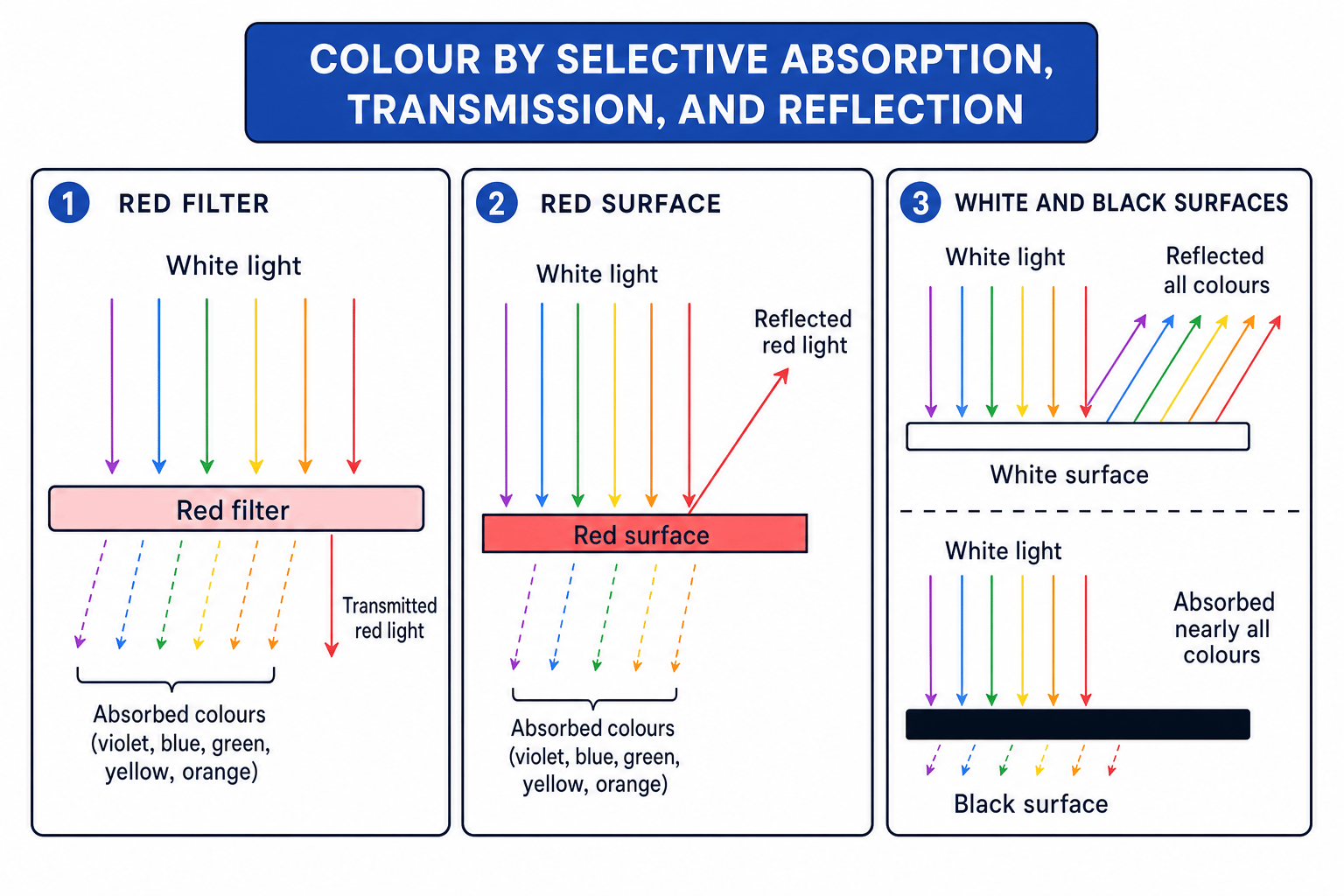
A red filter does not add red light. Instead, it transmits red light and absorbs many other colours. A red surface looks red in white light because it reflects red wavelengths and absorbs many other visible wavelengths.
A white surface reflects most visible wavelengths. A black surface absorbs most visible wavelengths, so little light is reflected to your eyes.
Filters do not add colour
A coloured filter does not “put colour into” the light. It removes some wavelengths and lets others through.
Predicting colour with a filter and surface
White light passes through a green filter and then shines on a red object. What colour will the object appear?
- The green filter transmits mainly green light and absorbs much of the red and blue light.
- The red object reflects red light well, but it absorbs most other colours, including green.
- Since very little red light reaches the object, and the green light is mostly absorbed, the object appears very dark or black.
A quick colour check
Ask two questions: What light reaches the object? Then ask: Which of those colours can the object reflect or transmit?
Practical skills: drawing neat ray diagrams
In PAG P4-style practical work, you may use ray boxes, glass blocks, mirrors, filters and lenses. The exam often tests the same thinking with diagrams.
For ray diagrams:
- Use a ruler for straight rays.
- Put arrows on rays to show direction.
- Draw the normal as a line at right angles to the surface.
- Label materials, such as air and glass.
- For refraction, show bending at the boundary, not randomly in the middle of a material.
In the exam
- For reflection, draw the normal first and make the two angles equal: θi=θr\theta_i = \theta_rθi=θr.
- For refraction, decide whether the ray is slowing down or speeding up, then bend it towards or away from the normal.
- For colour questions, remember that filters and coloured surfaces are selective: they absorb some wavelengths and transmit or reflect others.
Check yourself
- Why does a ray bend towards the normal when it enters glass from air?
- How is a convex lens different from a concave lens in a ray diagram?
- A blue object is viewed under red light. What would you expect to see, and why?