The electrons in an atom are arranged at different distances from the nucleus.
The Figure shows two changes, A and B, to an electron in an atom.
Figure
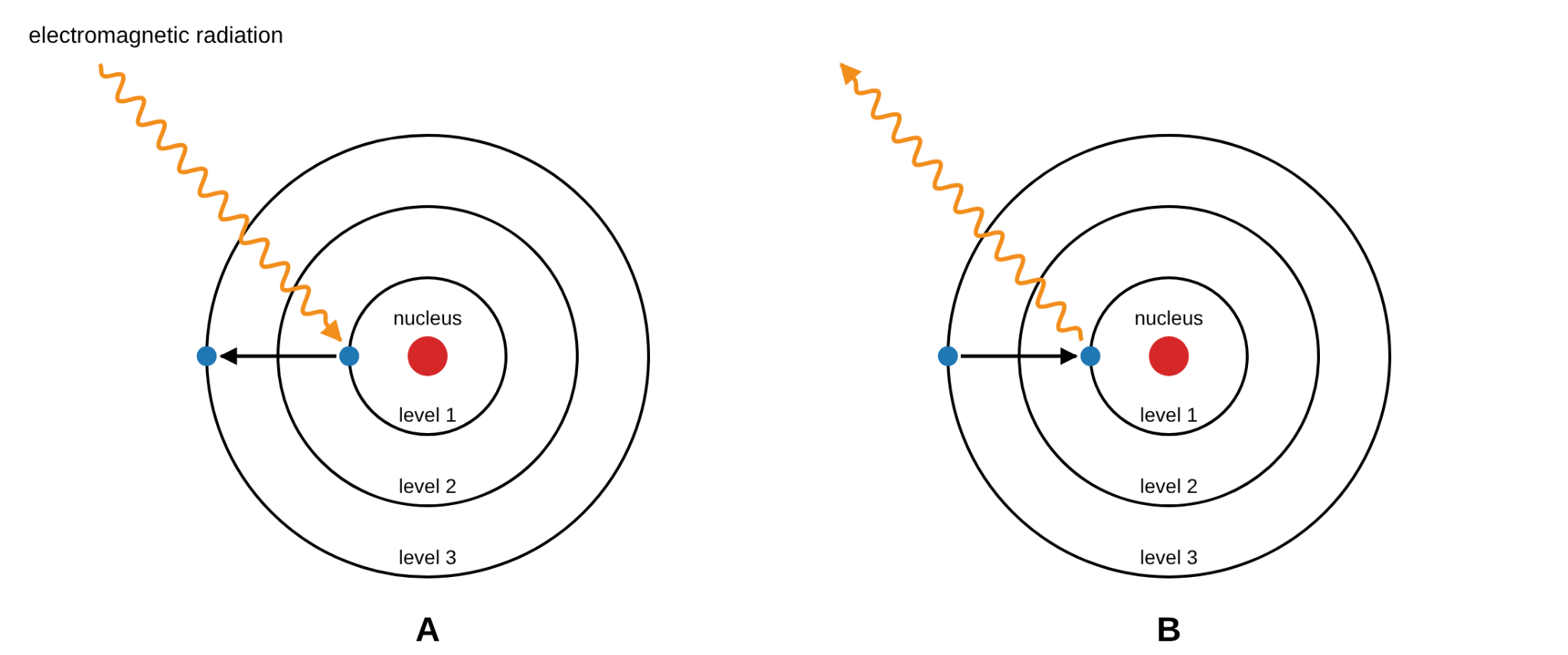
In change A, the electron absorbs electromagnetic radiation.
Describe what happens to the electron.
Describe what happens to energy in change B.
An atom can lose one of its outer electrons.
Name this process.
State the charge on the particle that is left when an atom loses an outer electron.
Give a reason for your answer.
48 exam-style questions on OCR GCSE Physics 6.1 Radioactive emissions, covering 6.1.1 Protons, neutrons and nuclear charge, 6.1.2 Isotopes and nuclear mass, 6.1.3 Representing nuclei and isotopes, 6.1.4 Unstable nuclei and radioactive emissions, 6.1.5 Changes to the nucleus during decay, 6.1.6 Representing radioactive decay, 6.1.7 Balancing mass and charge in decay, 6.1.8 Electron arrangements, ions and radiation, 6.1.9 Radiation absorbed and emitted by atoms and nuclei, 6.1.10 Half-life and random decay, 6.1.11 Net decline over several half-lives, and 6.1.12 Penetration of alpha, beta and gamma radiation. Each one has a worked solution and a mark scheme showing where the marks go.

