2.3.1 Newton's first law
Resultant force
Resultant force
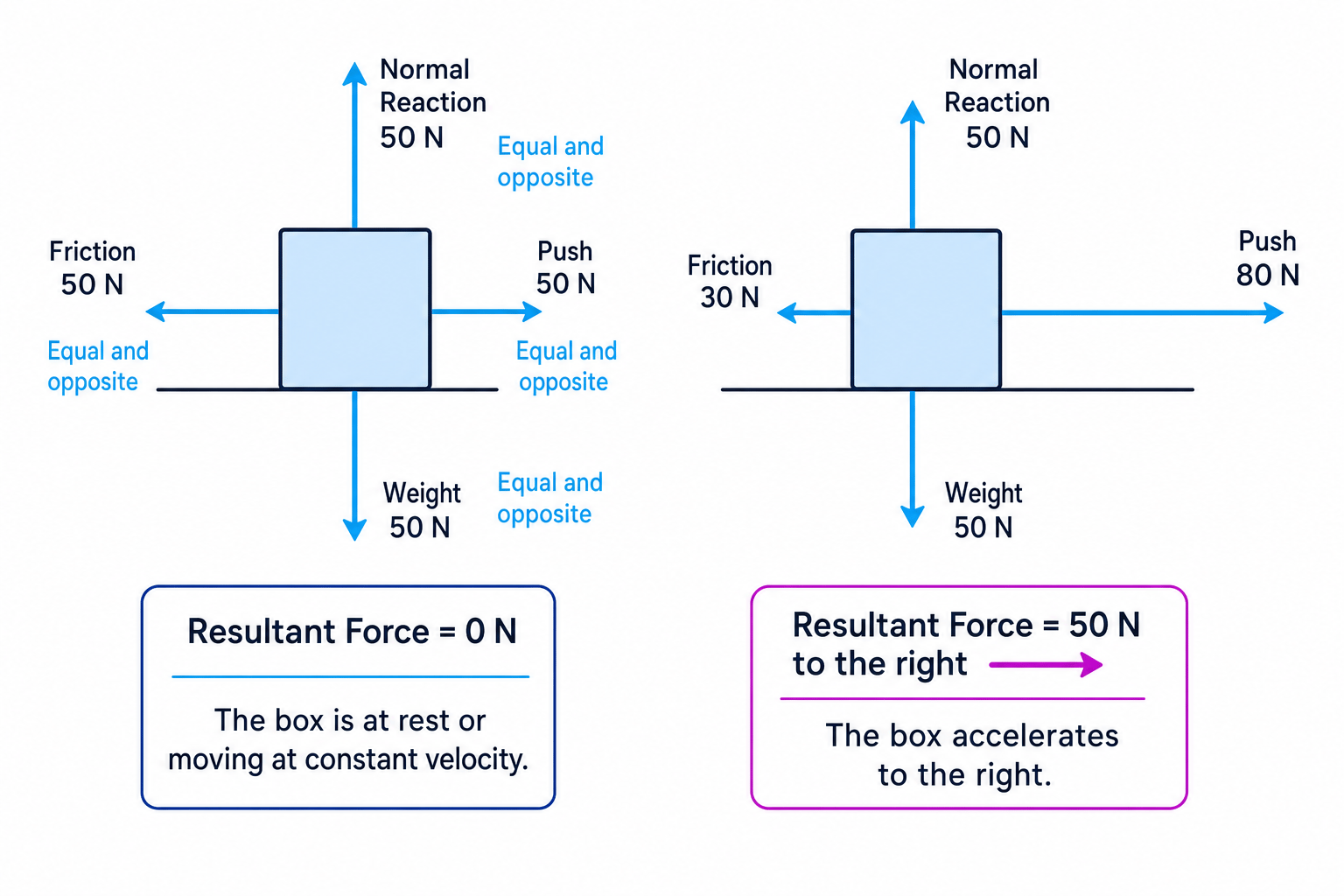
Resultant force is the single force that has the same effect as all the forces acting on an object, after their sizes and directions have been taken into account.
- A force is a vector quantity, so its direction matters as well as its size. Forces acting in the same direction are added. Forces acting in opposite directions are subtracted.
- For forces along one line, the direction of the larger total determines the direction of the resultant force. For example, 700 N700\ \text{N}700 N forwards and 250 N250\ \text{N}250 N backwards give 450 N450\ \text{N}450 N forwards.
- If forces are equal in size and opposite in direction, the resultant force is 0 N0\ \text{N}0 N. The forces are balanced, but forces are still acting on the object.
Balancing forces
- A car travels at constant velocity. Its engine provides a driving force of 1800 N1800\ \text{N}1800 N forwards.
- Constant velocity means the resultant force is 0 N0\ \text{N}0 N.
- Therefore driving force−resistive force=0\text{driving force}-\text{resistive force}=0driving force−resistive force=0.
- Substitution gives 1800 N−resistive force=0 N1800\ \text{N}-\text{resistive force}=0\ \text{N}1800 N−resistive force=0 N.
- The resistive force is 1800 N1800\ \text{N}1800 N backwards.
Newton's first law
Newton's first law
Newton's first law states that an object remains at rest or continues to move at constant velocity unless a non-zero resultant force acts on it.
- A constant velocity means constant speed in a constant direction. Motion at constant speed around a bend is not constant velocity because the direction changes.
- Newton's first law does not say that a moving object needs a forward resultant force. A resultant force is needed to change velocity, not to maintain a constant velocity.
- A bicycle slows when the rider stops pedalling because friction and air resistance provide a resultant force opposite to its motion. If no resultant force acted, it would continue at constant velocity.
Zero resultant force
Balanced forces
Balanced forces are forces whose vector sum is zero, so they produce no change in velocity.
- When the resultant force is zero, acceleration is zero. An object can therefore remain at rest or move at constant velocity.
- A book at rest on a table has weight acting downwards and an equal normal contact force acting upwards. The two forces balance, so the book remains at rest.
- A vehicle moving at constant velocity has a driving force forwards equal to the total friction and drag backwards. The forces balance, so its speed and direction remain constant.
- A falling object at terminal velocity has weight downwards equal to air resistance upwards. Its resultant force and acceleration are zero, so it continues downwards at constant speed.
Explaining balanced motion
- Link the force condition to the motion: the forces are balanced, so the resultant force is zero, therefore the object remains at rest or moves at constant velocity.
- Do not write that there are no forces. State that the forces are equal and opposite or that their resultant is zero.
- When a value and direction are required, include both, such as 450 N450\ \text{N}450 N forwards.
Non-zero resultant force
Acceleration
Acceleration is the rate of change of velocity.
- When the resultant force is not zero, the object's velocity changes. The acceleration is in the same direction as the resultant force.
- A resultant force in the direction of motion makes the object speed up. A resultant force opposite to the direction of motion makes it slow down.
- A resultant force at an angle to the motion changes the direction of the velocity. The speed can stay constant while the velocity changes.
Using an unbalanced force
- A car has a driving force of 4200 N4200\ \text{N}4200 N forwards and resistive forces totalling 3000 N3000\ \text{N}3000 N backwards.
- The resultant force is 4200 N−3000 N=1200 N4200\ \text{N}-3000\ \text{N}=1200\ \text{N}4200 N−3000 N=1200 N forwards.
- The resultant force is non-zero, so the car accelerates.
- The resultant force acts in the direction of motion, so the car speeds up.
Common force errors
- Zero resultant force does not mean zero individual forces.
- Constant speed only proves zero acceleration if the direction is also constant.
- Do not say that a force is used up. Forces act on objects and can change their velocity.
- State Newton's first law.
- Explain why an object moving at constant velocity has a resultant force of zero.
- Calculate the resultant force when 650 N650\ \text{N}650 N acts forwards and 280 N280\ \text{N}280 N acts backwards.
- Explain why zero resultant force does not mean that no forces are acting.
- Describe how a non-zero resultant force changes an object's velocity.
2.3.2 Newton's second law
Newton's second law
Newton's second law
Newton's second law states that the resultant force on an object equals its mass multiplied by its acceleration.
- The relationship is F=maF=maF=ma, where FFF is resultant force in newtons, mmm is mass in kilograms and aaa is acceleration in metres per second squared.
- The acceleration is in the same direction as the resultant force. A larger resultant force causes a larger acceleration in that direction.
- For constant mass, acceleration is directly proportional to resultant force: a∝Fa\propto Fa∝F. Doubling FFF doubles aaa.
- For constant resultant force, acceleration is inversely proportional to mass: a∝1ma\propto\dfrac{1}{m}a∝m1. Doubling mmm halves aaa.
- One newton is the resultant force that gives a mass of 1 kg1\ \text{kg}1 kg an acceleration of 1 m s−21\ \text{m s}^{-2}1 m s−2, so 1 N=1 kg m s−21\ \text{N}=1\ \text{kg m s}^{-2}1 N=1 kg m s−2.
Using the force equation
- Use the equation F=maF=maF=ma. Its rearranged forms are a=Fma=\dfrac{F}{m}a=mF and m=Fam=\dfrac{F}{a}m=aF.
- The force in this equation is the resultant force. Subtract opposing forces before substitution.
- Convert mass to kilograms before using the equation. For example, 750 g=0.750 kg750\ \text{g}=0.750\ \text{kg}750 g=0.750 kg.
- If velocity data are given, first calculate acceleration using a=v−uta=\dfrac{v-u}{t}a=tv−u, then use F=maF=maF=ma.
Calculating acceleration
- A van of mass 1500 kg1500\ \text{kg}1500 kg has a driving force of 4200 N4200\ \text{N}4200 N and resistive forces of 1200 N1200\ \text{N}1200 N.
- The resultant force is F=4200−1200=3000 NF=4200-1200=3000\ \text{N}F=4200−1200=3000 N.
- Rearranging F=maF=maF=ma gives a=Fma=\dfrac{F}{m}a=mF.
- Substitution gives a=30001500=2.0 m s−2a=\dfrac{3000}{1500}=2.0\ \text{m s}^{-2}a=15003000=2.0 m s−2.
- The acceleration is 2.0 m s−22.0\ \text{m s}^{-2}2.0 m s−2 forwards.
Finding resultant force
- A 900 kg900\ \text{kg}900 kg car increases its velocity from 8.0 m s−18.0\ \text{m s}^{-1}8.0 m s−1 to 20 m s−120\ \text{m s}^{-1}20 m s−1 in 6.0 s6.0\ \text{s}6.0 s.
- First calculate acceleration: a=v−ut=20−8.06.0=2.0 m s−2a=\dfrac{v-u}{t}=\dfrac{20-8.0}{6.0}=2.0\ \text{m s}^{-2}a=tv−u=6.020−8.0=2.0 m s−2.
- Then use F=maF=maF=ma: F=900×2.0=1800 NF=900\times2.0=1800\ \text{N}F=900×2.0=1800 N.
- The resultant force is 1800 N1800\ \text{N}1800 N in the direction of the acceleration.
Force, mass and acceleration
- Aim: to investigate how acceleration depends on resultant force and total moving mass using a trolley system.
- Apparatus: dynamics trolley, level or gently inclined runway, pulley and clamp, light string, mass hanger, slotted masses, additional trolley masses, two light gates with a data logger or a motion sensor, interrupt card, balance, metre rule and stop block.
- Variables, mass investigation: total moving mass is the independent variable, acceleration is the dependent variable, and the hanging mass, pulling force, release position, runway angle, light-gate positions and pulley arrangement are controlled.
- Method, set-up:
- Measure the mass of the trolley, hanger, string and every slotted mass that will move. Record the total moving mass in kilograms.
- Attach the trolley to the hanger using a light string over the pulley. Keep the string parallel to the runway and secure the pulley firmly.
- Fit the interrupt card, align and zero the light gates or motion sensor, mark a fixed release position and place a stop block before the pulley.
- Check whether the runway is level. If friction compensation is used, raise one end slightly until the trolley moves at nearly constant velocity after a gentle push, then leave the angle unchanged.
- Method, changing mass at constant pulling force:
- Place a fixed mass on the hanger so its weight provides an approximately constant pulling force, F=mhgF=m_{\mathrm{h}}gF=mhg.
- Release the trolley from the marked point without pushing it. Record the velocity-time data and determine the acceleration.
- Repeat at least three times and calculate the mean acceleration. Investigate anomalous readings rather than removing them automatically.
- Add a known mass to the trolley while leaving the hanging mass unchanged. Recalculate the total moving mass and repeat for at least five masses.
- Method, changing force at constant total mass:
- Place several slotted masses on the trolley and keep the total moving mass fixed throughout.
- Transfer one mass at a time from the trolley to the hanger. Each transfer increases the pulling force without changing the total mass being accelerated.
- For each pulling force, release the trolley from the same point, record at least three accelerations and calculate a mean.
- Results: increasing total mass decreases acceleration when the pulling force is constant. Increasing resultant force increases acceleration when total mass is constant.
- Maths: calculate acceleration using a=v−uta=\dfrac{v-u}{t}a=tv−u where required. Plot aaa against mmm for the mass investigation and aaa against FFF for the force investigation. A plot of aaa against 1m\dfrac{1}{m}m1 should be linear for constant force, while aaa against FFF should be a straight line through the origin when mass is constant.
- Watch out: use the mass of the whole moving system, including the hanger. Friction and pulley resistance mean the hanging weight is not exactly the resultant force. Slack string, a sloping runway, inconsistent release and misaligned light gates can also distort the results.
- Safety: secure the runway and pulley, use a stop block, keep feet clear of the falling hanger and use modest masses so the trolley remains controlled.
Using a graph gradient
- An acceleration against force graph passes through (0.20 N,0.25 m s−2)(0.20\ \text{N},0.25\ \text{m s}^{-2})(0.20 N,0.25 m s−2) and (1.00 N,1.25 m s−2)(1.00\ \text{N},1.25\ \text{m s}^{-2})(1.00 N,1.25 m s−2).
- The gradient is 1.25−0.251.00−0.20=1.25 m s−2 N−1\dfrac{1.25-0.25}{1.00-0.20}=1.25\ \text{m s}^{-2}\text{ N}^{-1}1.00−0.201.25−0.25=1.25 m s−2 N−1.
- Since a=Fma=\dfrac{F}{m}a=mF, the gradient equals 1m\dfrac{1}{m}m1.
- Therefore m=11.25=0.80 kgm=\dfrac{1}{1.25}=0.80\ \text{kg}m=1.251=0.80 kg.
Force calculation method
- Write F=maF=maF=ma before substituting, then show the resultant-force calculation separately.
- Use the unit N\text{N}N for force, kg\text{kg}kg for mass and m s−2\text{m s}^{-2}m s−2 for acceleration.
- For a practical improvement, name the change and link it to its effect, such as using an automatic release so the trolley is not given an extra push.
- Use directly proportional only when the graph is a straight line through the origin.
Common force errors
- Do not use the driving or pulling force as FFF without considering opposing forces.
- Do not put weight in newtons into the mass position. Calculate mass in kilograms first.
- Do not change force and mass at the same time unless total moving mass is deliberately kept constant by transferring masses.
- State Newton's second law and give the unit of each quantity in F=maF=maF=ma.
- Calculate the acceleration of a 1200 kg1200\ \text{kg}1200 kg car acted on by a resultant force of 3600 N3600\ \text{N}3600 N.
- Explain how acceleration changes when mass doubles at constant resultant force.
- Describe how the practical changes force while keeping total moving mass constant.
- Explain why repeats, a mean and friction control improve the investigation.
2.3.3 Weight and gravitational field strength
Weight and gravity
Weight
Weight is the force acting on an object because of a gravitational field.
- Weight is a vector force. Near the surface of a planet or moon it acts towards the centre of that body, described locally as vertically downwards.
- The symbol for weight is WWW and its unit is the newton, N\text{N}N. Weight must not be stated in kilograms.
- An object has weight whenever it is in a gravitational field. An astronaut in orbit still has weight because gravity provides the force that keeps the astronaut in orbit.
Gravitational field strength
Gravitational field strength
Gravitational field strength is the force per unit mass acting on an object placed in a gravitational field, measured in newtons per kilogram (N/kg).
- The symbol is ggg and the unit is newtons per kilogram, N kg−1\text{N kg}^{-1}N kg−1. A field strength of 10 N kg−110\ \text{N kg}^{-1}10 N kg−1 means that every kilogram experiences a gravitational force of 10 N10\ \text{N}10 N.
- Near Earth's surface, use g=10 N kg−1g=10\ \text{N kg}^{-1}g=10 N kg−1 unless a different value is supplied. Values such as 9.8 N kg−19.8\ \text{N kg}^{-1}9.8 N kg−1 may be used when given.
- Gravitational field strength depends on location. It is different on different planets and moons, and becomes weaker with increasing distance from the body producing the field.
Mass and weight
Mass
Mass is a measure of the amount of matter in an object and is measured in kilograms.
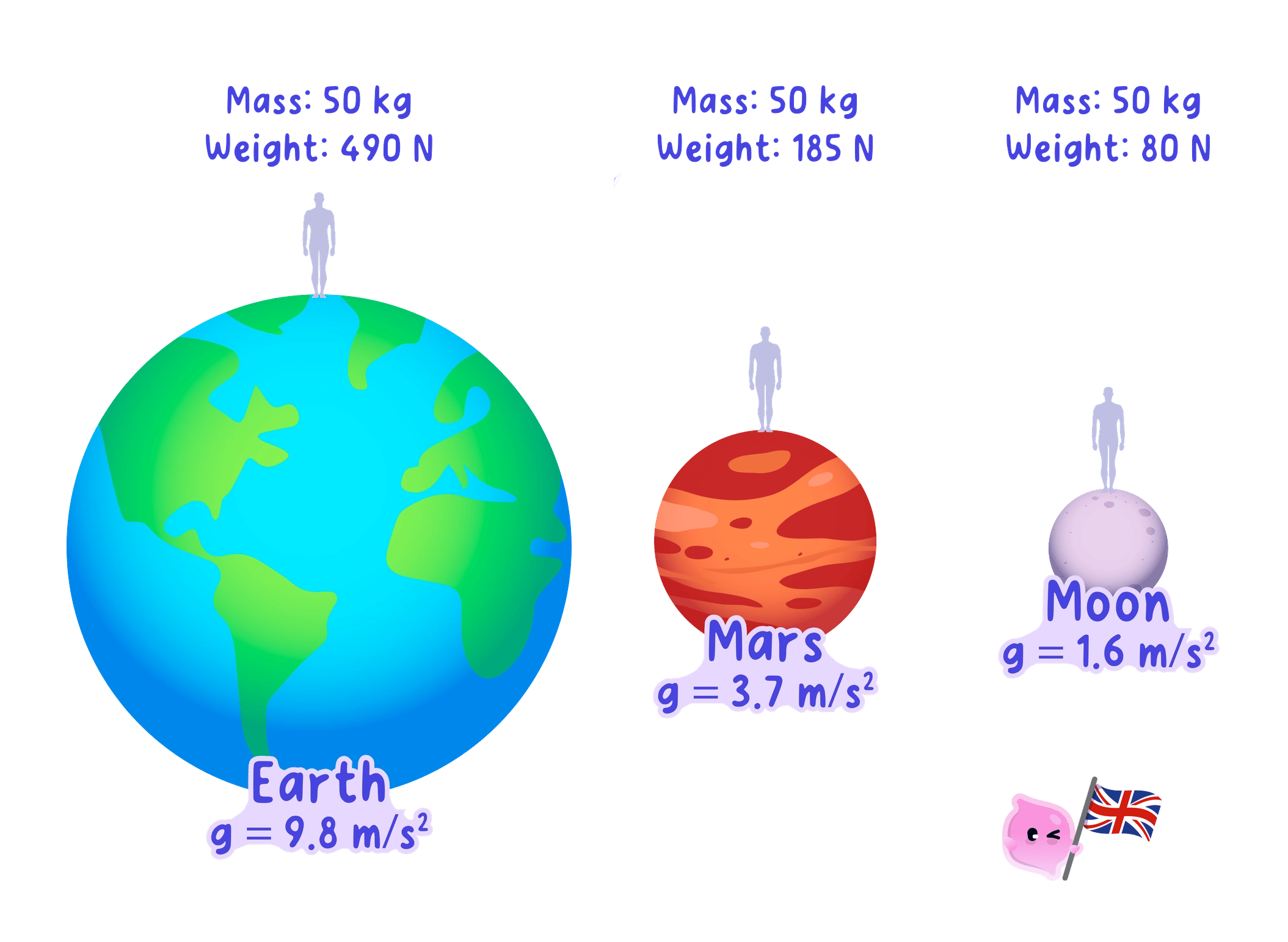
- Mass is a scalar and does not change when an object moves from Earth to the Moon. Weight changes because gravitational field strength changes.
- A 50 kg50\ \text{kg}50 kg person has the same mass everywhere. On Earth, using g=9.8 N kg−1g=9.8\ \text{N kg}^{-1}g=9.8 N kg−1, the weight is 490 N490\ \text{N}490 N. On the Moon, using g=1.6 N kg−1g=1.6\ \text{N kg}^{-1}g=1.6 N kg−1, the weight is 80 N80\ \text{N}80 N.
The weight equation
- The relationship is W=mgW=mgW=mg, where WWW is weight in newtons, mmm is mass in kilograms and ggg is gravitational field strength in newtons per kilogram.
- The rearranged forms are m=Wgm=\dfrac{W}{g}m=gW and g=Wmg=\dfrac{W}{m}g=mW.
- For a fixed mass, W∝gW\propto gW∝g. Doubling the gravitational field strength doubles the weight.
- For a fixed gravitational field strength, W∝mW\propto mW∝m. Doubling the mass doubles the weight.
Calculating weight
- A student has a mass of 58 kg58\ \text{kg}58 kg where g=10 N kg−1g=10\ \text{N kg}^{-1}g=10 N kg−1.
- Use W=mgW=mgW=mg.
- Substitution gives W=58×10=580 NW=58\times10=580\ \text{N}W=58×10=580 N.
- The student's weight is 580 N580\ \text{N}580 N.
Finding mass and weight
- A rock weighs 96 N96\ \text{N}96 N on the Moon, where g=1.6 N kg−1g=1.6\ \text{N kg}^{-1}g=1.6 N kg−1.
- Rearrange W=mgW=mgW=mg to m=Wgm=\dfrac{W}{g}m=gW.
- Substitution gives m=961.6=60 kgm=\dfrac{96}{1.6}=60\ \text{kg}m=1.696=60 kg.
- The mass remains 60 kg60\ \text{kg}60 kg on Earth. Using g=10 N kg−1g=10\ \text{N kg}^{-1}g=10 N kg−1, W=60×10=600 NW=60\times10=600\ \text{N}W=60×10=600 N.
Measuring weight
Newtonmeter
A newtonmeter is a calibrated force meter that measures force in newtons by the extension of a spring.
- Check that the newtonmeter reads zero before attaching the object. Correct the zero setting where possible.
- Select a newtonmeter with a range large enough for the expected weight and a scale fine enough to give a useful resolution.
- Hold or clamp the newtonmeter vertically, attach the object securely and allow it to hang freely without touching another surface.
- Wait for oscillations to stop, then read the scale at eye level to reduce parallax error.
- Record the value in newtons. A balance measures mass in kilograms, whereas a newtonmeter measures weight in newtons.
- The spring stretches because the attached weight pulls on it. The scale is calibrated so the extension gives the force directly.
Weight in different fields
- The same object weighs less where ggg is smaller because W=mgW=mgW=mg and its mass remains constant.
- A value of g=1.6 N kg−1g=1.6\ \text{N kg}^{-1}g=1.6 N kg−1 on the Moon gives a weight about one sixth of the value on Earth when g≈9.8 N kg−1g\approx9.8\ \text{N kg}^{-1}g≈9.8 N kg−1.
- The strength of a gravitational field decreases with distance from the body producing it. This reduces weight, although mass remains unchanged.
Explaining changes in weight
- Give the complete causal chain: the gravitational field strength is smaller, mass is unchanged, and W=mgW=mgW=mg, so weight is smaller.
- For calculations, write the equation, substitute values with consistent units, evaluate and state the final unit.
- Use mass for kilograms and weight for newtons. Calling kilograms a unit of weight loses precision and can lose the mark.
- When describing measurement, name the newtonmeter, state that it is read in newtons and include a method detail such as zeroing or reading at eye level.
Common gravity errors
- Do not say that mass changes with location. The gravitational field strength and weight change.
- Do not use m s−2\text{m s}^{-2}m s−2 when the required quantity is gravitational field strength. Use N kg−1\text{N kg}^{-1}N kg−1.
- Do not claim that orbit means no gravity. Orbiting objects are continuously falling under the gravitational force.
- Define weight and gravitational field strength.
- State the instrument used to measure weight and describe how it is read accurately.
- Calculate the weight of a 6.0 kg6.0\ \text{kg}6.0 kg object where g=10 N kg−1g=10\ \text{N kg}^{-1}g=10 N kg−1.
- Explain why an object's mass stays constant but its weight changes on the Moon.
- Rearrange W=mgW=mgW=mg to make ggg the subject.