2.4.1 Circular motion and centripetal force
Speed and velocity
Velocity
Velocity is speed in a stated direction, measured in metres per second.
- Speed is a scalar quantity. Velocity is a vector quantity. An object can therefore have constant speed while its velocity changes.
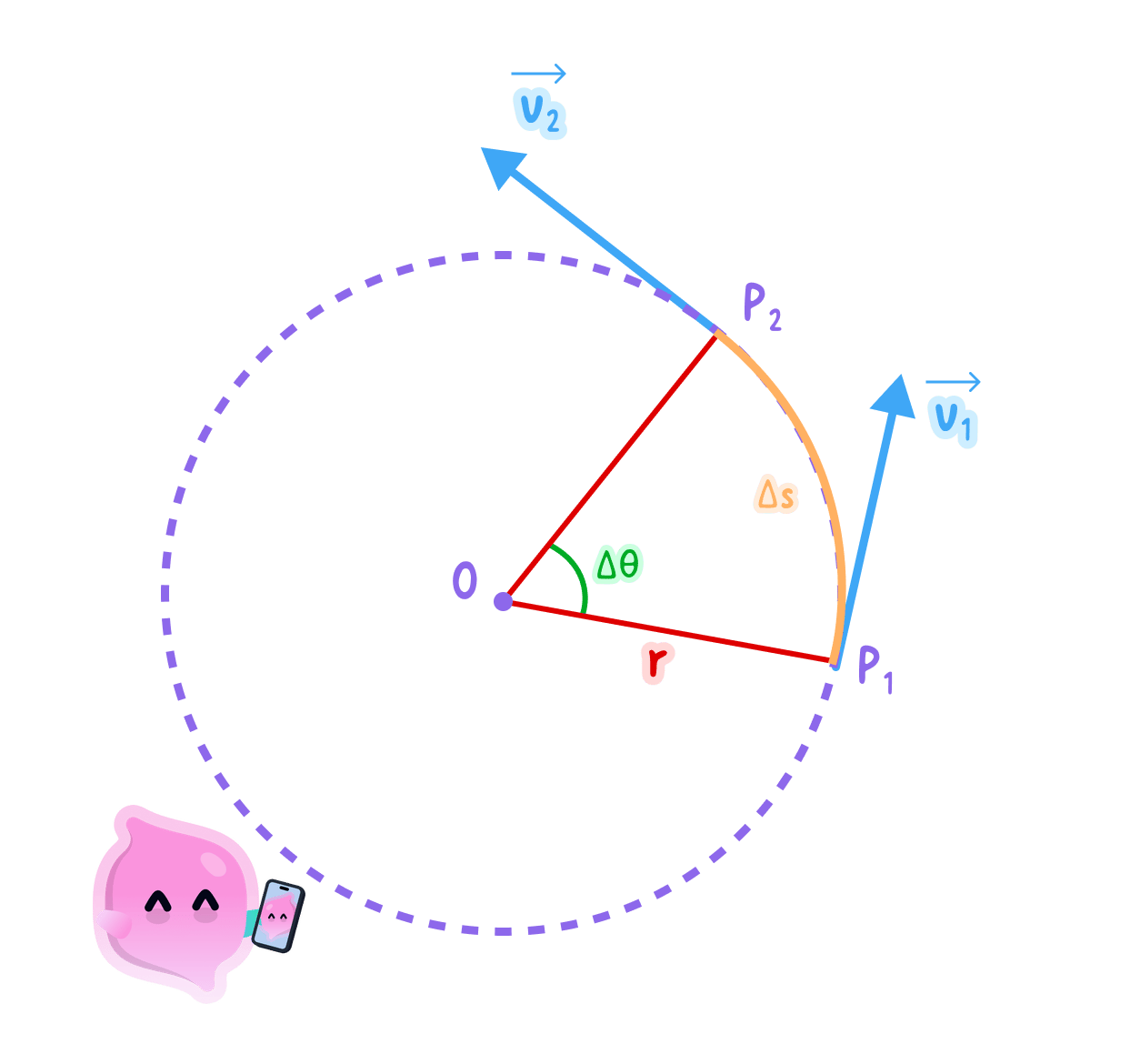
- An object travelling in a circle constantly changes its direction of motion. Its velocity changes even if its speed remains constant.
- At any point on the circular path, the instantaneous velocity is directed along a tangent to the circle. The tangent direction changes from point to point.
Acceleration in a circle
Acceleration
Acceleration is the rate of change of velocity.
- The relationship a=v−uta=\dfrac{v-u}{t}a=tv−u describes change in velocity. In circular motion, the change is in direction rather than necessarily in speed.
- An object moving in a circle at constant speed is accelerating because its velocity direction changes continuously.
- A changing velocity requires a non-zero resultant force. Without that force, Newton's first law predicts motion at constant velocity in a straight line.
Centripetal force
Centripetal force
Centripetal force is the resultant force acting on an object moving in a circle, directed towards the centre of the circle.
- The centripetal force acts towards the centre at every point on the path. It is perpendicular to the instantaneous velocity in uniform circular motion.
- The inward force continually changes the direction of the velocity, producing circular motion. It does not point along the tangent.
- If the centripetal force suddenly disappears, the object initially moves along the tangent to the circle at the point where the force stopped acting.
Forces that provide centripetal force
- Centripetal force is not an additional type of force. It is the name given to whichever real force, or resultant of forces, acts towards the centre.
- For a satellite or moon in orbit, gravitational force provides the centripetal force towards the centre of the planet.
- For a ball moving in a circle on a string, tension in the string provides the centripetal force towards the hand or pivot.
- For a car turning on a level road, friction between the tyres and road provides the centripetal force towards the centre of the bend.
- For clothes moving in a circle inside a washing-machine drum, the normal contact force from the drum provides the inward force.
Explaining an orbit
- A satellite moves around Earth in a circular orbit at constant speed.
- Its direction changes continuously, so its velocity changes.
- A change in velocity means the satellite is accelerating even though its speed is constant.
- The gravitational force acts towards the centre of Earth and provides the centripetal resultant force.
A string breaks
- A ball moves in a horizontal circle on a string.
- The tension acts towards the centre and provides the centripetal force.
- When the string breaks, the tension disappears and there is no inward force.
- The ball initially continues in a straight line along the tangent at the breaking point, in accordance with Newton's first law.
Explaining circular motion
- Use the linked chain: direction changes, so velocity changes, therefore the object accelerates.
- State that the resultant force acts towards the centre of the circle. Words such as sideways or inwards are less precise.
- For a named situation, identify the real force providing the centripetal force, such as gravity, tension, friction or normal contact force.
- Keep the explanation qualitative. No centripetal-force calculation is required for this content.
Common circular-motion errors
- Constant speed does not mean constant velocity when direction changes.
- Do not draw an outward force on the moving object. The resultant force required for circular motion is towards the centre.
- Do not say that an orbiting object has no gravity. Gravity supplies the centripetal force.
- Explain why an object moving in a circle at constant speed is accelerating.
- State the direction of the centripetal resultant force.
- Name the force providing centripetal force for a satellite, a ball on a string and a car on a bend.
- Describe the motion of a ball immediately after its string breaks.
- Explain why centripetal force is not an additional type of force.
2.4.2 Inertial mass
Inertial mass measures resistance to acceleration
Inertia
Inertia is the tendency of an object to remain at rest or continue moving at constant velocity unless a resultant force acts on it.
Inertial mass
Inertial mass is the ratio of the resultant force acting on an object to the acceleration it produces, measured in kilograms.
- Inertial mass measures how difficult it is to change an object's velocity, including how difficult it is to start an object moving from rest.
- The defining equation is m=Fam=\dfrac{F}{a}m=aF, where mmm is inertial mass in kilograms, FFF is resultant force in newtons and aaa is acceleration in metres per second squared.
- A large inertial mass means that the same resultant force produces a smaller acceleration because a=Fma=\dfrac{F}{m}a=mF.
- A small inertial mass means that the same resultant force produces a larger acceleration.
Resultant force must be used
- Use the resultant force, not one individual force, because opposing forces may partly or completely cancel.
- If the resultant force is zero, the acceleration is zero, so the object remains at rest or continues at constant velocity.
- Inertial mass is a property of the object and does not depend on the strength of the gravitational field.
- Do not describe inertia as a force because inertia is a tendency, not an interaction acting on the object.
- Do not use weight in m=Fam=\dfrac{F}{a}m=aF unless weight is the resultant force in the situation.
- Given: a resultant force of 18 N18\ \text{N}18 N produces an acceleration of 3.0 m/s23.0\ \text{m/s}^23.0 m/s2.
- Rearrange Newton's second law: m=Fam=\dfrac{F}{a}m=aF.
- Substitute: m=18 N3.0 m/s2=6.0 kgm=\dfrac{18\ \text{N}}{3.0\ \text{m/s}^2}=6.0\ \text{kg}m=3.0 m/s218 N=6.0 kg.
- The object's inertial mass is 6.0 kg6.0\ \text{kg}6.0 kg.
Comparing objects from data
- For the same resultant force, compare accelerations using m=Fam=\dfrac{F}{a}m=aF; the object with the smaller acceleration has the greater inertial mass.
- For the same acceleration, the object that requires the larger resultant force has the greater inertial mass.
- On a graph of resultant force against acceleration, F=maF=maF=ma, so the gradient equals the inertial mass.
- When explaining a comparison, link the same force to the different accelerations and then state which object has the greater inertial mass.
- For calculations, identify the resultant force before substituting and include the unit kg\text{kg}kg.
Force and acceleration data reveal mass
- A straight-line graph through the origin shows that resultant force is directly proportional to acceleration when mass is constant.
- A steeper FFF against aaa graph represents a larger inertial mass because its gradient ΔFΔa\dfrac{\Delta F}{\Delta a}ΔaΔF is larger.
- What does inertial mass measure?
- State the equation that defines inertial mass.
- Why must resultant force be used in the equation?
- What does the gradient of a force against acceleration graph represent?
2.4.3 Newton's third law and momentum in collisions
Newton's third law links interaction forces
Newton's third law
Newton's third law states that when two objects interact, they exert forces on each other that are equal in magnitude and opposite in direction.
Momentum
Momentum is the product of an object's mass and velocity, measured in kilogram metres per second (kg m/s).
- A Newton's third-law pair acts on two different objects during the same interaction.
- The forces are the same type, equal in magnitude, opposite in direction and present for the same time.
- The pair does not cancel because the two forces act on different objects.
- For a book resting on a table, the book pushes down on the table and the table pushes up on the book with an equal force.
- Do not pair the weight of a book with the table's normal contact force because both forces act on the book.
- The third-law partner of the book's weight is the gravitational force that the book exerts on Earth.
Momentum includes direction
- Momentum is calculated using p=mvp=mvp=mv, where ppp is momentum in kg m/s\text{kg m/s}kg m/s, mmm is mass in kg\text{kg}kg and vvv is velocity in m/s\text{m/s}m/s.
- Momentum is a vector, so choose one direction as positive and give motion in the opposite direction a negative velocity and momentum.
- An object at rest has zero momentum because v=0v=0v=0.
- Moving car: a 1200 kg1200\ \text{kg}1200 kg car travels east at 15 m/s15\ \text{m/s}15 m/s.
- Taking east as positive, p=mv=1200×15=1.8×10⁴ kg m/sp=mv=1200\times15=1.8\times10^4\ \text{kg m/s}p=mv=1200×15=1.8×104 kg m/s.
- Its momentum is 1.8×10⁴ kg m/s1.8\times10^4\ \text{kg m/s}1.8×104 kg m/s east.
Momentum is conserved in a closed system
Conservation of momentum
Conservation of momentum states that in a closed system the total momentum before an interaction equals the total momentum after the interaction.
- During a collision, each object experiences an equal and opposite force for the same time.
- Each object therefore has an equal and opposite change in momentum, so the total momentum of the system does not change.
- Write conservation as ∑pbefore=∑pafter\sum p_{\text{before}}=\sum p_{\text{after}}∑pbefore=∑pafter and include signs for direction.
- Kinetic energy does not have to be conserved in a collision because some energy may be transferred to thermal stores, sound or deformation.
- Before: a 2.0 kg2.0\ \text{kg}2.0 kg trolley moving right at 4.0 m/s4.0\ \text{m/s}4.0 m/s hits a stationary 3.0 kg3.0\ \text{kg}3.0 kg trolley and they stick together.
- Initial momentum: p=(2.0×4.0)+(3.0×0)=8.0 kg m/sp=(2.0\times4.0)+(3.0\times0)=8.0\ \text{kg m/s}p=(2.0×4.0)+(3.0×0)=8.0 kg m/s.
- Combined mass: m=2.0+3.0=5.0 kgm=2.0+3.0=5.0\ \text{kg}m=2.0+3.0=5.0 kg.
- Conservation gives 8.0=5.0v8.0=5.0v8.0=5.0v, so v=1.6 m/sv=1.6\ \text{m/s}v=1.6 m/s to the right.
Explosions also conserve momentum
- If two objects start at rest, their total initial momentum is zero.
- After they push apart, their momenta are equal in magnitude and opposite in direction, so their vector sum remains zero.
- State a positive direction before calculating and keep negative signs until the final answer.
- For a third-law explanation, name both objects, both forces, and state that the forces are equal in magnitude and opposite in direction.
- For conservation, calculate the total momentum of the whole system before and after the interaction.
Interaction forces explain momentum changes
- A larger force or a longer interaction time produces a larger change in momentum.
- Equal and opposite changes in momentum preserve the total momentum of a closed system.
- State Newton's third law.
- Define momentum and give its unit.
- Why do third-law forces not cancel each other?
- What condition is needed for total momentum to be conserved?
- How should direction be represented in a momentum calculation?
2.4.4 Force and rate of change of momentum
Force changes momentum over time
Rate of change of momentum
Rate of change of momentum is the change in an object's momentum divided by the time taken for that change.
Impulse
Impulse is the product of a force and the time for which it acts, and it equals the change in momentum it produces.
- Newton's second law can be written as F=Δpt=mv−mutF=\dfrac{\Delta p}{t}=\dfrac{mv-mu}{t}F=tΔp=tmv−mu for constant mass.
- FFF is the resultant force in newtons, mmm is mass in kilograms, uuu is initial velocity, vvv is final velocity and ttt is time in seconds.
- The change in momentum is Δp=pfinal−pinitial=mv−mu\Delta p=p_{\text{final}}-p_{\text{initial}}=mv-muΔp=pfinal−pinitial=mv−mu.
- The direction of the resultant force is the direction of the change in momentum, not necessarily the direction in which the object is moving.
Signs show changes in direction
- Choose a positive direction before substituting velocities.
- A negative velocity represents motion in the opposite direction, so a rebound usually gives a larger momentum change than stopping.
- Stopping: a 0.20 kg0.20\ \text{kg}0.20 kg ball moving at 12 m/s12\ \text{m/s}12 m/s is brought to rest in 0.040 s0.040\ \text{s}0.040 s.
- Δp=m(v−u)=0.20(0−12)=−2.4 kg m/s\Delta p=m(v-u)=0.20(0-12)=-2.4\ \text{kg m/s}Δp=m(v−u)=0.20(0−12)=−2.4 kg m/s.
- F=−2.40.040=−60 NF=\dfrac{-2.4}{0.040}=-60\ \text{N}F=0.040−2.4=−60 N.
- The mean force has magnitude 60 N60\ \text{N}60 N and acts opposite to the ball's initial motion.
A longer stopping time reduces force
- Rearranging gives FΔt=ΔpF\Delta t=\Delta pFΔt=Δp, so the same momentum change spread over a longer time produces a smaller mean force.
- Crumple zones, airbags, seat belts, crash mats and bending the knees on landing increase the time over which momentum changes.
- The change in momentum is fixed by the initial and final velocities, so increasing time reduces the rate of change of momentum and therefore the force.
- Safety comparison: a passenger's momentum changes by 420 kg m/s420\ \text{kg m/s}420 kg m/s.
- Without an airbag, F=4200.030=1.4×10⁴ NF=\dfrac{420}{0.030}=1.4\times10^4\ \text{N}F=0.030420=1.4×10⁴ N.
- With an airbag, F=4200.12=3.5×10³ NF=\dfrac{420}{0.12}=3.5\times10^3\ \text{N}F=0.12420=3.5×10³ N.
- Increasing the stopping time by a factor of four reduces the mean force by a factor of four.
Force-time graphs give impulse
- The area under a force-time graph equals impulse, J=FΔtJ=F\Delta tJ=FΔt, when the force is constant.
- For a changing force, estimate or calculate the total area under the graph to find Δp\Delta pΔp.
- The unit of impulse is N s\text{N s}N s, which is equivalent to kg m/s\text{kg m/s}kg m/s.
- Do not calculate mv+mumv+mumv+mu unless the chosen velocity signs make that the correct subtraction.
- Do not use speed without direction when an object rebounds.
- Use the resultant or mean force specified by the data, not an unrelated contact force.
Multi-stage calculations need a clear route
- If force and time are given, find momentum change using Δp=FΔt\Delta p=F\Delta tΔp=FΔt.
- If momentum change and one velocity are known, use m(v−u)=Δpm(v-u)=\Delta pm(v−u)=Δp to find the missing velocity.
- Write Δp=m(v−u)\Delta p=m(v-u)Δp=m(v−u) before dividing by time.
- Keep signs throughout the calculation, then describe the direction of a negative answer in words.
- When explaining a safety feature, state that it increases the stopping time for the same momentum change, which reduces the mean force.
- Write Newton's second law in momentum form.
- Why can a rebound produce a large change in momentum?
- How does an airbag reduce the force on a passenger?
- What does the area under a force-time graph represent?
