2.5.1 Stopping distance and reaction time
Reaction time determines thinking distance
Reaction time
Reaction time is the time between detecting a stimulus and beginning a response.
Thinking distance
Thinking distance is the distance a vehicle travels during the driver's reaction time.
- A reaction begins when receptors detect a stimulus, the nervous system processes it and muscles produce a response.
- Typical measured human reaction times are about 0.2 s0.2\ \text{s}0.2 s to 0.9 s0.9\ \text{s}0.9 s, but the value varies between people and conditions.
- Thinking distance is calculated using d=vtd=vtd=vt, where vvv is the vehicle's speed and ttt is the driver's reaction time.
Measuring human reaction time
- Aim: to measure reaction time, compare repeated results and evaluate the reliability of the method.
- Apparatus: a 30 cm30\ \text{cm}30 cm or 1 m1\ \text{m}1 m ruler, a chair and table, and a results table; an online reaction timer may be used as a second method.
- Variables: the tested condition is the independent variable, reaction time is the dependent variable, and the same participant, catching hand, ruler, release height, posture, instructions and surroundings are controlled.
- Method, ruler drop:
- Seat the participant with their forearm resting on the table and their thumb and first finger level with the ruler's 0 cm0\ \text{cm}0 cm mark.
- Hold the ruler vertically with the 0 cm0\ \text{cm}0 cm mark between the participant's open fingers without touching them.
- Release the ruler without warning and without giving any visual or verbal cue.
- Record the distance fallen at the point where the participant catches the ruler.
- Repeat at least five times, allow brief rests, identify any anomalous result and calculate the mean distance.
- Convert each distance sss from centimetres to metres and calculate reaction time using t=2sgt=\sqrt{\dfrac{2s}{g}}t=g2s, with g=9.8 m/s2g=9.8\ \text{m/s}^2g=9.8 m/s2, or use a supplied conversion table.
- Alternative electronic method: use a computer reaction timer that changes the screen after a random delay, click as soon as the signal appears, repeat at least five times and calculate the mean.
- Expected pattern: healthy alert participants commonly obtain reaction times between about 0.2 s0.2\ \text{s}0.2 s and 0.9 s0.9\ \text{s}0.9 s, with ruler-drop values often clustered near the lower part of this range.
- Quality: random release timing prevents anticipation, repeats reduce random uncertainty, the same operator improves consistency, and comparing two methods helps identify systematic delay from the apparatus.
- Uncertainty: anticipation, inconsistent finger position, reading the wrong ruler mark, practice, tiredness and screen or mouse delay can change the result.
- Improvement: use more repeats, randomise the delay, discard only justified anomalies, test conditions in a random order and use several participants before drawing a general conclusion.
- Safety: keep the seated participant's arm supported, keep the floor clear and do not test the effects of alcohol, illegal drugs or unsafe tiredness.
Stopping distance has two parts
Stopping distance
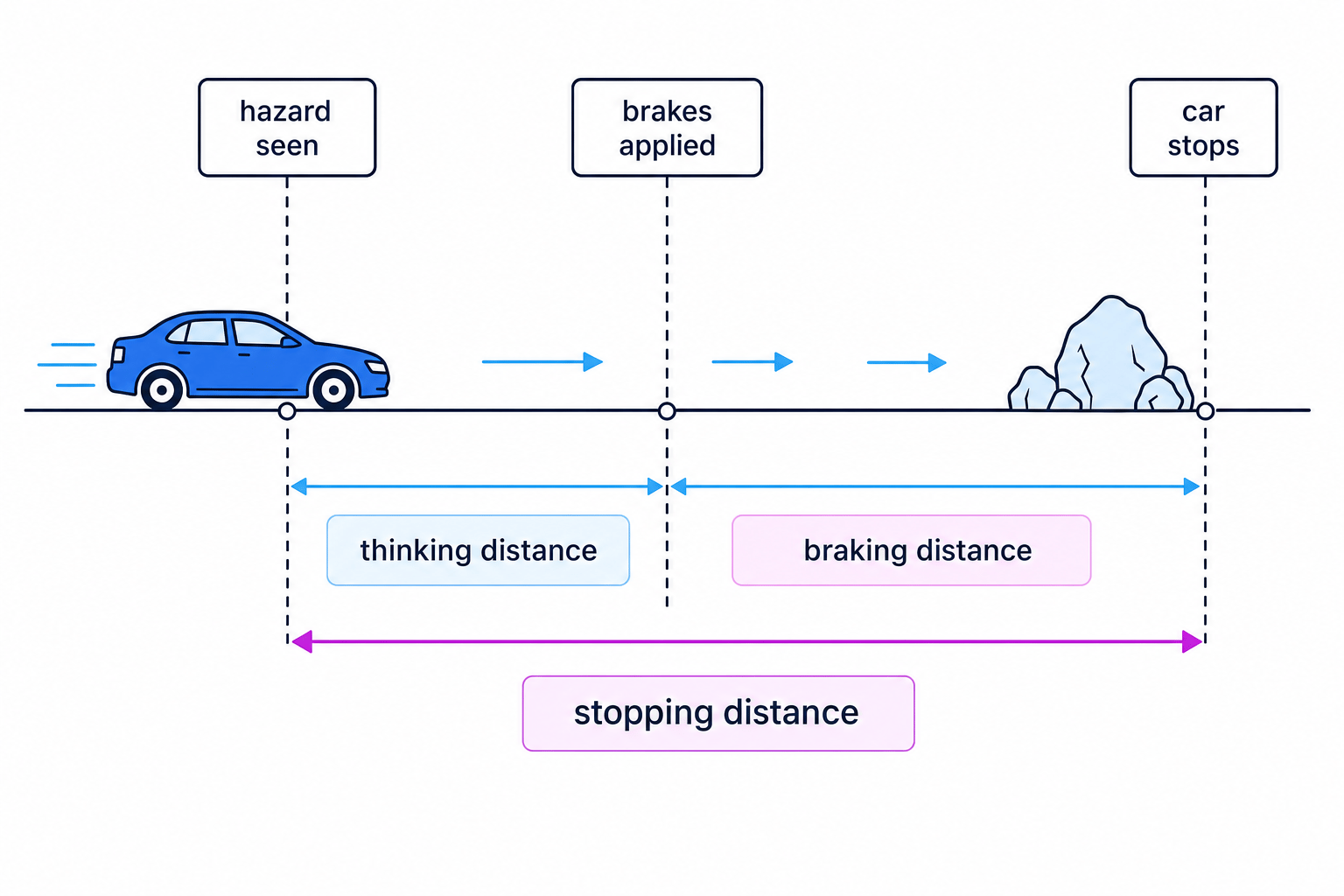
Stopping distance is the total distance travelled from the point a driver detects a hazard until the vehicle comes to rest.
Braking distance
Braking distance is the distance a vehicle travels after the brakes are applied until it comes to a stop.
- The relationship is stopping distance=thinking distance+braking distance\text{stopping distance}=\text{thinking distance}+\text{braking distance}stopping distance=thinking distance+braking distance.
- Thinking distance ends when braking begins, so the two distances are consecutive and must be added.
- At constant reaction time, thinking distance is directly proportional to speed because d=vtd=vtd=vt.
Typical stopping distances
- 20 mph20\ \text{mph}20 mph: 6 m6\ \text{m}6 m thinking distance and 6 m6\ \text{m}6 m braking distance give 12 m12\ \text{m}12 m in total.
- 30 mph30\ \text{mph}30 mph: 9 m9\ \text{m}9 m thinking distance and 14 m14\ \text{m}14 m braking distance give 23 m23\ \text{m}23 m in total.
- 40 mph40\ \text{mph}40 mph: 12 m12\ \text{m}12 m thinking distance and 24 m24\ \text{m}24 m braking distance give 36 m36\ \text{m}36 m in total.
- 50 mph50\ \text{mph}50 mph: 15 m15\ \text{m}15 m thinking distance and 38 m38\ \text{m}38 m braking distance give 53 m53\ \text{m}53 m in total.
- 60 mph60\ \text{mph}60 mph: 18 m18\ \text{m}18 m thinking distance and 55 m55\ \text{m}55 m braking distance give 73 m73\ \text{m}73 m in total.
- 70 mph70\ \text{mph}70 mph: 21 m21\ \text{m}21 m thinking distance and 75 m75\ \text{m}75 m braking distance give 96 m96\ \text{m}96 m in total.
- These values are general guides because attention, road conditions, weather, tyres and brake condition can change the actual distance.
Calculating total stopping distance
- Given: a car travels at 18 m/s18\ \text{m/s}18 m/s, the reaction time is 0.75 s0.75\ \text{s}0.75 s and the braking distance is 32 m32\ \text{m}32 m.
- Thinking distance: d=vt=18×0.75=13.5 md=vt=18\times0.75=13.5\ \text{m}d=vt=18×0.75=13.5 m.
- Stopping distance: 13.5+32=45.5 m13.5+32=45.5\ \text{m}13.5+32=45.5 m.
- The total stopping distance is 45.5 m45.5\ \text{m}45.5 m.
Reaction-time evidence must be evaluated
- A mean from repeated readings is more reliable than one measurement because random variation has less effect.
- A result for one person cannot represent all drivers because age, alertness, practice and individual differences affect reaction time.
- A ruler-drop test measures a simple visual response and does not reproduce every decision involved in recognising a road hazard.
- For a reaction-time method, state what is measured, explain why the release must be unexpected, include repeats and a mean, and identify a controlled variable.
- For stopping-distance calculations, calculate thinking distance first and then add the braking distance.
Distance begins before the brakes act
- A driver with a longer reaction time travels farther before braking even when the vehicle and road are unchanged.
- Increasing speed increases the distance travelled during every second of reaction time.
- Define reaction time.
- State the typical range of human reaction times.
- How is thinking distance calculated?
- What two distances make up stopping distance?
- Why should a ruler-drop measurement be repeated?
2.5.2 Factors affecting stopping distance
Stopping distance depends on driver, vehicle and road
Stopping distance
Stopping distance is the total distance travelled from the point a driver detects a hazard until the vehicle comes to rest.
Friction
Friction is a force that opposes the relative motion between two surfaces in contact.
- Thinking distance depends on the vehicle's speed and the driver's reaction time.
- Braking distance depends on speed, vehicle mass, brake condition, road condition and the friction between the tyres and road.
- Any factor that increases either part increases the total stopping distance.
Speed increases both parts
- At a fixed reaction time, thinking distance increases in direct proportion to speed because d=vtd=vtd=vt.
- The kinetic energy store is Ek=12mv2E_k=\dfrac{1}{2}mv^2Ek=21mv2, so doubling speed gives four times the kinetic energy.
- The brakes must transfer this extra energy, so braking distance rises much more sharply than thinking distance if braking force is similar.
Mass and braking force affect deceleration
- A greater mass gives a greater kinetic energy store at the same speed because Ek=12mv2E_k=\dfrac{1}{2}mv^2Ek=21mv2.
- For the same braking force, a greater mass also produces a smaller deceleration because a=Fma=\dfrac{F}{m}a=mF.
- Both links mean that a more massive vehicle needs a longer braking distance under the same conditions.
- Worn or overheated brakes can produce a smaller braking force, giving a smaller deceleration and a longer braking distance.
Road and tyres control friction
- Water, ice, loose gravel or mud can reduce tyre-road friction, reducing the maximum braking force.
- Worn tyres, low tread depth or unsuitable tyre pressure can reduce grip and increase braking distance.
- A smaller braking force produces a smaller deceleration, so the vehicle travels farther before stopping.
- Anti-lock braking systems help prevent the wheels locking, allowing the tyres to keep grip and the driver to retain steering control.
- Do not say that wet roads increase reaction time because road conditions change braking distance.
- Do not say that a larger mass increases thinking distance because mass affects the braking stage.
- Do not claim that doubling speed merely doubles braking distance because kinetic energy depends on v2v^2v2.
Driver factors change reaction time
- Alcohol, illegal drugs and some medicines can slow nervous-system processing and muscle response.
- Mobile phones, passengers, eating, loud music and adjusting controls divert attention from the road.
- Tiredness reduces alertness and can delay hazard detection and response.
- A longer reaction time increases thinking distance because the vehicle continues at its original speed for longer before braking.
- Wet road: water reduces friction between the tyres and road.
- The maximum braking force is smaller, so the deceleration is smaller.
- The braking distance increases, so the total stopping distance increases.
Calculations connect energy and distance
- If the mean braking force is treated as constant, the work done by the brakes is W=FsW=FsW=Fs.
- Equating work done with the initial kinetic energy gives Fs=12mv2Fs=\dfrac{1}{2}mv^2Fs=21mv2, so s=mv22Fs=\dfrac{mv^2}{2F}s=2Fmv2.
- This model shows why braking distance increases with mass and with the square of speed, but decreases when braking force increases.
- For an explain question, name the affected part of stopping distance, give the physical link such as smaller friction or greater kinetic energy, then state the effect on total stopping distance.
- Use precise phrases such as greater kinetic energy store, smaller braking force and smaller deceleration.
- When data are supplied, compare values quantitatively before explaining the pattern.
Every factor acts through distance or force
- Driver factors alter reaction time and therefore thinking distance.
- Vehicle and road factors alter kinetic energy, braking force or deceleration and therefore braking distance.
- Which two factors determine thinking distance?
- Why does doubling speed more than double braking distance?
- How does greater vehicle mass increase braking distance?
- How does a wet road increase stopping distance?
- Name two factors that can increase a driver's reaction time.
2.5.3 Dangers of large decelerations
Large decelerations produce large forces
Deceleration
Deceleration is acceleration that reduces the magnitude of an object's velocity.
- A rapid stop changes velocity in a short time. The magnitude of acceleration is ∣a∣=∣v−ut∣|a|=\left|\dfrac{v-u}{t}\right|∣a∣=tv−u, so a shorter stopping time produces a larger deceleration.
- A large deceleration requires a large resultant force. For an object of fixed mass, F=maF=maF=ma, so the force magnitude increases in direct proportion to the deceleration magnitude.
- Occupants continue moving when the vehicle first stops. Their inertia keeps them moving at the original velocity until a seat belt, airbag or part of the vehicle exerts a resultant force.
- Large forces can injure the body. Injury is more likely when the force is concentrated over a small area or when different body tissues stop over different times.
Safety features reduce the force
Stopping time
Stopping time is the time taken for an object or person to change from its initial velocity to its final velocity during a stop.
- Seat belts stretch slightly. This increases the time and distance over which the occupant loses momentum, reducing the average force because F=ΔpΔtF=\dfrac{\Delta p}{\Delta t}F=ΔtΔp.
- Airbags compress and spread the force. Compression increases the stopping time, while the large contact area reduces pressure on the head and chest because p=FAp=\dfrac{F}{A}p=AF.
- Crumple zones deform. Energy is transferred by work done deforming the vehicle, and the longer collision time reduces the force on the passenger compartment.
- A rigid passenger cell limits deformation around occupants. It reduces the chance that the vehicle structure enters the space occupied by passengers.
Estimating a collision force
- Situation: a 1200 kg1200\ \text{kg}1200 kg car slows from 13 m s−113\ \text{m s}^{-1}13 m s−1 to rest in 0.20 s0.20\ \text{s}0.20 s.
- Acceleration: a=0−130.20=−65 m s−2a=\dfrac{0-13}{0.20}=-65\ \text{m s}^{-2}a=0.200−13=−65 m s−2.
- Resultant force: F=ma=1200×(−65)=−7.8×10⁴ NF=ma=1200\times(-65)=-7.8\times10^{4}\ \text{N}F=ma=1200×(−65)=−7.8×10⁴ N.
- Interpretation: the negative sign shows that the force acts opposite to the initial motion, and its magnitude is 7.8×10⁴ N7.8\times10^{4}\ \text{N}7.8×10⁴ N.
Explaining the danger
- Link the quantities in order: short stopping time, large change in velocity per second, large deceleration, large resultant force, greater risk of injury.
- Name the object experiencing the force. A correct answer distinguishes the force on the vehicle from the force on an occupant.
- When estimating, state sensible values and show the method. Credit can be earned for a valid calculation even if a reasonable estimate differs from another estimate.
- Do not say that a safety feature reduces the change in momentum. A person brought to rest has the same momentum change, but the change occurs over a longer time.
- Do not use speed alone to explain force. Force depends on mass and acceleration, while acceleration depends on the change in velocity and the time taken.
- Do not confuse force with pressure. An airbag can reduce both by increasing stopping time and contact area, but these are separate effects.
- How does a shorter stopping time affect deceleration for the same change in velocity?
- Why does a larger deceleration produce a larger resultant force for the same mass?
- How does a seat belt reduce the average force on an occupant?
- Why does an airbag reduce pressure as well as force?
2.5.4 Braking distance and initial speed
Braking distance depends on speed
Braking distance
Braking distance is the distance a vehicle travels after the brakes are applied until it comes to a stop.
- Stopping distance has two parts. stopping distance=thinking distance+braking distance\text{stopping distance}=\text{thinking distance}+\text{braking distance}stopping distance=thinking distance+braking distance.
- Thinking distance is travelled before braking begins. For a fixed reaction time, d=vtd=vtd=vt, so thinking distance is directly proportional to initial speed.
- Braking distance is travelled while the brakes slow the vehicle. It depends on the vehicle's initial kinetic energy and the work done by the braking force.
Work done removes kinetic energy
Work done
Work done is the energy transferred when a force moves an object through a distance in the direction of the force.
- A moving vehicle initially stores kinetic energy. Ek=12mv2E_{\mathrm{k}}=\dfrac{1}{2}mv^{2}Ek=21mv2.
- The braking force does work against the motion. For a constant braking force, W=FdW=FdW=Fd, where ddd is the braking distance.
- Bringing the vehicle to rest transfers its initial kinetic energy. Therefore Fd=12mv2Fd=\dfrac{1}{2}mv^{2}Fd=21mv2.
- Rearranging gives the braking-distance model. d=mv22Fd=\dfrac{mv^{2}}{2F}d=2Fmv2.
- For constant mass and braking force, d∝v2d\propto v^{2}d∝v2. Doubling speed makes braking distance four times larger, while tripling speed makes it nine times larger.
- A larger mass increases braking distance for the same braking force. More kinetic energy must be transferred because EkE_{\mathrm{k}}Ek is directly proportional to mass.
- A smaller braking force increases braking distance. Worn brakes, wet or icy roads and reduced tyre grip limit the force available, so a greater distance is required to transfer the same energy.
Comparing two braking distances
- Situation: a 1200 kg1200\ \text{kg}1200 kg car brakes with a constant force of 7200 N7200\ \text{N}7200 N.
- At 13 m s−113\ \text{m s}^{-1}13 m s−1: d=1200×1322×7200=14.1 md=\dfrac{1200\times13^{2}}{2\times7200}=14.1\ \text{m}d=2×72001200×132=14.1 m.
- At 26 m s−126\ \text{m s}^{-1}26 m s−1: d=1200×2622×7200=56.3 md=\dfrac{1200\times26^{2}}{2\times7200}=56.3\ \text{m}d=2×72001200×262=56.3 m.
- Comparison: the speed doubles and the braking distance becomes four times larger, as predicted by d∝v2d\propto v^{2}d∝v2.
Estimating stopping distance
- Convert speed to metres per second before calculating. A useful estimate is 30 mph≈13 m s−130\ \text{mph}\approx13\ \text{m s}^{-1}30 mph≈13 m s−1 and 60 mph≈27 m s−160\ \text{mph}\approx27\ \text{m s}^{-1}60 mph≈27 m s−1.
- Calculate thinking distance with d=vtd=vtd=vt. A typical alert reaction time may be estimated as about 0.7 s0.7\ \text{s}0.7 s when no value is provided.
- Calculate braking distance using energy or kinematics. Use Fd=12mv2Fd=\dfrac{1}{2}mv^{2}Fd=21mv2 when force is known, or use a valid constant-acceleration equation when deceleration is known.
- Add the two distances only at the end. Thinking distance and braking distance respond differently to increasing speed.
Showing the square relationship
- Start from Fd=12mv2Fd=\dfrac{1}{2}mv^{2}Fd=21mv2 and rearrange to d=mv22Fd=\dfrac{mv^{2}}{2F}d=2Fmv2.
- State which quantities are constant. The conclusion d∝v2d\propto v^{2}d∝v2 requires constant mass and braking force.
- Use a ratio when only a comparison is needed. d2d1=(v2v1)2\dfrac{d_{2}}{d_{1}}=\left(\dfrac{v_{2}}{v_{1}}\right)^{2}d1d2=(v1v2)2.
- Do not state that total stopping distance is exactly proportional to v2v^{2}v2. Thinking distance is proportional to vvv, while only the braking part follows the square model under constant conditions.
- Do not use miles per hour in SI equations. Convert to m s−1\text{m s}^{-1}m s−1 first.
- Do not omit the factor 12\dfrac{1}{2}21 from kinetic energy.
- Do not assume braking force stays unchanged if road or brake conditions change.
- What two distances make up stopping distance?
- Why is thinking distance proportional to speed for a fixed reaction time?
- How can d∝v2d\propto v^{2}d∝v2 be derived from work done and kinetic energy?
- What happens to braking distance when speed doubles under constant conditions?
- Why can a wet road increase braking distance?