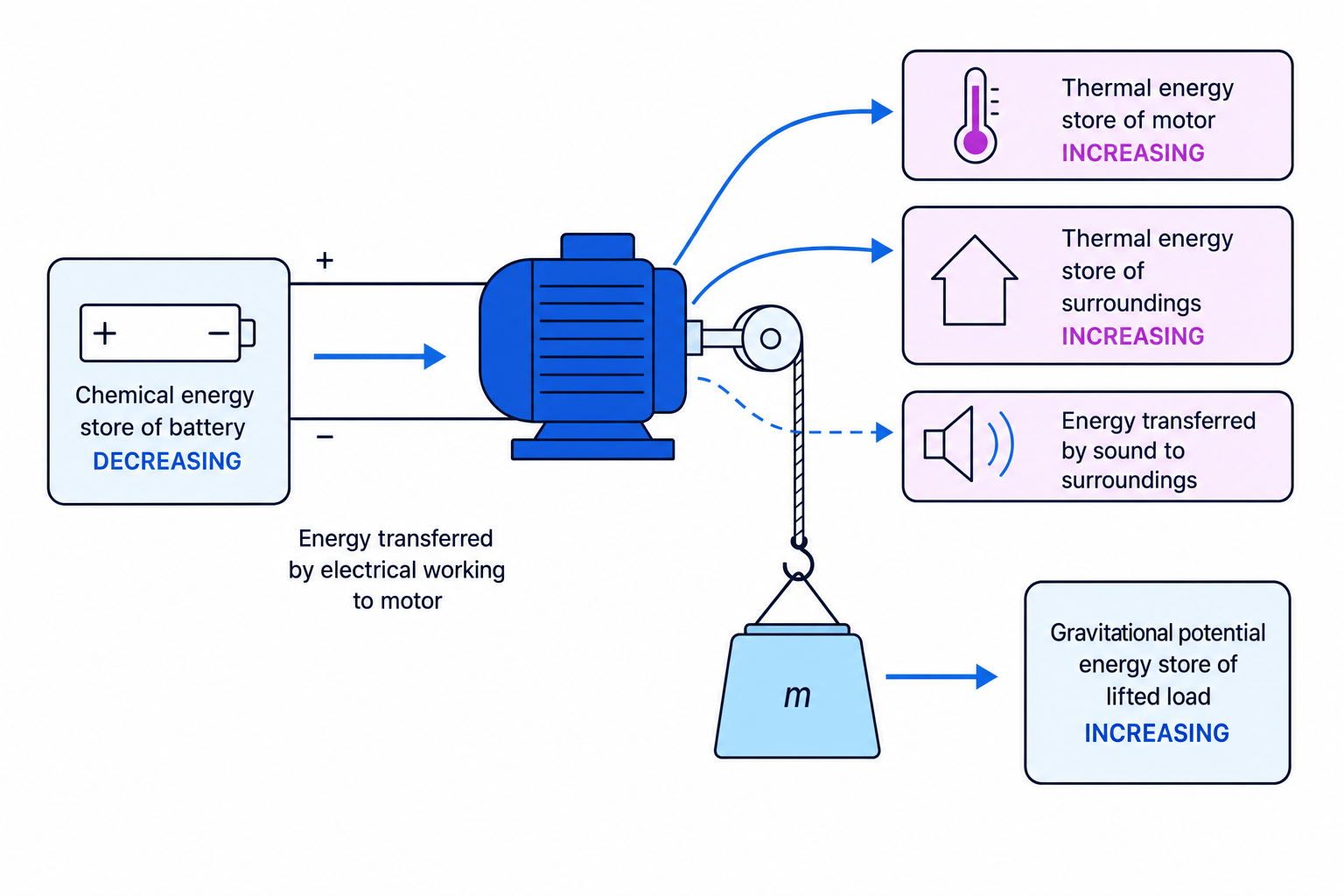
3.1.1 Gravitational potential energy
Gravitational potential energy
Gravitational potential energy
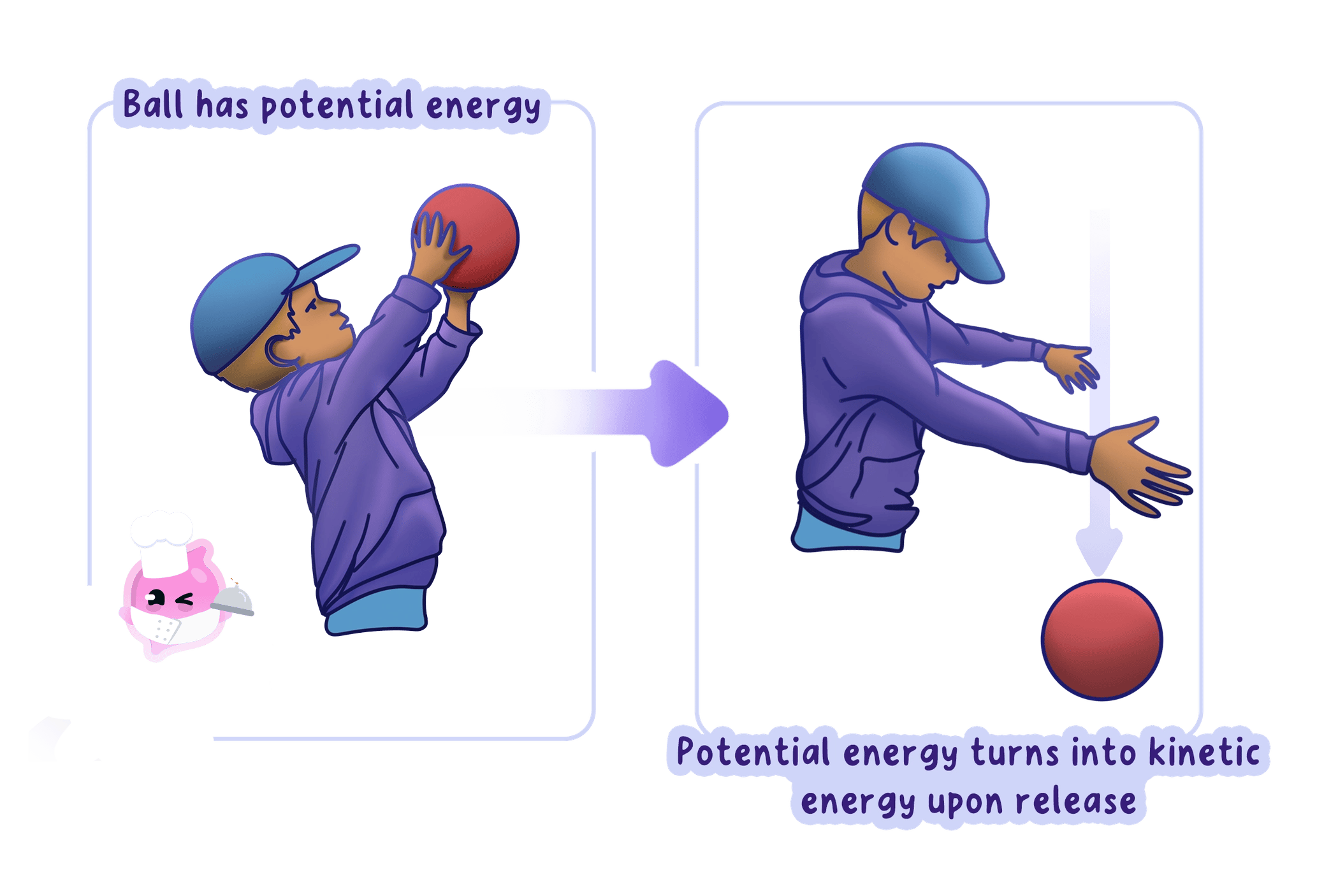
Gravitational potential energy is energy stored by an object because of its position in a gravitational field.
- Raising an object transfers energy to its gravitational store. A force must act upwards while the object moves through a vertical height.
- Lowering or falling transfers energy out of the gravitational store. The energy may enter a kinetic store or be dissipated by air resistance and deformation.
Calculating the energy change
Gravitational field strength
Gravitational field strength is the force per unit mass acting on an object placed in a gravitational field, measured in newtons per kilogram (N/kg).
- Use ΔEg=mgΔh\Delta E_{\mathrm{g}}=mg\Delta hΔEg=mgΔh. Here mmm is mass in kg\text{kg}kg, ggg is gravitational field strength in N kg−1\text{N kg}^{-1}N kg−1, and Δh\Delta hΔh is the change in vertical height in m\text{m}m.
- The answer is measured in joules. The units combine as kg×N kg−1×m=N m=J\text{kg}\times\text{N kg}^{-1}\times\text{m}=\text{N m}=\text{J}kg×N kg−1×m=N m=J.
- Use vertical height, not distance travelled. Moving up a slope changes gravitational potential energy according to the vertical rise only.
- The sign describes the direction of the energy change. A rise gives Δh>0\Delta h>0Δh>0 and an increase in gravitational potential energy, while a fall gives Δh<0\Delta h<0Δh<0 and a decrease.
- Near Earth's surface, use the stated value of ggg. If no value is supplied in an Edexcel GCSE calculation, g=10 N kg−1g=10\ \text{N kg}^{-1}g=10 N kg−1 is normally used.
Lifting an object
- Situation: a 12 kg12\ \text{kg}12 kg crate is lifted vertically by 1.8 m1.8\ \text{m}1.8 m where g=10 N kg−1g=10\ \text{N kg}^{-1}g=10 N kg−1.
- Substitution: ΔEg=12×10×1.8\Delta E_{\mathrm{g}}=12\times10\times1.8ΔEg=12×10×1.8.
- Energy change: ΔEg=216 J\Delta E_{\mathrm{g}}=216\ \text{J}ΔEg=216 J.
Rearranging for height
- Situation: a 55 kg55\ \text{kg}55 kg gymnast gains 2695 J2695\ \text{J}2695 J of gravitational potential energy where g=9.8 N kg−1g=9.8\ \text{N kg}^{-1}g=9.8 N kg−1.
- Rearrangement: Δh=ΔEgmg\Delta h=\dfrac{\Delta E_{\mathrm{g}}}{mg}Δh=mgΔEg.
- Height gained: Δh=269555×9.8=5.0 m\Delta h=\dfrac{2695}{55\times9.8}=5.0\ \text{m}Δh=55×9.82695=5.0 m.
Using the equation accurately
- Write the equation before substituting values.
- Convert mass to kilograms and height to metres.
- Select the change in vertical height from a diagram rather than the length of a ramp.
- Give the final energy change in joules and include a sensible number of significant figures.
- Do not use weight in newtons for mmm. The equation requires mass in kilograms.
- Do not use total height when the object starts above ground. Use Δh=hfinal−hinitial\Delta h=h_{\mathrm{final}}-h_{\mathrm{initial}}Δh=hfinal−hinitial.
- Do not write ggg in m s−1\text{m s}^{-1}m s−1. Gravitational field strength is measured in N kg−1\text{N kg}^{-1}N kg−1.
- What is gravitational potential energy?
- What does each symbol mean in ΔEg=mgΔh\Delta E_{\mathrm{g}}=mg\Delta hΔEg=mgΔh?
- Why is the length of a slope not used as Δh\Delta hΔh?
- What sign does ΔEg\Delta E_{\mathrm{g}}ΔEg have when an object falls?
3.1.2 Kinetic energy
Kinetic energy
Kinetic energy
Kinetic energy is energy stored by an object because it is moving.
- Every moving object has energy in its kinetic store. A stationary object has v=0v=0v=0, so its kinetic energy is zero.
- Kinetic energy depends on mass and speed. A more massive object at the same speed has more kinetic energy, and a faster object of the same mass has more kinetic energy.
Calculating kinetic energy
- Use Ek=12mv2E_{\mathrm{k}}=\dfrac{1}{2}mv^{2}Ek=21mv2. Mass mmm is measured in kg\text{kg}kg, speed vvv in m s−1\text{m s}^{-1}m s−1, and kinetic energy EkE_{\mathrm{k}}Ek in J\text{J}J.
- Kinetic energy is directly proportional to mass at constant speed. Doubling mass doubles EkE_{\mathrm{k}}Ek.
- Kinetic energy is proportional to the square of speed at constant mass. Doubling speed gives four times the energy, while tripling speed gives nine times the energy.
- This square relationship explains why high-speed collisions are severe. The brakes and safety structures must transfer a much larger amount of energy when speed increases.
Calculating kinetic energy
- Situation: a 1200 kg1200\ \text{kg}1200 kg car travels at 15 m s−115\ \text{m s}^{-1}15 m s−1.
- Substitution: Ek=12×1200×152E_{\mathrm{k}}=\dfrac{1}{2}\times1200\times15^{2}Ek=21×1200×152.
- Energy: Ek=135000 J=1.35×10⁵ JE_{\mathrm{k}}=135000\ \text{J}=1.35\times10^{5}\ \text{J}Ek=135000 J=1.35×10⁵ J.
Comparing two speeds
- Situation: a cyclist and bicycle have a combined mass of 80 kg80\ \text{kg}80 kg.
- At 4 m s−14\ \text{m s}^{-1}4 m s−1: Ek=12×80×42=640 JE_{\mathrm{k}}=\dfrac{1}{2}\times80\times4^{2}=640\ \text{J}Ek=21×80×42=640 J.
- At 8 m s−18\ \text{m s}^{-1}8 m s−1: Ek=12×80×82=2560 JE_{\mathrm{k}}=\dfrac{1}{2}\times80\times8^{2}=2560\ \text{J}Ek=21×80×82=2560 J.
- Comparison: doubling speed multiplies the kinetic energy by 444.
Rearranging for speed or mass
- For speed, rearrange and take the square root. v=2Ekmv=\sqrt{\dfrac{2E_{\mathrm{k}}}{m}}v=m2Ek.
- For mass, rearrange to m=2Ekv2m=\dfrac{2E_{\mathrm{k}}}{v^{2}}m=v22Ek.
- The calculated speed is a magnitude. Kinetic energy is a scalar, so the equation does not give a direction.
Finding speed from energy
- Situation: a 0.42 kg0.42\ \text{kg}0.42 kg ball has 21 J21\ \text{J}21 J in its kinetic store.
- Rearrangement: v=2Ekmv=\sqrt{\dfrac{2E_{\mathrm{k}}}{m}}v=m2Ek.
- Speed: v=2×210.42=10 m s−1v=\sqrt{\dfrac{2\times21}{0.42}}=10\ \text{m s}^{-1}v=0.422×21=10 m s−1.
Avoiding calculation losses
- Convert all quantities to SI units before substitution.
- Square the speed, not the mass and not the whole expression.
- Keep the factor 12\dfrac{1}{2}21 visible in the working.
- When rearranging for speed, take the square root only after evaluating 2Ekm\dfrac{2E_{\mathrm{k}}}{m}m2Ek.
- Do not substitute speed in km h−1\text{km h}^{-1}km h−1 or mph\text{mph}mph.
- Do not treat kinetic energy as a vector. It has magnitude only and is always non-negative.
- Do not assume doubling speed doubles kinetic energy. It makes the kinetic energy four times larger.
- What is kinetic energy?
- What does each symbol mean in Ek=12mv2E_{\mathrm{k}}=\dfrac{1}{2}mv^{2}Ek=21mv2?
- How does kinetic energy change when mass doubles at constant speed?
- How does kinetic energy change when speed doubles at constant mass?
- How is the equation rearranged to find speed?
3.1.3 Energy transfers and conservation of energy
Energy stores and transfers
Energy store
An energy store is a way in which energy is held in a system, such as a kinetic, gravitational, elastic, chemical, magnetic, electrostatic, nuclear or thermal store.
- Energy is transferred between stores. The four transfer pathways are mechanically, electrically, by heating and by radiation.
- A transfer diagram must identify the initial store, the pathway and the final store. It should also identify the object or system whose store changes.
- Energy is often dissipated during a transfer. Dissipated energy spreads into thermal stores of the surroundings and becomes less useful because it is harder to transfer for a chosen purpose.
Energy transfer diagrams
Sankey diagram
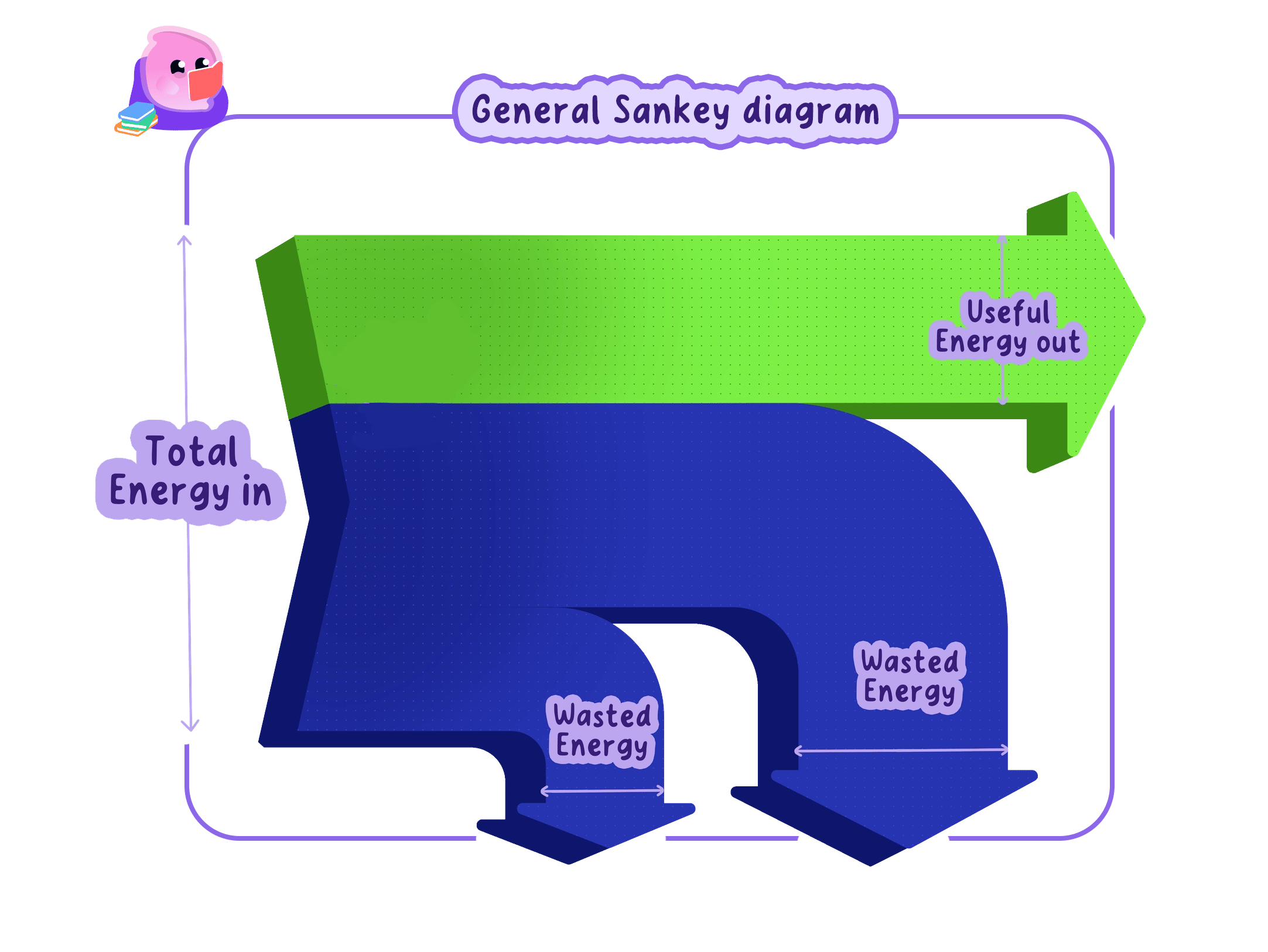
A Sankey diagram is an energy transfer diagram in which the width of each arrow is proportional to the amount of energy it represents.
- The input arrow represents the total energy supplied.
- Useful and dissipated output arrows split from the input. Their total width must equal the input width because energy is conserved.
- Calculate a missing transfer by subtraction. Einput=Euseful+EdissipatedE_{\mathrm{input}}=E_{\mathrm{useful}}+E_{\mathrm{dissipated}}Einput=Euseful+Edissipated.
- Labels must name energy stores or transfer pathways precisely. Avoid vague labels such as energy lost.
Conservation of energy
Conservation of energy
Conservation of energy means that energy cannot be created or destroyed, only transferred between stores.
Closed system
A closed system is a system across whose boundary no energy is transferred, so its total energy stays constant.
- The total energy of a closed system remains constant. Internal transfers can change individual stores, but there is no net change in the total.
- Energy does not disappear when a device is inefficient. The non-useful part is transferred to thermal stores of the device and surroundings.
Analysing system changes
- Object projected upwards: energy transfers mechanically from the kinetic store to the gravitational store, with some dissipated by air resistance.
- Object moving up a slope: the gravitational store increases, while friction transfers some energy to thermal stores.
- Moving object hitting an obstacle: energy leaves the kinetic store and is transferred into thermal and elastic stores, while sound waves carry energy away and work is done deforming the objects.
- Object accelerated by a constant force: work done by the force transfers energy into the kinetic store, while resistive forces may dissipate some energy.
- Vehicle slowing down: energy leaves the kinetic store and is transferred mainly to thermal stores of the brakes, tyres, road and surroundings.
- Water heated to boiling in a kettle: energy is transferred electrically from the supply to thermal stores of the heating element and water, with some transferred to the kettle and surroundings.
Energy changes for a rising ball
- Situation: a 0.20 kg0.20\ \text{kg}0.20 kg ball is thrown upwards at 12 m s−112\ \text{m s}^{-1}12 m s−1 where g=10 N kg−1g=10\ \text{N kg}^{-1}g=10 N kg−1.
- Initial kinetic energy: Ek=12×0.20×122=14.4 JE_{\mathrm{k}}=\dfrac{1}{2}\times0.20\times12^{2}=14.4\ \text{J}Ek=21×0.20×122=14.4 J.
- Ignoring air resistance: conservation gives mgΔh=14.4 Jmg\Delta h=14.4\ \text{J}mgΔh=14.4 J.
- Maximum height gained: Δh=14.40.20×10=7.2 m\Delta h=\dfrac{14.4}{0.20\times10}=7.2\ \text{m}Δh=0.20×1014.4=7.2 m.
- With air resistance: some energy is dissipated to thermal stores, so the ball reaches a height below 7.2 m7.2\ \text{m}7.2 m.
Writing energy explanations
- Name the store and the object. Write the kinetic store of the car, not simply kinetic energy.
- Name the transfer pathway. State mechanically, electrically, by heating or by radiation.
- Account for dissipated energy. State which thermal stores increase rather than saying energy is lost.
- For a closed system, state that the total energy remains constant.
- Do not write that energy is used up or destroyed.
- Do not call heat an energy store. Heating is a transfer pathway, while a thermal store belongs to an object or system.
- Do not label every unwanted output as heat. Name the thermal store that gains energy and the transfer pathway where required.
- What are the four energy transfer pathways?
- What does the width of a Sankey arrow represent?
- What does conservation of energy mean?
- Why is the total energy of a closed system constant?
- Describe the energy changes when a vehicle slows down.